Get Full Government Meeting Transcripts, Videos, & Alerts Forever!
Get email alerts on the Emergency Towing Zones topic
No spam. Unsubscribe anytime.
Transportation commission defers decision on emergency tow zones after dispute over sale and control of local firms
Summary
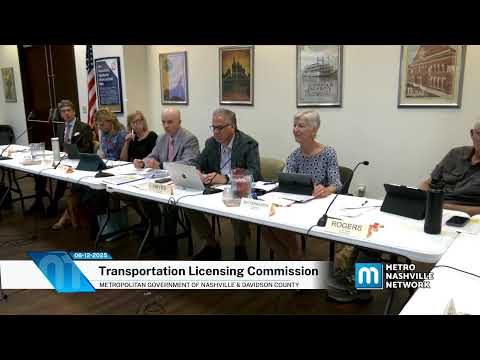
The Metropolitan Transportation Licensing Commission on a motion by Commissioner Anne Butterworth deferred action on the annual review of emergency towing zones to its July meeting and asked Metro Legal to issue a written opinion about whether recent ownership changes at local tow companies should be treated as prohibited transfers of zone service.
The Metropolitan Transportation Licensing Commission on a motion by Commissioner Anne Butterworth deferred action on its annual review of emergency tow (nonconsent) zones and related company authorizations until its July meeting, asking Metro Legal for a written opinion on whether recent ownership changes count as prohibited transfers of service.
The commission opened an annual public hearing on emergency wrecker zones and heard from Metro Police Department traffic officials and multiple towing company representatives about how zones operate, whether response-time data are reliable, and whether recent transactions involving Dad’s Towing and West Nashville Wrecker Service (announced in press material as tied to Guardian Fleet Services) complied with Metro code. Captain James Williams of the Metro Police Department’s traffic division told the commission that response-time data are currently unreliable because arrival times are recorded through a manual, dispatcher-officer process and that the department is exploring software to capture timestamps automatically.
Why it matters: emergency towing zones are assigned to specific companies for police-initiated, nonconsent tows on interstates and other unsafe locations. Assignments affect public safety (clearing highway incidents) and can confer valuable, exclusive service rights. Commissioners said they need legal clarity and more documentary evidence about recent corporate changes before deciding whether to reauthorize or reassign zones.
Most substantive facts and concerns - Multiple drivers and company presidents testified that equipment and service remain available across zones; Topo (TowPro) reported 6,816 emergency calls responded to last year, including 245 heavy-duty tows. Through May of the current year Topo reported 2,639 calls and 87 heavy tows (annualizes roughly to 209 heavy calls). (David Williams/Topo) - Metro police said there were about 18,000 police-initiated nonconsent tows in 2024 and about 7,500 so far this year; staff emphasized response time as central to whether zones are working. (Captain James Williams, MPD) - Several commenters raised a specific compliance question about whether Guardian Fleet Services’ role with Dad’s Towing and West Nashville Wrecker constituted an approved partnership or an unreported change of control; public commenters supplied social-media and Secretary of State filings they said showed transfers and management changes that the commission had not explicitly approved. - Company representatives, including Jim Mitchell of Dad’s Towing, said Mitchell remains operationally involved: “I am partners with Guardian, and I will remain partners and operate daily. Not 1 day has passed since that I have not been at Dads at West National.” (Jim Mitchell)
What the commission decided and directed - Action deferred: the commission voted to defer any action on emergency tow zones, company reauthorizations, and the STR Towing new-zone application until July to allow staff and Metro Legal to review documents and provide a written legal opinion in advance of the next meeting. The motion carried. The commission also asked that Metro Legal provide its opinion to commissioners in advance and consider whether posting the opinion publicly is appropriate. - Procedural instruction: commissioners asked NDOT staff and Metro Legal to collect and provide documents that bear on whether the November partnership/merger filings constituted a change of control that would require commission approval under the Metro code. Commissioners cited a 2008 precedent in which the commission removed a company after an attempted partner addition was ruled noncompliant.
Context and next steps - Commissioners repeatedly emphasized they do not yet have reliable time-stamped response-time data; Metro PD and the Department of Emergency Communications acknowledged current data collection is manual and imperfect and said they are exploring an app-based system that would timestamp requests and arrivals and make response-time metrics auditable. - The commission scheduled review of the legal definition of “change in control” and whether Metro code or MTLC rules require submission of partnership/joint-venture agreements before a partner can be added or a controlling interest transferred. Metro Legal will prepare written guidance for the July packet.
Ending note: the commission kept the annual hearing record open until July so that Metro Legal, NDOT staff, and towing companies can submit documents about ownership, corporate filings, and operational data for review before the commission considers reassigning zones or acting on pending applications.