House subcommittee reviews Defense Production Act as reauthorization nears
Get AI-powered insights, summaries, and transcripts
SubscribeSummary
The House Financial Services subcommittee convened experts and GAO to examine uses and limits of the Defense Production Act ahead of its scheduled expiration on Sept. 30, 2025, focusing on agency experience, funding levels, and options to modernize statutory authorities.
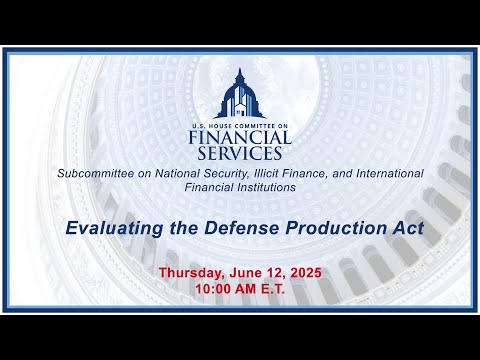
The House Committee on Financial Services’ Subcommittee on National Security, Illicit Finance, and International Institutions convened a hearing to evaluate the Defense Production Act and to inform its pending reauthorization before the law expires on Sept. 30, 2025.
The hearing centered on how agencies have used DPA authorities since the last reauthorization and on recommendations to improve execution, oversight and interagency coordination. William Russell, director of contracting and national security acquisitions at the Government Accountability Office, told the subcommittee that agencies have relied on the DPA across multiple emergencies and that Congress has provided substantial funding since 2018. "Since its last reauthorization in fiscal year 2018, Congress has appropriated at least 3,200,000,000.0 for DPA related activities," Russell said, and he described hundreds of millions in title 3 investments and thousands of priority ratings placed on orders.
The nut graf: GAO and other witnesses said the DPA remains an important tool but faces operational frictions — from tracking rated orders to underused loan authorities — that, if not addressed, risk hampering rapid industrial response in future crises.
GAO outlined specific use and funding figures during testimony. Russell summarized that agencies placed more than 2,500,000 title 1 priority ratings from fiscal 2018–2024 and recorded 222 title 3 investments valued at about $33,200,000,000.0 to expand manufacturing capacity. He also noted that since fiscal 2020 Congress has appropriated at least $4,400,000,000 to the DPA fund and at least another $10,000,000,000 for COVID-related DPA responses. Russell said the title 3 loan authority has been used once since 2018 and that some agencies lack the in-house expertise to deploy loan instruments effectively.
Witnesses and members discussed examples from recent years in which DPA authorities were invoked — ventilator and N95 production during the COVID-19 pandemic, efforts to reconstitute naval industrial-base capacity in 2025, and actions to accelerate heat pump and transformer production — and whether those invocations matched the statute’s intent. Adam Levin, analyst in economic development policy at the Congressional Research Service, said the DPA gives the president "fairly wide latitude" so long as actions are tied to the statutory definition of national defense, and he noted Congress has historically amended that definition to add items such as homeland security.
Members on both sides emphasized different priorities for reauthorization. Some said the DPA should be modernized to take a more proactive posture on critical sectors such as microelectronics, critical minerals, and pharmaceuticals; others warned against executive overreach and urged stronger congressional guardrails. Rep. Casten and Rep. Waters raised concerns about executive discretion and possible misuse, citing other statutes and recent public disputes as examples prompting calls for clearer limits and enhanced oversight.
The hearing record will include written testimony and follow-up: the chair said members would have five legislative days to submit extraneous materials, and witnesses were asked to respond to follow-up questions no later than July 17.
Ending: The witnesses said that DPA reauthorization offers a chance to address cataloged operational weaknesses — tracking rated orders, expanding DPA expertise in agencies, and strengthening interagency lessons-sharing — but emphasized Congress must decide what statutory scope and oversight are appropriate before reauthorization.