Get Full Government Meeting Transcripts, Videos, & Alerts Forever!
Get email alerts on the Gaming Revenue Policy topic
No spam. Unsubscribe anytime.
Committee orders bill drafts to raise online sports tax, add monitoring and slice more revenue from skill‑games and pari‑mutuel wagering
Summary
LSO, gaming industry counsel and public officials briefed the Select Committee on the state’s four gaming revenue streams (lottery, pari‑mutuel/historic horse racing, skill‑based amusement games, and online sports wagering). After testimony the committee asked LSO to draft several bills: raise online sports wagering state share from 10% to 20%;
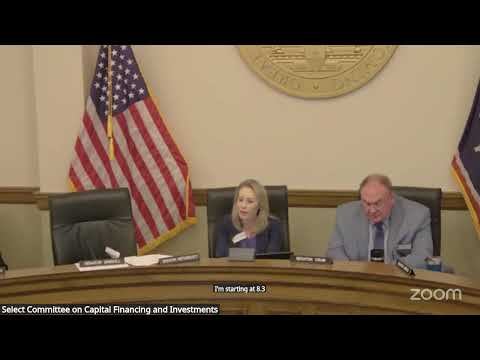
The Select Committee on Capital Financing & Investments reviewed historic and current gaming revenues and voted to request multiple bill drafts to change how Wyoming collects and monitors gambling proceeds. LSO fiscal staff, the gaming industry and county and health officials presented data and the committee took several drafting votes after public comment.
What staff presented: LSO analyst Karen von (Vaughn) walked the committee through the state’s four main gaming revenue streams — the state lottery, pari‑mutuel wagering (live racing and simulcast/historic horse racing), skill‑based amusement games (skill games), and online sports wagering. LSO explained the statutory distributions for each stream and how Wyoming’s approach compares to other states.
Key figures LSO cited: the lottery has produced small absolute dollars relative to larger states (LSO noted 2024 lottery gross play roughly $40 million, and that Wyoming’s local governments have received about 13 cents on the dollar when comparing total played to amounts returned to local governments in that program). Skill‑based amusement games are taxed by statute so that 20% of net proceeds fund local governments and the School Foundation Program (LSO said the SFP has received about $11.7 million from skill games since 2020). Online sports wagering — authorized in 2021 and taxed at 10% of operators’ net proceeds — has yielded roughly $1.0–$1.5 million to the state general fund in each of the last two full years; LSO noted total wagering activity of about $629 million over multiple years in the packet and reported state receipts figures in committee materials. The lottery and sports wagering statutes also dedicate modest unclaimed or earmarked amounts for mental‑health programs ($200,000 from lottery unclaimed prizes and $300,000 from sports wagering proceeds).
Public comment and industry testimony: Tracy Laycock, general counsel for Wyoming Downs and 307 Horse Racing, explained how pari‑mutuel taxation and retainage work: handle (gross wagers) is not the same as revenue; operators distribute a large share of each wager back to bettors, and the state’s statutory tax rates apply to handle and different distributions then follow. Laycock cautioned that operator effective tax rates are higher than headline numbers imply because operators also fund breeders’ awards and other statutory obligations; she said the effective tax rate for live racing/historic racing in Wyoming is about 1.9% when required breeder assessments are included, and warned that tax increases put pressure on operator margins, payouts and local employment.
Committee drafting votes and direction: Following LSO presentation and public comment, committee members made and approved these drafting requests (conceptual language to be prepared by LSO): - Increase the state’s share of online sports wagering net proceeds from 10% to 20% and return the draft for fiscal estimation. (motion passed) - Increase skill‑based amusement game statutory transfer from 20% to 25% of net proceeds, with the additional 5% directed to state highways. (motion passed) - Increase historic horse racing/simulcast taxation by one percentage point (a committee motion set a 1% increase; committee accepted a friendly amendment to apply the change to simulcast as well). Committee directed LSO to model the change and return with fiscal effects and noted payouts and breeder obligations currently exist; operators said effective tax with breeder assessments is already about 1.9%. - Require that all regulated gaming platforms be subject to a central monitoring system for machine and wagering reporting; committee asked LSO to draft statutory language requiring a centralized monitoring system. (motion passed)
Other discussion and requests: committee members and county commissioners discussed consolidating gaming receipts into a single state account and making periodic distributions (quarterly/annual) rather than many small monthly transfers. County commissioners urged that local governments be considered in any reallocation (counties noted they manage the majority of local roads and asked to be included if highway money is reallocated). The Department of Health and county officials said the state currently directs $300,000 from sports wagering and $200,000 of unclaimed lottery tickets to problem‑gaming/mental‑health efforts; some counties decline those grants. Committee members asked LSO and the gaming commission for better data collection on problematic gaming prevalence, for a central monitoring system to improve revenue verification, and for scenario fiscal notes on proposed tax changes.
Next steps: LSO listed seven draft items it will produce and return with fiscal notes: (1) repeal/restore language for SIPA consequences (separate agenda item), (2) constitutional/statutory drafting for the generational fund (previous item), (3) online sports wagering revenue rate change to 20%, (4) skill‑based amusement games revenue change to 25% (with highways allocation for the increase), (5) historic horse racing/simulcast tax increase (1%), (6) statutory requirement for a central monitoring system for gaming, and (7) draft language to standardize distributions and packaging for committee review. The committee asked the gaming commission to present monitoring and reporting capabilities at the next meeting and requested LSO estimate fiscal impacts on the SFP, local governments and general fund for each draft.