Get Full Government Meeting Transcripts, Videos, & Alerts Forever!
Get email alerts on the Public Funding Pmtf topic
No spam. Unsubscribe anytime.
Committee hears that governor’s line‑item veto restored CIPA transfers and could exhaust PMTF reserve by FY2028
Summary
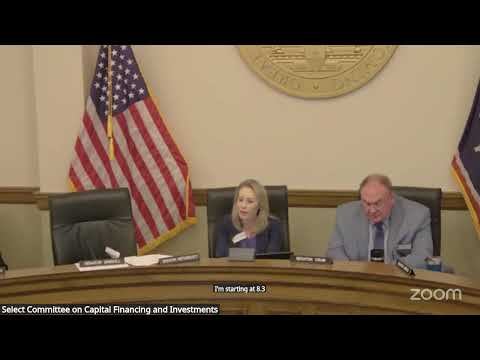
Members of the Select Committee on Capital Financing & Investments were told LSO’s six‑year projections show the governor’s line‑item veto of 2025 Senate File 169 increases near‑term transfers from the PMTF reserve account and could deplete that reserve within a few years unless statutes are corrected.
Members of the Select Committee on Capital Financing & Investments spent the morning reviewing changes made by the governor’s line‑item veto to 2025 Senate File 169 and what LSO staff said will be materially different fiscal outcomes for the Permanent Mineral Trust Fund (PMTF) reserve account and accounts the law calls the Strategic Investments and Projects Account (CIPA/SIPA) and the Legislative Stabilization Reserve Account (LSRA). The committee directed staff to draft corrective legislation and asked the treasurer and LSO to work on options for the next meeting.
LSO attorney Michael Fuller and LSO budget analyst Polly Scott told the committee that the enacted bill would originally have repealed SIPA effective July 1, 2026, and removed a statutory guarantee from the PMTF reserve account for transfers to CIPA. The governor’s line‑item veto instead made the act effective immediately and (among other changes) reversed the split of PMTF earnings above 2.5% so that those excess earnings would be credited entirely to CIPA rather than split between CIPA and the LSRA. Fuller summarized: “The primary purpose of that bill was to repeal SIPA effective 07/01/2026. The governor reversed the repeal and made the entire act effective immediately.”
Why it matters: LSO showed table estimates the committee had in its packet that compare three outcomes — the law before the 2025 session changes, the legislature’s enrolled (post‑session) version, and the law after the governor’s line‑item veto. Under the governor’s action, LSO projects the PMTF reserve account will be heavily relied upon and is estimated to fall short of its guarantee beginning in fiscal 2028. Scott briefed the committee that, under the vetoed‑into‑law distribution rules, over the six‑year forecast period the LSRA would receive effectively zero, CIPA would retain roughly $574,200,000 and transfer about $470,000,000 to the School Foundation Program (SFP); the PMTF reserve transfers supporting the spending policy were estimated at about $795,900,000 over six years. Scott said the reserve account’s duration under the governor’s changes was shortened to “about 3–3 plus years.”
Treasurer Curt Meyer told the committee those changes “substantially changed the bill and changed the appropriations” and warned the legislative leadership the vetoed structure would “zero out the reserve accounts” within a few years depending on investment returns. Senator Hicks told the committee the change “has significant long term fiscal impact” and urged this committee to consider bringing corrective legislation next session.
Discussion vs. direction vs. decisions: Committee members debated options and directed LSO and the treasurer’s office to produce a more detailed analysis and draft language. Several members asked that any corrective bill preserve the legislature’s ability to target funding to reserve accounts and the school account while restoring transparency. Senator Crum, Representative Nicholas and Treasurer Meyer all offered variations for how a fix might be structured; the committee conceptually approved asking LSO to draft a repeal/restore bill to reverse the governor’s distribution changes and to present a clear replacement that would protect reserve account duration.
Numbers and legal references discussed: LSO referenced the statutory distribution language it cited in committee materials (LSO referenced a statutory citation orally as “9‑4‑601(d)(6)” for a portion of the federal mineral royalties distribution). Fuller and Scott also described the $10,000,000 annual transfer to the state penitentiary capital construction account that had been part of the law and which the governor’s veto left in place. Scott walked committee members through tables showing estimated six‑year totals under alternate laws: e.g., the LSRA estimated at $124,100,000 under one scenario and CIPA receipts of $451,400,000 under another. Fuller and Scott repeatedly stressed that the January CREG forecast used in the tables excludes realized capital gains and that final fiscal‑year 2025 numbers will change when capital gains are realized.
What the committee asked staff to do next: committee members voted to ask LSO to prepare bill drafts to (1) restore the legislative‑adopted repeal of SIPA or otherwise correct the distribution language the governor changed, and (2) present clearer statutory options tying reserve‑guarantee mechanics to durable funding paths for the SFP and LSRA. The treasurer and staff were asked to provide a more comprehensive analysis of the reserve account projections, and the chair asked Representative Nicholas to work with the treasurer, Senator Hicks and LSO to produce draft language prior to the committee’s next meeting.
Ending: Committee members said they want the draft returned with precise fiscal notes and with a clear explanation of whether a statutory or constitutional approach is needed to protect long‑term reserve capacity.