Get Full Government Meeting Transcripts, Videos, & Alerts Forever!
Get email alerts on the Neighborhood Traffic And Development topic
No spam. Unsubscribe anytime.
Mesa planning board approves Beverly Apartments rezoning after traffic debate
Summary
The City of Mesa Planning and Zoning Board unanimously approved rezoning and a minor General Plan amendment for the Beverly Apartments project at 120 N. Beverly, after public concern about traffic and safety and staff traffic analysis showing projected volumes within typical local-street ranges.
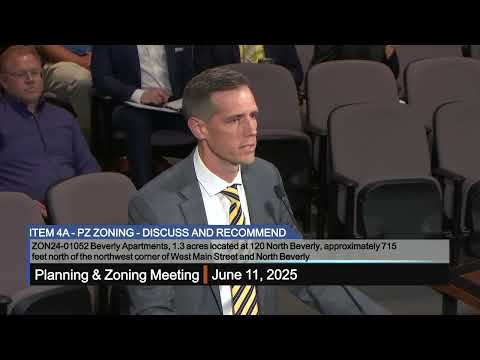
The City of Mesa Planning and Zoning Board on June 11 approved rezoning and a site-plan review for the Beverly Apartments, a proposal to replace an existing 12-unit multifamily property with 36 units at 120 North Beverly.
The project, described at the hearing as a rezoning to multiple-residence categories (RM-2, RM-3, RM-4) with a plan area development overlay, won a unanimous vote with three members absent after public comment and a city transportation analysis addressing neighborhood traffic concerns.
Residents and neighbors told the board they feared the cumulative effect of two nearby projects would sharply increase traffic on Beverly and endanger pedestrians and schoolchildren. “Potentially tripling traffic…will put lives at risk and permanently change the character of this neighborhood,” Madison Reynolds, a neighborhood resident, told the board. Reynolds asked the city to reduce density, gate Beverly, or postpone projects until traffic impacts could be verified while school is in session.
The applicant’s attorney, Taylor Earl, said the site currently contains 12 units and the proposal would increase that to 36 units. Earl described the proposal as transit-oriented and said it was designed to limit car dependency: “We are an affordable project…we expect to be at 50% AMI, and we're really focusing away from car dependency in this project.”
Ryan Hudson, the city traffic engineer, summarized the transportation department’s review. Hudson said existing average daily traffic volumes on Beverly are generally in the 400–500 vehicles-per-day range. Using a conservative estimate for the 36-unit project, he said the development would add roughly 200 to 240 trips per day and could raise Beverly’s volumes into the 600–700 vehicles-per-day range—“very comparable to a lot of local residential streets within the city of Mesa’s local street network,” he said. Hudson also noted the city’s speed-hump policy and cited 500 vehicles per day as a threshold the city evaluates when considering traffic-calming warrants.
Board members said they heard neighborhood safety concerns and discussion of traffic-mitigation options, including speed cushions, but they also noted the transportation department’s assessment that the post-development volumes would remain within typical local-street ranges. Vice Chair Pitcher moved to approve both the rezoning/site-plan item and a related minor General Plan amendment to change the place type to mixed residential with a sustained growth strategy; the motion passed unanimously with three members absent.
The board did not adopt any additional conditions such as gating the street. Hudson said traffic-calming measures (for example, speed cushions) are an option that could be pursued later but would require council direction and follow the established Mesa speed-hump policy.
The project proponents said the proposal is consistent with city efforts to support transit-oriented housing near light rail and that the added units are necessary to support walkable, mixed-use development. Neighborhood speakers said they were not opposed to growth in general but urged that density be balanced with safety and verified traffic analysis.
The board approved the rezoning and site plan by motion; no additional formal directions to staff were recorded at the time of the vote.
Looking ahead, the project will proceed under the approvals granted by the Planning and Zoning Board and will follow any subsequent city review and permitting steps required for construction.