Get Full Government Meeting Transcripts, Videos, & Alerts Forever!
Get email alerts on the Comprehensive Plan Growth Strategy topic
No spam. Unsubscribe anytime.
Seattle staff outline growth-strategy choices, capacity and SEPA limits ahead of June 23 public hearing
Summary
City central staff told the Seattle City Council select committee that the proposed comprehensive plan increases citywide zoning capacity while growth targets remain lower, and warned that changes beyond what the environmental review studied could require further SEPA study.
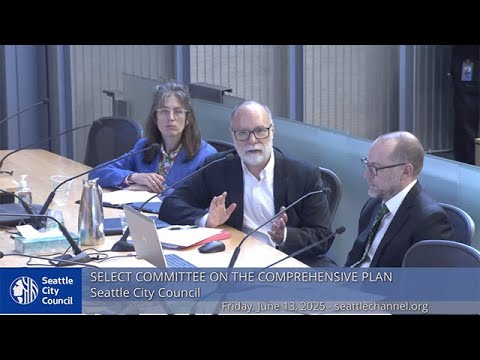
Chair Joy Hollingsworth convened the Seattle City Council Select Committee on the Comprehensive Plan on June 13 to hear central staff briefings and to remind the public that the public hearing on the comprehensive plan and related permanent legislation will be on June 23.
Central staff presented the growth strategy element of the mayor’s proposed comprehensive plan, emphasizing that the plan separates planning targets from zoning capacity. "The comp plan has an adjusted target ... 80,000 new housing units and a 159,000 new jobs," said Lish Whitson, central staff. "The mayor's proposed comprehensive plan contemplates a citywide zone residential development capacity of approximately 300,000 new units." Whitson added that Seattle had added roughly 42,000 units since 2019 and that 2021 zone capacity stood at roughly 172,000 units.
The memo and presentation framed where that capacity could be directed: regional centers, urban centers, neighborhood centers, manufacturing/industrial centers and urban neighborhoods. HB Harper, central staff, described the taxonomy and said regional centers are the most intense areas, urban centers would allow midrise development and neighborhood centers would be midrise near services and transit. "Regional centers are where you'd see tower development," Harper said.
Why it matters: the countywide planning policies set a target allocation to Seattle (the presentation cited an original county allocation of 112,000 housing units and about 170,000 jobs for 2019–2044). The comprehensive plan adjusts the city’s growth target to 80,000 new housing units but adopts zoning capacity that would allow much more building, giving the city "degrees of freedom" in directing growth while affecting land costs and development patterns, staff said.
Staff emphasized that the council can change designations and boundaries but is constrained by the countywide planning policy criteria and the scope of the final environmental impact statement (EIS) already published. "Any changes that the council may make ... has to be something that was studied in the final environmental impact statement," Whitson said. Central staff noted that some large shifts — for example designating a new regional center in a location not studied in the EIS — would likely require additional review. Council member Andrew Rink asked for clarification and Whitson warned that adding density beyond what was analyzed in the EIS "would be outside ... the scope of what was studied in the environmental review."
The presentation also covered how transit is used as an organizing principle for center designations and how the city defines transit service areas differently for the growth-strategy map than for parking exemptions. Staff said the mayor’s proposal includes some expansions to match planned high-capacity transit and frequent-transit areas — for example an expansion in Uptown and a proposed neighborhood center at the Madison Valley terminus of the Madison BRT.
Council members raised operational and safety concerns tied to land-use choices. Council member Tammy Kettle asked about a provision that would allow "no setback required from alley" and warned that narrowing alleys could affect first responders and solid-waste service providers. "We cannot jam it to the point where it impacts ... first responders," Kettle said, pressing staff for clarifications on when alley setbacks would still be required.
Central staff reminded the committee that the council previously funded a supplemental EIS, which OPCD is scoping now, and that further environmental review will be possible and may be required for some council amendments. Chair Hollingsworth reiterated logistical details for public participation: written public comment was being accepted that day and the two-session public hearing will be June 23, with a remote morning session and an in-person afternoon session.
Ending: Staff said more phases of implementing regulations and zoning decisions will follow; the comprehensive plan adoption will set the future land use map and policy framework, while later work will refine specific zoning within adopted center boundaries. Council members signaled they will press staff with amendment proposals and that some changes may require supplemental environmental study.