
BFRW committee hears widespread stakeholder concern about embodied carbon appendix; committee sets comment deadline
Get AI-powered insights, summaries, and transcripts
Subscribe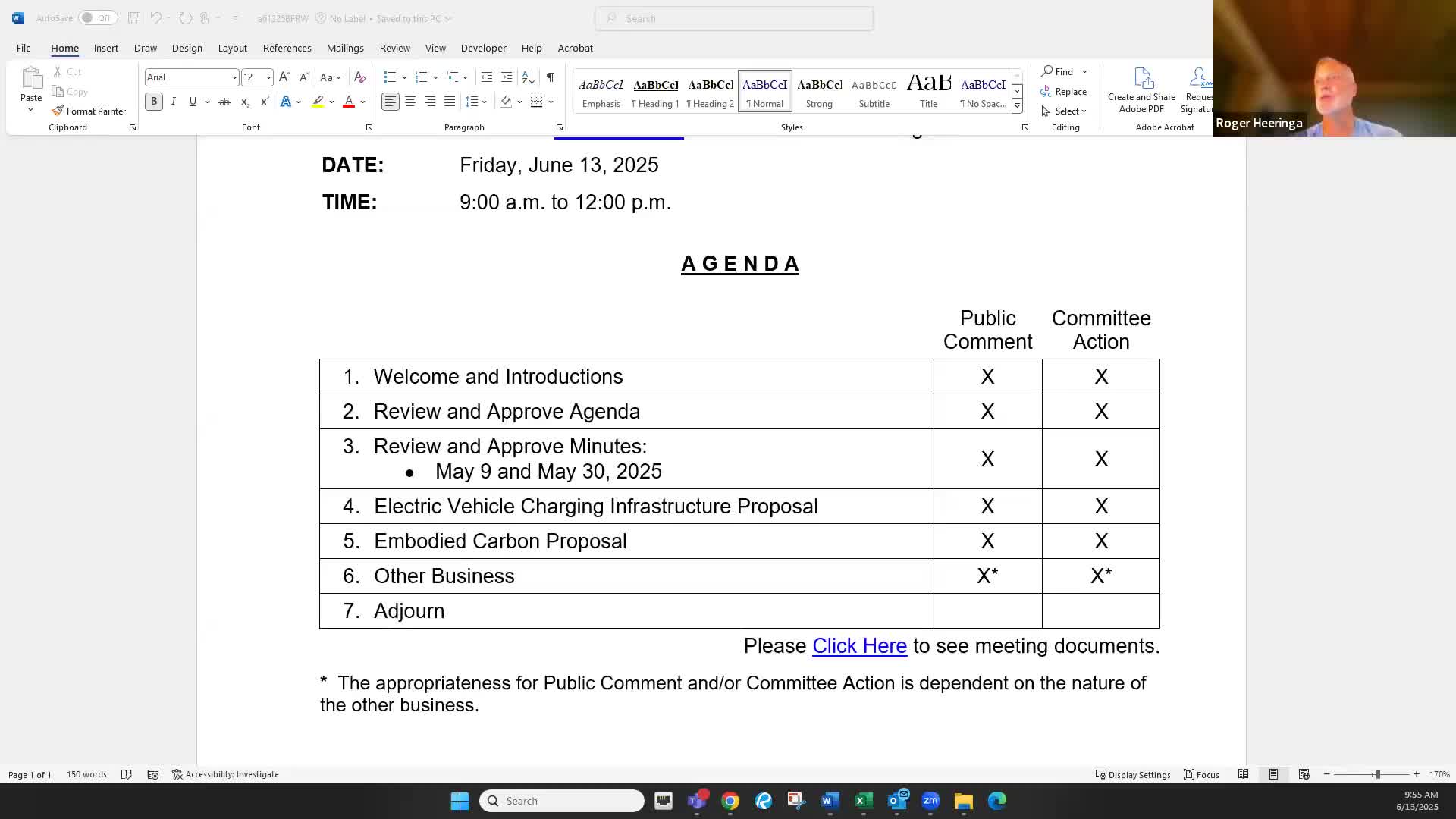
Summary
The BFRW committee on June 13 heard broad industry and advocacy comment on a proposed embodied-carbon appendix and set a 5 p.m. June 23 deadline for written comments while agreeing to continue technical review at meetings through July.
The State Building Code Council's BFRW committee held an extended debate on a proposed "embodied carbon" appendix on June 13, receiving written and oral comments from trade groups, climate advocates, design professionals and legislators. The committee did not vote to adopt the appendix; instead members set a written-comment deadline and agreed to continue technical review at future meetings.
Committee chair Roger Haringa read a process statement that set a 5 p.m. June 23 deadline for written public comments and outlined the committee's schedule for handling submissions. "Moving forward, all comments on this proposal must be sent to the SBC staff in writing and submitted prior to 5PM on June 23," Haringa read from the posted notice. The committee will consider comments at upcoming BFRW sessions (June 27, July 2 and July 18) and return recommended language to the full council by July 18.
What the proposal does and why people objected - Proposal scope: The posted draft proposes an appendix offering three compliance pathways: a product-based (material/product) prescriptive pathway, a whole-building life-cycle assessment (LCA) performance pathway, and a building-reuse pathway. The appendix would allow jurisdictions that opt in by local ordinance to apply the appendix to large projects (draft language referenced thresholds such as 50,000 or 100,000 square feet; exact threshold varies among submitted versions). - Industry objections: Multiple trade groups and material producers said they had been "walled out" of early drafting and urged more stakeholder engagement. The Washington Aggregate and Concrete Association, American Wood Council, CalPortland, and others asked for more time and collaborative drafting before forwarding a recommendation to the full council. Rachel Jamieson of the American Wood Council said the industry supports carbon reductions but raised concerns about timing and stakeholder engagement. - Proponent and technical comments: Proponents and technical advocates, including the Carbon Leadership Forum and New Buildings Institute representatives, urged multi-path flexibility (allowing project teams to choose either whole-building LCA, a prescriptive product pathway, or a reuse pathway). Carbon Leadership Forum representatives and other LCA practitioners argued whole-building analyses are increasingly feasible and inexpensive for projects above the proposed threshold.
Committee discussion and procedural directions - Stakeholder process: Several industry speakers said they lacked early access to the draft that went to the technical advisory group (TAG) and then to council. Committee members and staff described the proposal's nine-month public trajectory, noting it was first submitted to the TAG in September 2024 and has been in front of SBCC committees and the council in various forms. Todd Byreuther and staff emphasized this committee's role in technical cleanup and in coordinating with state agencies and the legislature. - Equity and economic impacts: Committee members flagged equity questions (regional supply-chain impacts, small-business impacts, and the potential to advantage or disadvantage specific materials or mills). Members said the BFRW must consider the state's economic and small-business impacts if a prescriptive/product pathway is pursued. - Building reuse: Several members and outside speakers urged that reuse or partial reuse be an explicit, simple compliance pathway or off-ramp; designer John Spanier suggested that a quantified retention threshold (for example, keeping 45% of an existing building by mass or other proxy) could serve as a practical shortcut in many projects.
Action and next steps - Public comment deadline and process: The chair set a firm written-comment deadline of 5 p.m. June 23. Staff will categorize incoming submissions as editorial/technical or general/public-policy and place them on the committee spreadsheet. The committee asked staff to add the opposition letter from industry groups to the working record. - No adoption; further analysis: The committee did not send a final recommendation to the council. Members said they will continue analysis across the committee's remaining meetings and encouraged departments and the legislature to coordinate on related policy work.
Why it matters: The appendix would create a defined pathway for jurisdictions that opt in to consider embodied carbon in building decisions. Supporters say it provides flexible tools that can reduce life-cycle emissions; opponents say the timing and drafting process did not include sufficient input from industry and small suppliers and that a product-based prescriptive pathway could have uneven local economic effects.
Representative input and state coordination - Representative Mia D'er (Doer) joined the meeting and said she supports moving the needle in this code cycle, noting the legislative buy-clean and buy-fair work is ongoing and her preference is to set expectations now while further updates can come through future legislative or code cycles. - Department of Commerce staff said the Buy Clean/Buy Fair technical work group is a parallel forum and will continue to provide input on data and policy regardless of the committee's schedule.
Outstanding technical questions - Whether the product/prescriptive pathway (assembly-level EPD baselines) is defensible as a statewide proxy without disadvantaging small or regional producers. - How to define and measure building reuse (what percentage or metric equates to a compliance off-ramp) and whether reuse should be treated as an explicit exemption or as a compliance pathway requiring data collection. - How to reconcile embodied-carbon targets with operational emissions pathways and whether operational emissions (site vs. source energy vs. greenhouse-gas accounting) should be integrated into a single metric in future work.
The committee will continue the discussion at its next scheduled meetings and has directed staff to manage public submissions and the working draft on the SBCC website.