
BFRW committee tables EV-charging prescriptive change after weeks of technical debate
Get AI-powered insights, summaries, and transcripts
Subscribe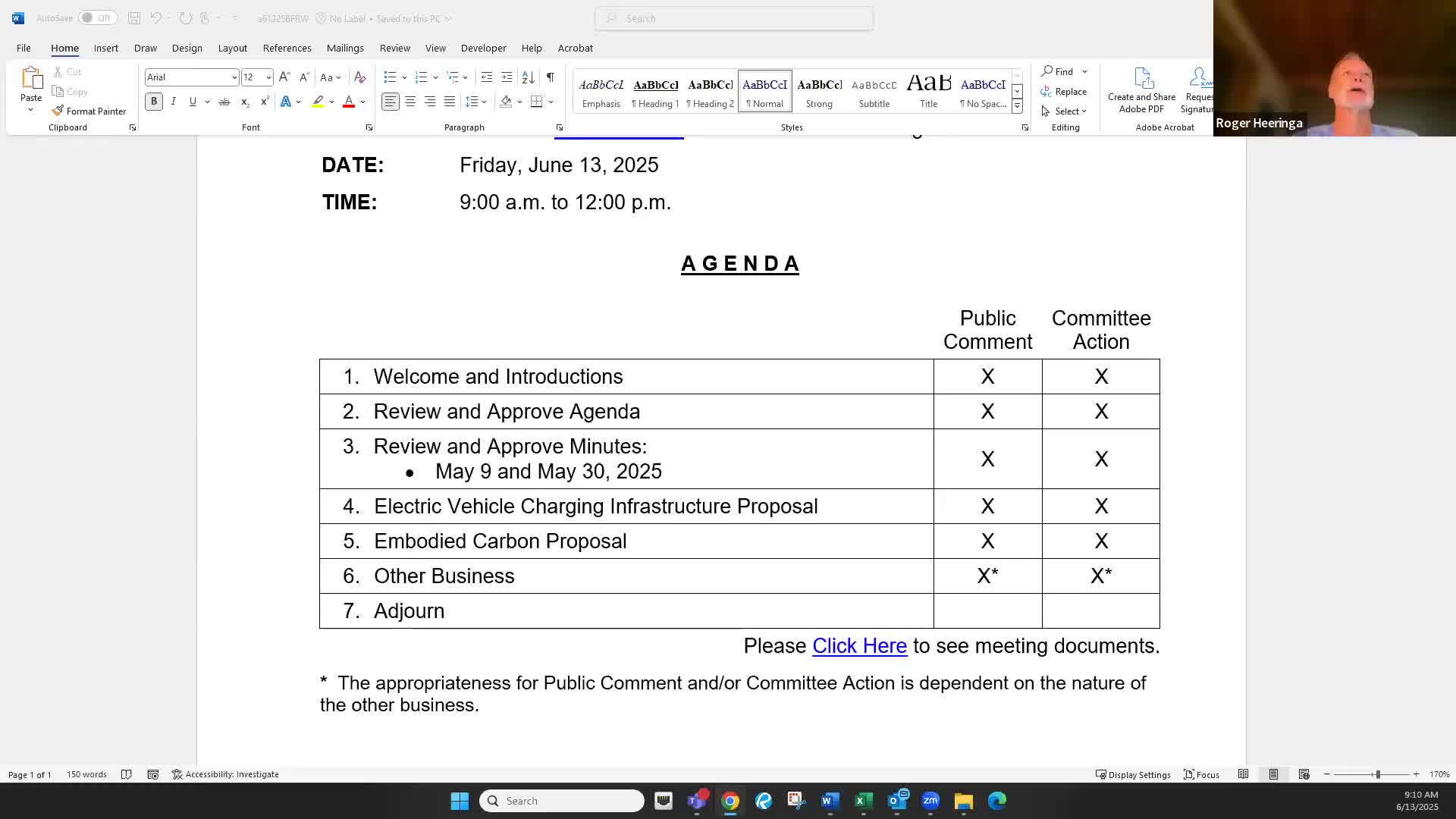
Summary
The State Building Code Council's BFRW committee voted June 13 to table a proposed rewrite of EV-charging readiness rules, directing staff to post a consolidated editorial draft and continue technical review at subsequent June and July meetings.
BFRW committee members on the State Building Code Council on Friday tabled action on a proposed rewrite of electric-vehicle (EV) charging infrastructure provisions, saying they will post an updated editorial draft and continue technical work at future meetings.
The committee voted to table consideration of the EV-charging language and directed staff to post a cleaned Word version of the draft for review; the committee will revisit the item at subsequent June and July meetings. The committee did not adopt substantive changes at the June 13 session.
The proposal under discussion would replace the existing prescriptive percentages for EV-ready and EV-capable parking spaces with a three-column, phased approach (0-year / 5-year / 20-year) commonly described in the meeting as 10/10/40 in the final column and intended to align with projected EV adoption. Todd Byreuther, a committee presenter, said the three-column approach is intended to ‘‘anticipate a 20-year horizon of EV adoption’’ and that the 10+10+40 columns are cumulative to reach about a 60% adoption assumption statewide. He also described the blue edits on screen as largely editorial and intended to bring the state code terms closer to ICC/IECC definitions.
Why it matters: Committee members said they want a clean, single draft before voting and raised technical questions that staff and proponents must clarify. Several members and public commenters pressed for clarity on whether the code should count parking spaces or dwelling units when calculating triggers for residential occupancies and whether exceptions in prior cycles had created loopholes. Committee members frequently referenced the state statute (RCW) language restricting requirements for employee parking and the Northwest Power and Conservation Council power plan forecasts that underlie the 10/10/40 adoption path.
Key committee concerns and discussion points - Counting spaces versus units: Members repeatedly debated whether multifamily requirements should be calculated by parking spaces (the current table) or by dwelling units (a proposal some stakeholders favor). "Take for example ... market might be driving that to a parking factor of 2. So what does the council and the law state? Should that be parked at the number of parking spaces that the market was driving or should it be parked at the number of dwelling units?" Byreuther said, describing the policy choice facing the council. - Residential exceptions and the 10-space threshold: Committee members asked why an existing exception referencing "less than 10 parking spaces" had been written and whether that exception unintentionally exempted small multifamily buildings. Angela Haupt said she would research the history of that exception and reach out to previous council members for context. - EV-ready versus EV-capable balance: Climate and environmental commenters urged retaining a larger share of EV-ready spaces (one commenter said, "I would really encourage the council or the committee not to roll back the existing 25% of EV ready spaces"). Some builders argued that EV-capable was less costly up front; others cautioned retrofit costs make EV-ready preferable long term. - Forecast alignment: The draft calls the middle and long-term columns to align with a regional forecast; Byreuther pointed the committee to the Northwest Power and Conservation Council power plan and explained the cumulative 10/10/40 numbers came from the council's modeling assumptions, with 2025 baseline adoption near 5%, a 2030 target of about 20% and a 2045 projection near 57—60%.
Direction and formal action - The committee voted to table the proposal for further work and to post an updated Word version that accepts the editorial (blue) edits and highlights unresolved red-line items for future action. (Motion details: mover/second not specified in the transcript; outcome: motion passed.) - The committee directed staff to post the cleaned draft and to add additional public comments and advocacy letters to the committee's working spreadsheet so members can track unresolved issues before the next meeting.
What remains unresolved - Whether numeric triggers should be by parking spaces or dwelling units for group R occupancies. - The precise handling and history of exception 2.2 (the "less than 10 parking spaces" language) and whether it creates an unintended residential loophole. - Final split between EV-ready and EV-capable percentages for multifamily, and how to reflect cost differences and retrofit risk in the code.
Next steps - Committee members agreed to bring the updated editorial draft back to the June 27 and July meetings for additional discussion and to incorporate any new public comments. The committee chair asked staff to make the Word draft the single controlled file so stakeholders can clearly see which edits are editorial and which remain substantive.