Get Full Government Meeting Transcripts, Videos, & Alerts Forever!
Get email alerts on the Stormwater Capture Schools topic
No spam. Unsubscribe anytime.
State Water Board, Pacific Institute and Second Nature identify large stormwater capture potential on LA County school grounds
Summary
A staff member from the State Water Resources Control Board's Storms unit and researchers from the Pacific Institute and Second Nature described a countywide screening that found Los Angeles public school campuses generate roughly 3 billion gallons of stormwater annually and that about 2 billion gallons of that runoff could be captured on-site for water supply and neighborhood benefits.
A staff member from the State Water Resources Control Board's Storms unit and researchers from the Pacific Institute and Second Nature on the webinar described a large, site-level opportunity to capture stormwater on Los Angeles County public school grounds that could supply water and deliver multiple co-benefits to students and surrounding communities.
The findings matter because school campuses are concentrated sources of impervious surface in dense neighborhoods and, if retrofitted with green infrastructure, can reduce runoff, lower local temperatures, improve water quality, and provide educational and recreational space for students in under-resourced areas.
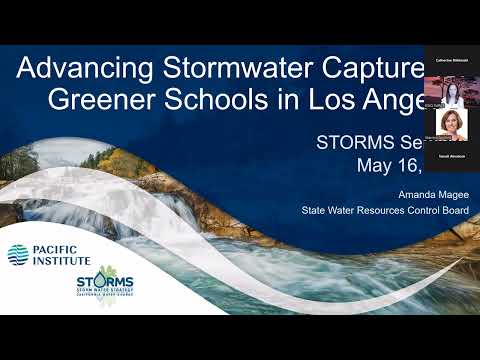
Presenters summarized a technical analysis that combined stakeholder input with a spatial tool called Rain Steward to rank nearly 1,900 school properties in LA County by multi-benefit potential. "Storms was developed in 2016. It's a clever acronym for the strategy to optimize resource management of stormwater," the State Water Board staff member said, describing the board's effort to reframe stormwater as a resource. Sonali Abraham, identified in the webinar as a senior research specialist at the Pacific Institute, said the project team "looked at the stormwater capture potential on schools public schools in LA County." Catherine Reimaki, research director at Second Nature, said the Rain Steward tool was built to "leverage digital tools to make stormwater science actionable and to actually see stormwater projects come to fruition."
Method and key numbers: The team combined extensive stakeholder engagement with a parcel-scale technical analysis. The Rain Steward analysis produced a countywide estimate that school campuses generate just over 3,000,000,000 gallons of stormwater annually, and that about 2,000,000,000 gallons of that volume appear capturable for water-supply or reuse purposes using distributed on-site practices. The project input to Rain Steward included 1,888 LA Unified School District properties and produced automated fact sheets and ranked lists to help prioritize sites for further engineering and funding effort. Catherine Reimaki said the tool scores sites across four benefit areas—water supply, water quality, flood reduction and urban heat mitigation—and produces a 0–100 score for each site and benefit.
Recommendations and implementation notes: The presenters offered four main recommendations drawn from the report and stakeholder conversations: 1) encourage strategic partnerships between community organizations and school districts to expand capacity for design, funding and maintenance (the Jackson Elementary retrofit with Amigos de los Rios was cited as an example); 2) use community-driven priorities at each campus to guide which co-benefits are emphasized and to build long-term stewardship; 3) adopt a multi-benefit planning lens at the outset so projects maximize combined outcomes rather than pursuing single objectives in isolation; and 4) prepare schools proactively for potential Municipal Separate Storm Sewer System (MS4) permit expectations by implementing best management practices now.
Costs and funding: The Rain Steward outputs include initial, scalable cost estimates that the presenters described as modifiable as projects move from screening to design; the initial default cost used in the tool was described as roughly $1,000,000 per acre-foot as a placeholder that users can refine. Presenters said the Storms program itself does not offer grant funding for school projects. Potential funding sources mentioned during the webinar included local ballot measures (for example, Measure W/Safe Clean Water Program), stormwater utilities, foundation and philanthropic grants, state grant programs and targeted green-space programs, with community organizations often helping schools access and administer grants.
Limitations and next steps: Presenters emphasized the analysis is a planning- and screening-level assessment, not an engineering design. Costs and water-quality metrics should be refined in site-level studies; Rain Steward is intended to prioritize and reduce the number of sites needing full engineering scans. The team also noted implementation barriers such as competing school priorities, limited on-site facilities capacity, and the need to tailor messaging to school decision-makers. The Storms unit said it is reevaluating its work plan to align future projects with climate and water-supply goals and stakeholder input and hopes to have a new slate of projects by next year.
Availability: Presenters said the full report, slides and a recording would be posted and that the Storms team would notify webinar attendees when materials are available.