Get Full Government Meeting Transcripts, Videos, & Alerts Forever!
Get email alerts on the Sgma Fees topic
No spam. Unsubscribe anytime.
State Water Board proposes graduated SGMA extraction fees to ease burden on small pumpers; stakeholders urge caution
Summary
Board staff proposed replacing a flat $20 per-acre-foot SGMA extraction fee with a five-bracket graduated structure that would lower fees for most pumpers while raising fees for a small number of high-volume extractors. Staff sought comments and noted fee waivers remain for qualifying small entities.
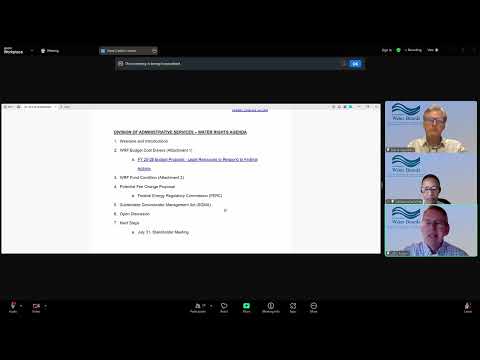
State Water Resources Control Board staff presented a concept June 11 to change the Sustainable Groundwater Management Act (SGMA) extraction fee from a flat $20 per acre-foot to a graduated, five-bracket structure designed to reduce fees for the majority of pumpers and increase fees only for a small number of high-volume extractors.
Natalie Stork, director of the Office of Sustainable Groundwater Management at the State Water Board, told stakeholders the program needs roughly $5.5 million per year to support state intervention work and that staff developed a graduated-fee concept to reduce the burden on small and mid-sized pumpers. Under the concept, the fee schedule would keep the $300 per-well base fee but add five volume brackets for per-acre-foot charges: 0–2 acre feet (no volumetric charge), up to 305 AF at $5/AF, the next bracket at $9/AF, and a top bracket at $40/AF (the board’s original 2024 level). Staff said the proposal would yield roughly the same revenue as the current flat-fee structure if adopted based on modeled pumping in the subbasin.
Stork said the proposal is based on best-available evapotranspiration data and a number of assumptions; staff acknowledged significant uncertainties about how many basins may be declared probationary, how many pumpers would be subject to fees, and the timing of reporting and payments. She also noted that fee revenue is deposited in the water rights fund and may only be used for SGMA state-intervention work.
Stakeholder reactions and timing
Kasha Hunt, a policy advisor for the Eastern Tule Groundwater Sustainability Agency, asked the board to avoid increasing state fees, saying local landowners already face increased GSA fees and costs from SGMA implementation after a 2023 plan deficiency. "The increased cost of SGMA implementation paired with additional increased fees from the state would only further harm the financial stability of the sub basin's landowners," Hunt said.
Community Alliance with Family Farmers supported the graduated approach as more equitable for small and family-scale farms. Other GSA representatives asked for clarity on timing and accounting; staff said the current fee schedule adopted last year (the $20/AF level) would apply unless changed and that any revised schedule adopted before reporting would apply to the coming reporting cycle. Staff invited written comments and said changes to the fee schedule would be presented to the board for adoption on Sept. 16 if pursued.
Waivers and administrative notes
Staff confirmed existing fee waivers for low-income individuals, community water systems serving disadvantaged communities, and schools will remain in place when fees are updated. Natalie Stork said staff plan to release additional waiver guidance later in the year before billing and reporting deadlines.
Ending note
The concept paper was presented for stakeholder feedback; staff asked for written comments and said they will refine the proposal and present options at the July 31 stakeholder meeting and to the board ahead of the Sept. 16 agenda. No fee change was adopted at the June 11 meeting.