Get Full Government Meeting Transcripts, Videos, & Alerts Forever!
Get email alerts on the Waste Discharge Permit Fund Budget topic
No spam. Unsubscribe anytime.
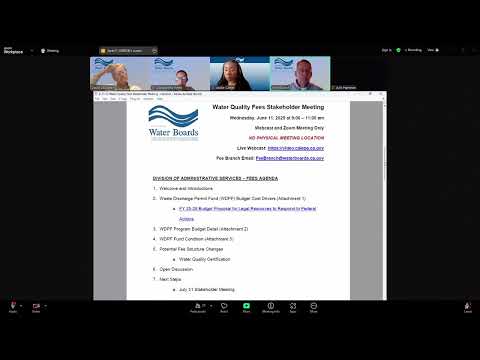
State Water Resources Control Board stakeholders review $14.5 million cut to Waste Discharge Permit Fund; fee options discussed
Summary
State Water Resources Control Board staff told stakeholders at a virtual water quality fee meeting that the Waste Discharge Permit Fund (WDPF) fee‑setting budget for fiscal year 2025–26 would fall from about $202 million to roughly $187 million under the governor’s May revise — a $14.5 million decline, or about 7.2 percent.
State Water Resources Control Board staff told stakeholders at a virtual water quality fee meeting that the Waste Discharge Permit Fund (WDPF) fee‑setting budget for fiscal year 2025–26 would fall from about $202 million to roughly $187 million under the governor’s May revise — a $14.5 million decline, or about 7.2 percent.
The reduction is driven mainly by vacancy‑savings and position eliminations requested in 2024 budget‑reduction letters, lower pro rata charges from other state agencies, and cuts to monitoring contracts, staff said. David Ciccarelli, fee and revenue branch chief in the board’s Division of Administrative Services, said staff are preparing options for the board that would reduce specific program fees modestly to align forecast revenue with the lower budget.
Why it matters: The fund pays for permit and oversight programs across the state. Staff presented figures showing projected fee revenue under current fee structures of about $191 million against projected program expenditures of about $187.3 million, a surplus of roughly $4 million under current fees. Staff said one option to rebalance revenue and expenditures would be percentage reductions applied to base fees in affected programs (for example, a roughly 2.3% reduction in the Waste Discharge Requirements program under staff modeling).
Staff presented program‑level cost drivers and numbers cited in the meeting. Jackie Carter and Cassandra White, fee and revenue branch staff, and John Russell, deputy director of Division of Administrative Services, explained that the May revise reflects several line items that reduce state operations spending by about $3.9 million, lower pro rata charges by roughly $1.5 million, and include targeted savings adjustments from budget letters 24‑20 and 24‑24 that together account for about $9.4 million of the reduction.
Cassandra White summarized the single budget change proposal (BCP) tied to legal defense against increased federal legal challenges: “The water board’s portion is $800,000 and would support three permanent positions,” she said, adding that the CalEPA package totals $2.9 million and 12 positions across agencies. White also said one of the fee funds would see a $200,000 allocation under that BCP.
Staff said the board prioritized reductions so that its highest‑priority programs — particularly the State’s drinking water program — were spared where possible. John Russell said managers targeted large contracts for reductions rather than cutting unevenly across regions. “We got rid of a couple of really big monitoring contracts in the GAMMA and SWAMP program,” he said, adding that the board also significantly reduced the oil and gas program budget. The combined reduction to SWAMP and GAMMA cited in discussion was roughly $5.7 million; staff said the two programs together total on the order of $30 million.
Stakeholder reaction and questions: Several stakeholders pressed staff on specific program impacts and the permanence of the cuts. Bob (identified in the meeting as representing multiple cities and water agencies) criticized the legal‑resources BCP, calling it a general‑fund responsibility and saying it should not be charged to fee payers: “The BCP is improper. It is a general‑fund expense, not fee payers or ultimately rate payers,” he said, adding his comments were offered on behalf of a list of cities and agencies. Sharon Green of the Los Angeles County Sanitation Districts asked whether the reductions from the budget letters are one‑time or permanent; John Russell replied, “No. They were intended to be permanent reductions.”
Stakeholders also raised program‑specific questions. Noel (stakeholder) asked whether the board had considered reduced acreage in irrigated agriculture when sizing the irrigated lands regulatory program; staff said they review acreage with regional boards and expect some small regions to add orders that could increase acreage, and that fee forecasts already reflect expected acreage changes. Debbie asked for clarity on the scale of reductions to SWAMP and GAMMA and was told the combined reduction was about $5.7 million.
Reserves, fee choices and next steps: Staff presented a fund‑condition snapshot showing a projected fund reserve rising from roughly 12% to near 13–15% under the May revise numbers and current revenue forecasts. Staff said the board historically aims for a roughly 5% reserve for this larger fund but that the higher reserve in the short term gives the board options: it could recommend fee reductions or use reserves to smooth fee impacts across years. David Ciccarelli said staff will brief board members with stakeholder feedback after the budget is finalized and that the board will make final policy choices at a future fee‑adoption hearing.
Stakeholders warned of broader fiscal risk. Bob cautioned that funds held by agencies can be subject to state fund sweeps during large general‑fund shortfalls and urged the board to consider whether to expend some balance rather than risk its loss: “Our money could be swept,” he said.
No formal board action was taken at the meeting; staff framed the presentation as informational and said final proposals would return to the board after the Legislature and administration conclude budget negotiations. Staff also announced the next WDPF stakeholder meeting on July 31 and invited stakeholders to contact fee branch staff with follow‑up questions.
Ending: Staff emphasized that the figures presented were based on the May revised budget and could change before the final 2025–26 budget is adopted; they said they would publish a more detailed summary of reductions once the budget outcome is final and accounting closes the year.