Get Full Government Meeting Transcripts, Videos, & Alerts Forever!
Get email alerts on the Water Rights Fund topic
No spam. Unsubscribe anytime.
State Water Resources Control Board outlines $1.9–2.1 million structural gap and options to address it
Summary
Board staff told stakeholders the water rights fund faces a structural deficit for FY 2025–26 and presented options including using reserves, spreading a modest fee increase across multiple charges, or repurposing a temporary loan to support SGMA work.
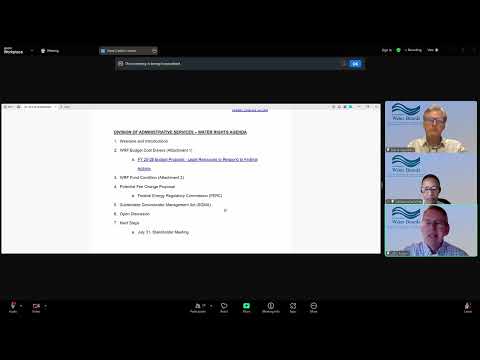
The State Water Resources Control Board’s fee and revenue staff told stakeholders June 11 that the water rights fund faces a structural deficit of roughly $1.9 million to $2.1 million for fiscal year 2025–26, and staff outlined options that include drawing on fund reserves or generating about 5% more revenue through fee changes.
David Ceccarelli, fee and revenue branch chief within the board’s Division of Administrative Services, said staff estimate the fund will need “about additional 5% in revenue to balance basically total revenues with expenditures in 25–26.” The projection is based on the governor’s May revised budget figures and current authorized spending.
The deficit follows an adjusted beginning fund balance near $8.1 million and a year in which actual expenditures ($24.1 million in 2023–24) were lower than budgeted levels because the agency froze hiring during state-directed budget-reduction drills. John Russell, deputy director of division administrative services, said the reductions implemented across state programs “are intended to be permanent. So we're treating them that way.”
Why it matters: the water rights fund pays for permitting, enforcement and other water-rights program costs. Drawing down reserves or adopting fee increases would affect water rights holders, while leaving reserves high raises the possibility that the Department of Finance might target those balances in future budget actions.
Details and staff proposals
Jackie Carter and Cassandra White presented the fund’s cost-driver breakdown. Staff reported a net fee-setting budget decrease of about $1.1 million (2.8%) from the board’s previously proposed $38.8 million to a May-revised fee-setting figure near $37.7 million. Cost changes include an $835,000 reduction in state operations and a $473,000 decrease in pro rata allocations to other state agencies. The board is also considering a budget change proposal (BCP) to add legal resources to respond to federal actions; the water board’s share is $800,000 and three positions, with other water board funds receiving smaller shares.
Ceccarelli told stakeholders the Sustainable Groundwater Management Act (SGMA) program is authorized in the water rights fund and that the May revise includes a technical BCP proposing a loan from the Underground Storage Tank Cleanup Fund of approximately $5.4 million to continue SGMA implementation; staff said the loan would be repaid within three years when SGMA fee revenues come in. "Once the revenue comes in, we'll be able to track it and compare that, of course, with the loan," Ceccarelli said.
Stakeholder concerns and next steps
Several stakeholders urged caution about raising fees. Bob Gore, consultant with the Guelco Group representing multiple municipal and irrigation clients, recommended using reserves to reduce or eliminate any proposed fee increase and reiterated opposition to the BCP for legal resources, saying it is “not a proper use of fee payers funds.” Another stakeholder asked whether state operations budgets will rebound; staff said the recent reductions are being treated as ongoing and that policymakers will be consulted on reserve policy.
Staff said they will update fund projections at the next stakeholder meeting after the Legislature and governor finalize the budget; the next meeting is scheduled for July 31, and staff plan to present updated numbers before a board consideration scheduled for the September 16 meeting.
Ending note
No policy decision or fee adoption occurred at the June 11 stakeholder meeting; staff solicited stakeholder comment and said they will bring options to the board for policy direction later this summer.