Get Full Government Meeting Transcripts, Videos, & Alerts Forever!
Get email alerts on the Land Use And Infrastructure topic
No spam. Unsubscribe anytime.
Boone County hearing on Merrill subdivision, ready‑mix plant centers on water, roads and conflict‑of‑interest concerns
Summary
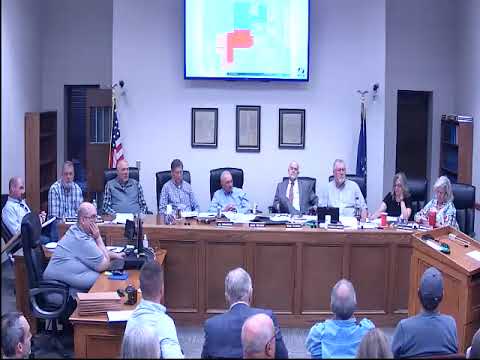
Residents, the petitioner and a developer representative addressed the Boone County Area Plan Commission about a proposed Merrill Minor subdivision and an adjacent portable ready‑mix concrete operation, focusing on water availability, county road impacts and an allegation of conflict of interest.
Residents, a petitioner and a developer representative addressed the Boone County Area Plan Commission on a proposed Merrill Minor subdivision and an adjoining portable ready‑mix concrete operation, focusing on water supply, road impacts and an allegation of conflicts of interest.
Neil Merrill, the petitioner, said he learned about the proposed subdivision at the meeting and urged the commission to balance development and farmland preservation while making infrastructure plans. “I didn't know about this development until tonight,” Merrill said. He asked the commission to ensure utilities and roads would be in place so new businesses and residents could “anchor and put down roots.”
The hearing drew multiple residents who raised three recurring concerns: whether the project would reduce groundwater available to nearby domestic wells; whether narrow County Road 350 can safely carry additional heavy truck traffic; and whether a commissioner who participated in drafting a zoning ordinance and who owns nearby land should take part in the APC process. One commenter alleged the draft ordinance advantages properties near an interstate and said the APC member’s land “checks every box” in the ordinance; that allegation was raised during public comment and not resolved during the hearing.
A developer representative presented recent studies and graphics referencing the Indiana Finance Authority and the Lebanon Utilities Environmental Assessment. They said Lebanon’s well field currently produces roughly 4.0 to 4.5 million gallons per day and that a Sugar Creek reservoir, a concept in the regional study, could provide an estimated 5,000,000 gallons per day but would take 20–25 years to plan, finance and build. The representative cited an IFA/central regional analysis that, in aggregate, estimated 6 million to 10 million gallons per day of available regional supply under certain scenarios.
To put the proposed plant’s water needs in local context, the developer said prior portable ready‑mix plants used for interstate construction once drew between about 75,000 and 120,000 gallons per day; they said Shelby (the operator identified by the presenter) plans typical daily production near 600 cubic yards of concrete — about 18,000 gallons of water — and up to about 1,200 cubic yards on a very large day. The presenter added that, by that calculation, Shelby’s largest daily use would equal roughly 0.45 percent of Lebanon’s current wellfield withdrawals. The representative also said prior nearby pours during interstate work did not cause reported impacts to local wells and pledged to “remediate” any wells DNR determines were harmed.
Speakers also discussed proximity. The presenter said Lebanon’s municipal wells are roughly 1.6 miles from the project site, while domestic wells near the site were described as roughly 1,200–1,500 feet from the location of past portable plants and from the proposed plant’s footprint. Residents disputed whether drilled wells and long‑term development could safely coexist without county or regional sewer and water infrastructure.
On transportation, commenters described County Road 350 as narrow and not built for sustained heavy truck use. The developer told the commission they had spoken with a highway department staff member (identified in the hearing as “Nick”) and planned to remediate the county roads they use for construction and operation, potentially including widening. The developer also said portions of roadwork had been contemplated as part of a redevelopment commission allocation area and could be funded by bond proceeds tied to that area; the redevelopment allocation was referenced as background rather than as a formal, immediate funding commitment.
Commissioner Lawson (identified in the hearing as a county commissioner) told the group the highway department indicated the road would need remediation and that the developer would have to satisfy the county’s requirements; Lawson confirmed the county had contemplated using redevelopment bond proceeds as part of the broader project financing but did not announce any immediate county expenditure.
The commission closed public comment and allowed the petitioner a rebuttal; the developer asked for a favorable recommendation to the commission. No formal vote or final decision was taken during the hearing. Commissioners asked for the water materials referenced in the petitioner’s presentation to be included in the public packet before future consideration.
Why this matters: The hearing highlighted that private‑well groundwater, narrow local roads and coordination with municipal utilities are central concerns when industrial or high‑volume commercial operations are proposed in parts of Boone County that rely on drilled wells and county roads rather than municipal systems. The commission did not act to approve or deny the application at this meeting; it heard public comment, petitioners’ rebuttal and questions from commissioners that signal further review and requests for supplemental information.