Get Full Government Meeting Transcripts, Videos, & Alerts Forever!
Get email alerts on the Parking And Parking Code topic
No spam. Unsubscribe anytime.
Wilsonville planning commission unanimously backs code changes to align with state's climate-friendly parking rules
Summary
The Wilsonville Planning Commission voted unanimously June 11 to approve resolution LP25-0002, recommending the City Council adopt development-code amendments to comply with Oregon’s Climate Friendly and Equitable Communities parking rules and to expand local flexibility on parking-lot design.
The Wilsonville Planning Commission voted unanimously June 11 to approve resolution LP25-0002, recommending the City Council adopt development-code amendments to comply with Oregon’s Climate Friendly and Equitable Communities (CFEC) parking rules and to expand local flexibility on parking lot design.
City planning manager Daniel Polley, who presented the staff report, said the amendments are driven by state rules and by a desire to “better encourage quality and functional development with park when as parking is developed, in Wilsonville.” He described the proposal as a local alignment with CFEC requirements and noted the package includes both changes to parking minimums and to parking-lot design standards.
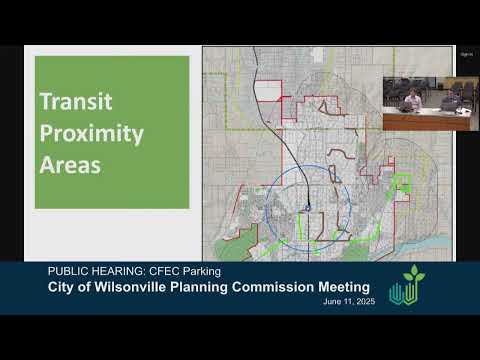
The changes endorse the commission’s preferred “option 1,” which removes most municipal minimum parking requirements where the state’s transit-proximity rule applies and makes other local code consistent with state rules. Polley told commissioners that the transit-proximity rule exempts much of the city from minimums because it defines “frequent transit” proximity as within a half-mile of frequent bus routes (including SMART routes 4 and 2X) or within three-quarters of a mile of a rail station. He said the on‑the‑ground areas not affected by the transit‑proximity exemptions include Charbonneau, most of Villebois’ western two-thirds, and part of the Northwest Industrial Area.
Under the package approved by the commission, the city would remove parking minimums in the covered areas and adopt updated design standards for parking areas that are built. A major technical change required by CFEC is to lower the threshold that triggers enhanced design requirements from 200 spaces to about 40 spaces; staff said this creates three size tiers (under 40 spaces, 40–200 spaces, and 200-plus spaces) with different landscaping, screening and pedestrian-path standards.
Polley and staff also described a solar option that lets developers install photovoltaic panels in place of a portion of required parking-lot tree plantings. For lots with 40 or more spaces, the city’s proposed rule would require 40% parking-lot tree canopy (30% for smaller lots) and allow solar panels in lieu of 25% of required parking-lot trees (equal to roughly 10% of total required canopy) if the panels are placed on‑ or off‑site.
Staff said they made two changes after earlier work sessions: (1) removing a carryover requirement that 25% of parking-lot trees be placed in interior islands for the 40–200‑space tier (that interior-tree requirement will now apply only to 200‑plus space lots, consistent with existing code), and (2) clarifying internal pedestrian‑walkway requirements to reference the development’s “main entrance” rather than “front entrance” to account for situations like Old Town Square where the primary access from a lot differs from the street-facing entrance.
The hearing record for LP25-0002 was opened and closed at the meeting; there were no public testimony submissions in person, by Zoom, or by email. After staff presentation and a brief opportunity for commissioner questions, a commissioner moved the approval, the motion was seconded, and the commission voted unanimously to approve the resolution recommending city-council adoption.
Action (formal): Motion to approve resolution LP25-0002 as written; seconded; outcome: approved unanimously. The commission’s approval constitutes a recommendation to the City Council rather than the final local adoption; staff will forward the recommended development-code amendments and supporting materials to the council for consideration.
Why it matters: The amendments implement state CFEC parking requirements that aim to reduce inefficient land use, improve walkability and reduce vehicle emissions by reforming minimum parking requirements and by strengthening design standards for new parking. By aligning the local code with the state rules and adding options such as the solar-in-lieu provision, staff said the city intends to maintain predictable development standards while enabling projects that support transit and lower vehicle dependence.
Next steps: The commission’s vote sends staff’s recommended code amendments to the City Council for final action. Staff indicated continued coordination with council and noted those changes are intended to ensure local code mirrors current state CFEC rules and the transit-proximity exemptions.