Get Full Government Meeting Transcripts, Videos, & Alerts Forever!
Get email alerts on the Pharmacy Technician Roles topic
No spam. Unsubscribe anytime.
Board hears hospital systems on expanding pharmacy technician roles; committee signals interest in PIC-driven ratio flexibility
Summary
On June 12 the California State Board of Pharmacy Licensing Committee heard presentations from major health systems on expanding inpatient pharmacy technician duties and discussed whether to give pharmacists-in-charge more discretion to set pharmacist-to-technician ratios in hospitals.
SACRAMENTO — The California State Board of Pharmacy Licensing Committee on June 12 heard hour-long presentations from four health systems about how hospitals use pharmacy technicians and the safeguards those systems apply as technology and roles evolve.
The presentations came from Stanford HealthCare, Cedars‑Sinai Medical Center, UC San Diego Health and Kaiser Permanente. Speakers described technicians performing sterile and nonsterile compounding, operating and maintaining automation (box pickers, pill pickers, automated dispensing cabinets), performing medication histories and prior‑authorization work, supporting 340B and purchasing compliance, and participating in diversion surveillance and data‑analytics programs.
Why it matters: Committee members said they want consumer protection to remain paramount while giving the profession flexibility to adapt to automation, workforce shortages and growing clinical demands on pharmacists. The committee discussed regulatory options that would let a pharmacy’s pharmacist‑in‑charge (PIC) set a higher inpatient technician ratio under defined guardrails rather than a one‑size‑fits‑all numeric mandate.
Stanford HealthCare’s presentation described a broad inpatient technician workforce. Dandry Desai, executive director of pharmacy at Stanford HealthCare, said technicians handle ordering, automated‑dispensing‑cabinet restocking, med‑history work, insurance benefit investigations and some certified checking roles such as TechCheckTech. Evelyn Talbert, inpatient pharmacy technician manager, described processes that document deliveries and exchanges to nursing units and programs that log cost‑savings interventions when a missing high‑cost medication is found and returned to inventory. Desai said Stanford’s inpatient operation has about 632 licensed beds and verifies roughly 10,000 orders per day across the health system.
Cedars‑Sinai emphasized career ladders and competency testing. Rita Shane, vice president and chief pharmacy officer at Cedars‑Sinai, traced the system’s technician career ladder back to 1989 and said the hospital requires technician competency exams, role‑specific training and continuing quality assurance. Cedars‑Sinai said it uses technicians in medication‑history collection, transitions‑of‑care follow‑up calls, surveillance and sterile compounding oversight, and that many technicians hold PTCB certification and additional specialty certificates.
UC San Diego Health and Kaiser Permanente likewise described technicians’ roles in compounding, automation, inventory and diversion programs. Charles Samuels ("Chuck"), chief pharmacy officer at UC San Diego Health, highlighted the role technicians play managing unit‑stock automation, and Nancy Yam outlined best‑possible medication history activities. Doug O’Brien, vice president of acute care and infusion pharmacy for Kaiser Permanente, said Kaiser’s California hospitals verify an estimated 50 million orders per year and dispense tens of millions of doses; he stressed that barcode and RFID technologies, automated dispensing cabinets and high‑resolution IV‑hood cameras have materially reduced medication errors and enabled more technician responsibilities.
Committee discussion focused on the pharmacist‑to‑technician ratio. The board’s current institutional regulation sets the inpatient ratio at one pharmacist to two pharmacy technicians; the committee noted proposed legislative language for noninstitutional settings that would allow increases (up to one to four) with the PIC deciding the actual ratio at each pharmacy. Board chair Seung Oh reminded members that “the protection of the public shall be paramount” while opening the floor to options for greater local flexibility.
Members expressed general support for a model that gives the PIC discretion to set ratios within parameters and requires organizations to maintain documented training, competency, supervision and periodic quality assurance — especially where technicians perform clinical or sterile tasks. Board members and presenters emphasized distinguishing technicians’ distribution/automation duties from higher‑risk clinical tasks that merit tighter pharmacist oversight.
Public commenters included Mark Johnston of CVS Health, who recommended a “tech delegation” model that lets pharmacists delegate individual duties to technicians based on documented training, experience and supervision; Chasney Johnson, a pharmacy technician, urged continued pharmacist involvement in hiring and onboarding; and other commenters urged caution and emphasized patient‑facing needs in underserved communities.
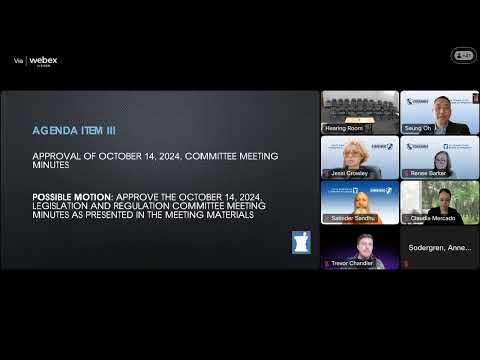
The committee also recorded one formal action at the meeting: members approved the draft minutes from the Oct. 17, 2024 Licensing Committee meeting. Vice Chair Chandler moved to approve the minutes, Satinder Sandu seconded, and the motion passed unanimously with recorded yes votes.
The committee did not adopt regulatory text at the session but signaled a preference for a PIC‑driven flexibility model combined with mandated institutional safeguards (documented training and competencies, QA/audit, supervision standards and limits on high‑risk activities). Members asked staff to bring draft language for further review at upcoming meetings and to present the public‑comment record.
The committee recessed after the session and said further rulemaking work on the inpatient ratio would continue through staff and the full board. The board’s next regular meetings were announced in the session materials.