Get Full Government Meeting Transcripts, Videos, & Alerts Forever!
Get email alerts on the Property Disposition And Local Development topic
No spam. Unsubscribe anytime.
Panama City CRA explores ‘Spark’ plan to return CRA and city lots to private ownership
Summary
At a Panama City CRA virtual workshop, commissioners discussed a ‘Spark’ proposal to sell or transfer CRA and city-owned parcels with scoring, deed restrictions, and alternatives such as community land trusts to encourage local redevelopment and small-business growth.
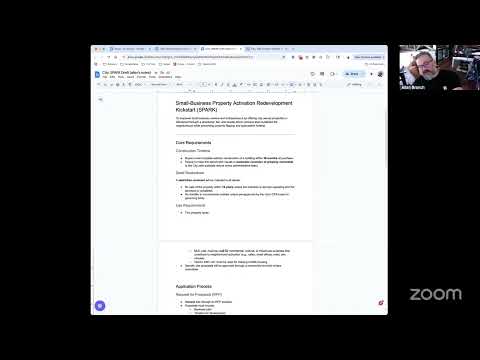
At a Panama City Community Redevelopment Agency virtual workshop on Oct. 11, commissioners discussed a proposal called “Spark” to return city- and CRA-owned parcels to private owners through sales, targeted transfers or land‑trust arrangements aimed at spurring local redevelopment.
The proposal, presented by Commissioner Alan, would treat different parcel types—commercial corridor lots on MLK Boulevard, infill residential lots and downtown / Main Street parcels—differently, with options ranging from market sales to deeply discounted transfers tied to deed restrictions or reversion clauses to ensure development happens.
Why it matters: Panama City and its CRA hold multiple vacant or underused parcels in Glenwood, Millville and along MLK Boulevard. The Spark approach is intended to create “sparks” of private investment that can set market comparables and attract bank financing, increase tax rolls, and support local entrepreneurs and small-business owners who want to build in their neighborhoods.
Details of the proposal and discussion
Commissioner Alan said the document he showed the board was “a program that we desperately need feedback on,” and described a range of options including selling lots at market value, selling for nominal fees (for example, $1) tied to development commitments, or transferring parcels into a community land trust.
Supporters of the Spark approach discussed a scoring system to favor local and minority-owned buyers, prospective buyers who completed business-plan or development workshops, or those who hold preapproval letters from lenders. “We want people of the neighborhood building back their neighborhoods,” Alan said, adding that small builders and first-time brick-and-mortar entrepreneurs often need coaching and connections to financing.
Board members and staff raised several implementation points:
- Reversion clause and deed restrictions: Commissioners discussed adding reversionary language so a parcel reverts to the CRA or city if required development does not occur within a defined period.
- Scoring and vetting: The board discussed scoring applications to prioritize local buyers, minority‑owned businesses, veteran‑owned firms or applicants who complete vetted business-plan programs. The board suggested tying points to participation in programs like the Cornerstone Trust business-plan/microloan series cited in the meeting.
- Financing and equity: Commissioners and participants noted that selling land cheaply can give buyers equity to leverage loans, while community land trusts remove land cost from mortgage calculations but can complicate resale appreciation.
- Partnerships and technical assistance: Commissioners asked staff to explore partnering with the Florida Housing Coalition, the Incremental Development Alliance, Habitat-type nonprofit developers and local lenders to provide technical assistance, sweep equity, and training so recipients are not set up to fail.
Alternatives discussed: community land trusts and developer models
Michelle Zirkle, identified at the workshop as a CRA program manager, summarized how community land trusts and conservation‑style restrictive covenants have been used elsewhere in Florida to preserve affordability. She noted the board could pursue a land-trust model on a small pilot set of 5–10 parcels rather than converting the entire CRA portfolio.
Commissioner Alan and other board members noted pros and cons: a land trust can keep homes affordable by removing land from comps, but developers or owners have raised concerns that land-trust resale formulas limit appreciation. The board agreed they need more research and examples from Leon County, Tallahassee and Franklin County before choosing a direction.
Staff directions and next steps
Staff told the board they are updating a citywide parcel map and hope to have it available in about a week; the map will include CRA, city and housing-owned parcels. Commissioners requested a spreadsheet with parcel addresses, parcel numbers, acreage/dimensions, zoning, latest sale dates and notes so they can score and group lots for pilot programs.
Commissioners asked staff to schedule a follow-up meeting with subject-matter groups, including the Florida Housing Coalition, to present community land-trust models and answer technical questions. The board agreed to continue developing the Spark concept internally before directing staff to prepare formal policy or grant programs.
Quotes of record
“This is a program that we desperately need feedback on,” Commissioner Alan said when introducing the document he called “Spark.”
“We don’t want to set people up for failure,” Michelle (CRA program manager) said, arguing for coupling transfers with training and technical support.
Ending
The CRA did not take a formal vote on a policy at the workshop. Instead, commissioners asked staff for an updated parcel list and a follow-up presentation from housing-sector experts, and agreed to continue refining the Spark approach at the next CRA virtual workshop.