Get Full Government Meeting Transcripts, Videos, & Alerts Forever!
Get email alerts on the Transportation Funding Wheel Tax topic
No spam. Unsubscribe anytime.
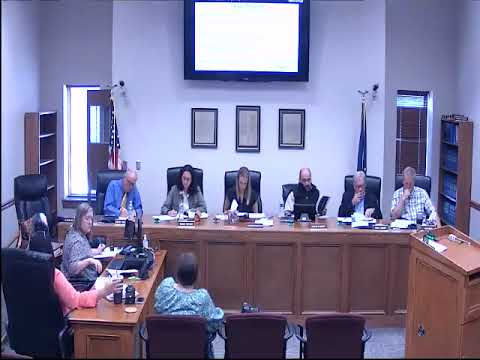
Boone County hears detailed briefing on vehicle wheel tax and excise surtax options
Summary
An LTAP consultant outlined how a county wheel tax (wheel tax) and vehicle excise surtax—adopted together as LOHA—could raise local road funding and qualify Boone County for Community Crossings Matching Grant direct distributions beginning in fiscal 2027; no ordinance was proposed or voted on.
Boone County officials received a detailed informational presentation on a county wheel tax and vehicle excise surtax—together described in the briefing as a two-part local option highway funding mechanism—during a council meeting.
The presentation matters because adoption of both taxes is required to create a new, recurring local revenue stream for roads and bridges and to qualify county and municipal units for a new Community Crossings Matching Grant (CCMG) direct distribution that begins in fiscal 2027. Jennifer Sharkey, who identified herself as a representative of the Indiana Local Technical Assistance Program, told the council LOHA (the combined wheel tax and excise surtax) is intended to support local road and bridge funding activities and that counties must adopt both taxes concurrently to be eligible for the new direct-distribution funding.
Sharkey described two distinct charges: an excise surtax (which may be implemented as a flat fee of $7.50 up to $50 per vehicle or as a percentage of the excise tax from 2% up to 20%, with a $7.50 minimum) and a wheel (or registration) tax (a flat fee between $5 and $80 applied to larger/heavier vehicles). She said if the county adopts LOHA before Aug. 31 in a given year, collections would begin the following January; if passed on or after Sept. 1, collections would begin the January after that. Sharkey added the Bureau of Motor Vehicles charges a 15¢ service fee per transaction that the BMV retains.
The presentation included estimated revenue ranges based on Boone County registration data. Sharkey corrected a slide during Q&A and said the county government share (the portion the county itself would retain under the local road/street distribution formula) was estimated at about $217,000 up to $1,550,000 at flat fee rates. She also gave conservative ranges for how much Boone County could receive under the new CCMG lane-mile direct distribution starting in fiscal 2027 — roughly $800,000 up to $1.5 million in different scenarios — and cautioned those numbers depend on how many eligible local units adopt LOHA.
Council members and staff pressed on distribution mechanics and limitations. Kevin Danhorn asked whether the 15¢ BMV fee came to the county; Sharkey replied the 15¢ is retained by the Bureau of Motor Vehicles and does not pass to the county. Nick (identified in the meeting as the Boone County highway director) confirmed direct-distribution eligibility is based on lane miles maintained by the local unit and does not include state or federal highways; Nick said only roads the county currently maintains would count toward the lane-mile calculation. Sharkey also noted some vehicle classes and uses are exempt (state-owned vehicles, school buses, certain nonprofit buses and funeral vehicles).
Council discussion touched on an interlocal issue with Zionsville: Boone County would distribute funds according to the local roads and streets formula, which assigns a population credit that could send a substantial share to Zionsville even though the county still maintains some overlapping roads. Sharkey said those jurisdictional and interlocal maintenance arrangements would need further work for Boone County.
No ordinance, amendment or motion to adopt LOHA was made at the meeting. Sharkey offered to provide detailed estimates and materials; council members thanked her and indicated staff would follow up if the county seeks more modeling or moves toward an adoption timeline.
Ending: The presentation was informational only; the council took no formal action on a wheel tax or excise surtax at this meeting and asked staff to pursue follow-up analysis if desired.