Get Full Government Meeting Transcripts, Videos, & Alerts Forever!
Get email alerts on the Banking Tax Credit topic
No spam. Unsubscribe anytime.
Public hearing held on tax credit to incentivize new Oregon-chartered banks; proponents cite Ohio precedent
Summary
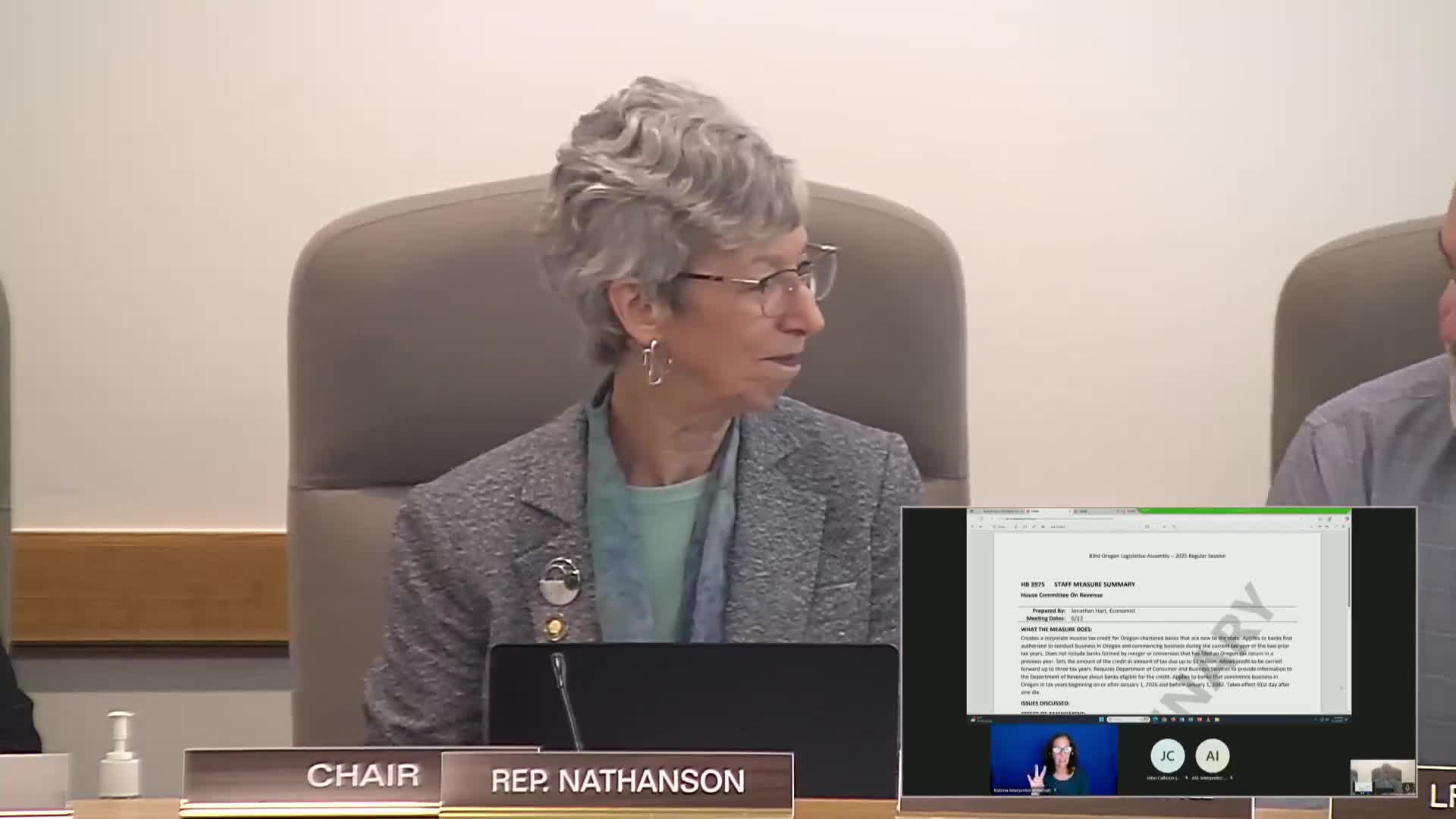
The House Committee on Revenue held a public hearing June 12 on House Bill 3975, which would create a corporate income tax credit for newly chartered Oregon banks.
The House Committee on Revenue held a public hearing June 12 on House Bill 3975, which would create a corporate income tax credit for newly chartered Oregon banks. Committee staff described the proposal as a limited, three-year credit that would exempt a qualifying de novo Oregon-chartered bank from corporate income tax liability up to $1 million per year during the initial three tax years.
Why it matters: Supporters said the measure would lower the effective startup cost of forming a new community bank in Oregon and could encourage de novo bank formation in rural and underserved markets. Testimony noted a long-term decline in Oregon-chartered community banks and cited Ohio’s 2020 law, which sponsors said produced new state-chartered banks after that state enacted a similar incentive.
Supporter testimony: Scott Bruin, president and CEO of the Oregon Bankers Association and Community Banks of Oregon, said the measure would “help offset the extraordinary costs of regulatory compliance, technology, staffing, and capital formation that are inherent in starting a bank today.” He added that HB 3975 is modeled on Ohio’s law and said, “House bill 3,975 is a smart growth oriented response to Oregon's community banking challenge, and we know the concept works.”
Tax Fairness Oregon’s John Calhoun said his group supports the bill, noting the proposal is narrowly targeted to state‑chartered de novo banks and that the bill specifically excludes new banks that are formed by reorganizing an existing bank. He said the credit is distinctive and should not be generalized to other startup industries.
Committee discussion noted these facts from testimony: the last new Oregon-chartered bank was formed in 2007 (Lewis & Clark Bank), the number of state‑chartered community banks has declined from the mid‑1990s level of about 54 to 13 today, and the effort is intended to incentivize community-focused, tax‑paying lenders that serve small businesses and rural areas. No committee vote or motion on the bill occurred during the public hearing; the committee closed the hearing and indicated staff and sponsors may continue work on bill language.
What to watch next: The committee did not take final action; if the bill advances, fiscal and eligibility details—including the three-year term and the $1 million annual cap—will be reviewed in subsequent committee work sessions.