Get Full Government Meeting Transcripts, Videos, & Alerts Forever!
Get email alerts on the Transient Lodging Tax topic
No spam. Unsubscribe anytime.
Committee adopts amendment shifting transient lodging tax split to 40/60 baseline; bill moves to floor
Summary
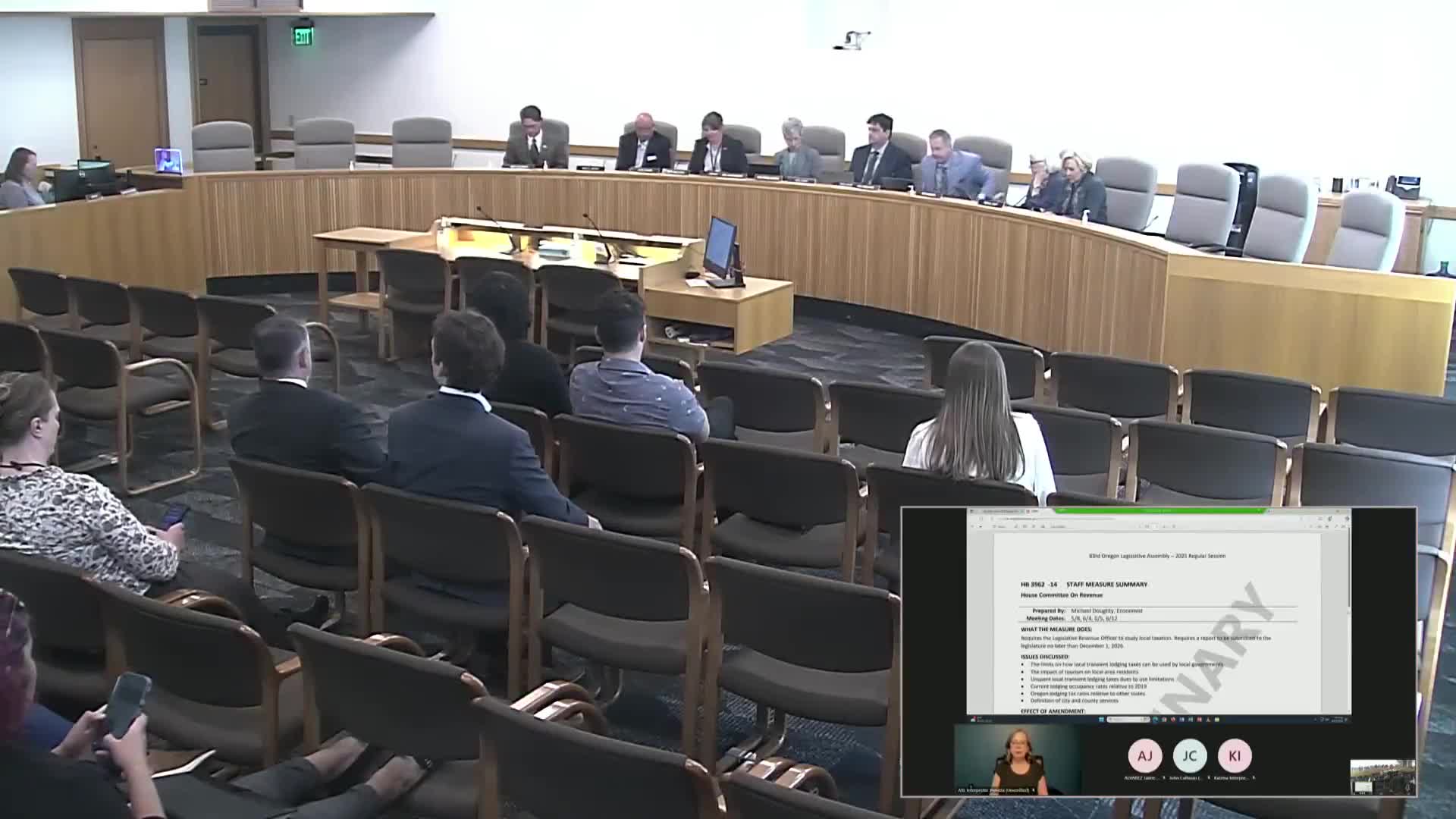
The House Committee on Revenue on June 12 adopted the dash-14 amendment to House Bill 3962 and advanced the bill to the floor with a due-pass recommendation.
The House Committee on Revenue on June 12 adopted the dash-14 amendment to House Bill 3962 and advanced the bill to the floor with a due-pass recommendation. The dash-14 amendment establishes a baseline distribution for local transient lodging tax (TLT) revenues: at least 40% must be used for tourism promotion or tourism-related facilities and no more than 60% may be used for city or county services. The amendment becomes operative Jan. 1, 2026.
Why it matters: The change reduces the statutory minimum for destination marketing organizations compared with prior law (which locked in at least 70% for tourism promotion for taxes in effect after July 1, 2003). Committee members and legislative counsel said the amendment also clarifies treatment of local governments that adopted TLTs before July 1, 2003 and allows units of local government to opt into the new split going forward.
Key clarifications from legislative counsel Alan Dale: “Tourism promotion means advertising, publicizing, distributing information to attract and welcome tourists, conducting strategic planning and research to stimulate future tourism, conduct operating tourism promotion agencies, and marketing special events and festivals.” He continued that a “tourism related facility is a conference center, convention center, or visitor information center, and other improved real property for useful life of 10 or more years to substantial purpose of supporting tourism or accommodating tourist activities.”
Legislative counsel and staff confirmed other mechanics: the amendment applies to both previously grandfathered local TLTs and to new or increased local TLTs adopted after the amendment; the 40% is a minimum and the 60% cap on city/county services is a maximum; the tax collection fee retained by providers (typically 5%) is unchanged; and LRO and OLIS fiscal materials reported no fiscal impact.
Committee debate and votes: Several representatives expressed concern about the effect on smaller communities and the timing of the change. Representative Reschke and Representative Smith announced they would vote against the amendment, while Representative Marsh said, “I am going to support the amendment,” and Vice Chair Walters moved the amendment. The committee adopted the dash-14 amendment and then voted to move House Bill 3962, as amended, to the floor with a due-pass recommendation.
What to watch next: The amendment is operative Jan. 1, 2026; local governments that do not presently have a TLT may adopt one in the future and would be subject to the amendment’s distribution rules. Legislative counsel recommended local governments consult ORS definitions for specific allowable uses.
Sources: Staff presentation, legislative counsel Alan Dale, committee roll-call and public hearing record.