Get Full Government Meeting Transcripts, Videos, & Alerts Forever!
Get email alerts on the Budget Appropriations topic
No spam. Unsubscribe anytime.
House advances state budget that uses Revenue Stabilization Trust Fund for one-time projects; Gator scholarship allocation reduced pending contract approval
Summary
Representative Brett McFarland urged lawmakers to pass House Bill 1, saying the appropriations package aligns state general-fund totals with the latest REC forecast and programs about $1.2 billion from the Revenue Stabilization Trust Fund for one-time infrastructure and institutional projects.
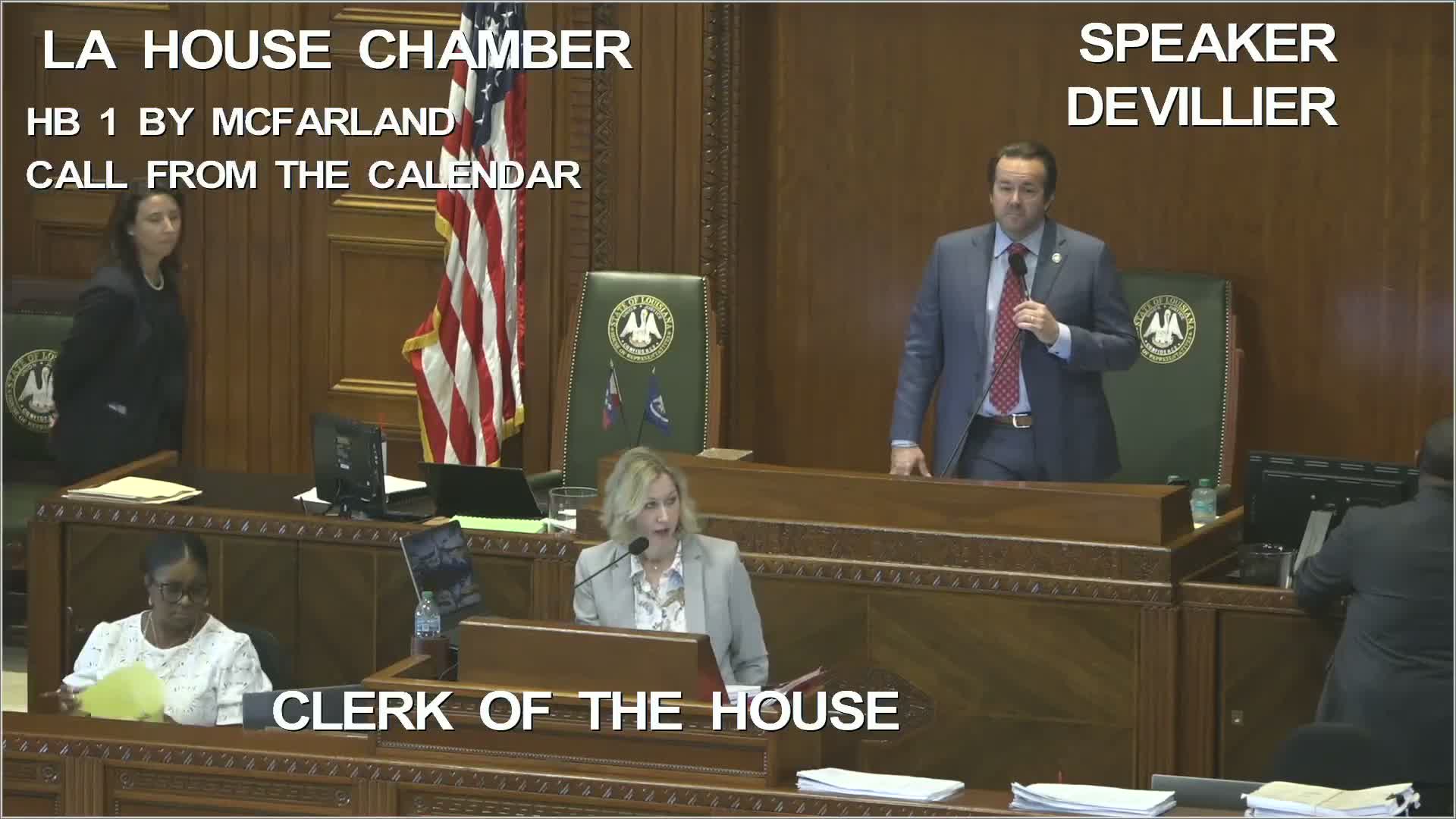
Representative Brett McFarland (Representative) moved House Bill 1, the fiscal 2025-26 appropriations bill, reporting the chamber’s version aligns state general fund figures with the latest revenue estimating conference (REC) forecast and uses the Revenue Stabilization Trust Fund for one-time expenses.
McFarland told lawmakers the Senate’s changes increase expenditures to reflect the REC forecast and shift one-time stabilization dollars into infrastructure and targeted projects. He itemized Senate restorations and additions: a $50,800,000 reduction from the Gator scholarship set-aside, with $30,000,000 of that redirected to high-dosage tutoring; roughly $46,400,000 to higher education institutions; $15,300,000 for a Baton Rouge facility to house criminal defendants found incompetent to stand trial; an increase in the per-diem for housing adult offenders in local jails (to $3 per day, as reported); $10,000,000 to restore a portion of personnel cuts; $8,300,000 for a new Medicaid eligibility and enrollment module at the Louisiana Department of Health; $5,900,000 for increased overtime at the Department of Corrections; and $5,000,000 for child-welfare expenses at DCFS.
McFarland said $1.2 billion from the Revenue Stabilization Trust Fund is programmed for one-time uses, including tens or hundreds of millions for transportation and economic development: $709,000,000 (reported in discussion as a multi-hundred-million allocation) for the Louisiana Transportation Infrastructure Fund; $272,700,000 for Louisiana Economic Development initiatives; $75,000,000 for a water sector fund; $67,200,000 for a modernization and security fund; $43,200,000 for higher-education campus revitalization; $22,900,000 for criminal justice and first-responder funding; and $10,000,000 for voting technology upgrades.
On the Gator scholarship program — a state-funded voucher-like initiative discussed at length — McFarland said the Senate reduced the amount that had been proposed for special populations. He told the House that the contract to operate Gator still must be approved by the Joint Legislative Committee on the Budget and that the program’s first-year enrollments and vendor contract remain outstanding. He noted roughly 40,000 students applied for the program and that about 30,000 of them already attend private schools.
Members questioned McFarland on the Gator reduction and on which expenditures are recurring versus one-time. McFarland said most state-general-fund activity remains steady and that the apparent increase in total budget size is driven by additional federal dollars and accounting moves (means-of-finance swaps), not a broad increase in recurring state general fund obligations. He told lawmakers approximately $60 million of the REC-recognized increase is available on a recurring basis for the coming year, with the remainder tied to one-time or timing-driven items.
After debate and questions from multiple members, the House took the motion to concur in the Senate amendments; the chair asked for favorable passage.
Why it matters: HB 1 sets state spending levels for the year and uses stabilization reserves to smooth or finance large, one-time projects. It also leaves critical program starts — including the Gator scholarship’s operational contract and first-year implementation details — subject to further approvals.
What happens next: McFarland and other lawmakers said remaining implementation steps include Joint Legislative Committee on the Budget approval of program contracts and the final enrollment and vendor arrangements for the Gator program. If those administrative steps are not completed, some disbursements tied to the contract would not occur.