Get Full Government Meeting Transcripts, Videos, & Alerts Forever!
Get email alerts on the Urban Forestry topic
No spam. Unsubscribe anytime.
South Pasadena staff propose streamlined tree ordinance to speed hazardous-tree removals and simplify permits
Summary
South Pasadena Public Works staff on June 11 presented draft recommendations to update the city's tree ordinance intended to shorten permit timelines, clarify trimming and removal criteria, and protect the urban canopy while reducing costs and delays for residents.
South Pasadena Public Works staff on June 11 presented draft recommendations to update the city's tree ordinance intended to shorten permit timelines, clarify trimming and removal criteria, and protect the urban canopy while reducing costs and delays for residents.
The staff presentation, made by Danielle Garcia, water conservation management analyst for the City of South Pasadena, summarized a comparative review of seven nearby municipal codes and recommended a series of changes including a protected-species list focused on native and drought-tolerant trees, clearer thresholds for when trimming permits are required, alignment with industry standards (International Society of Arboriculture and ANSI), and reductions to replacement requirements for hazardous or development-related removals.
Why it matters: Commissioners said the current permit and removal process can be lengthy and costly for homeowners and for city staff. Staff said the proposed changes aim to make the rules more predictable, easier to administer and enforce, and more consistent with neighboring cities while preserving high-value native canopy.
Staff overview and recommendations
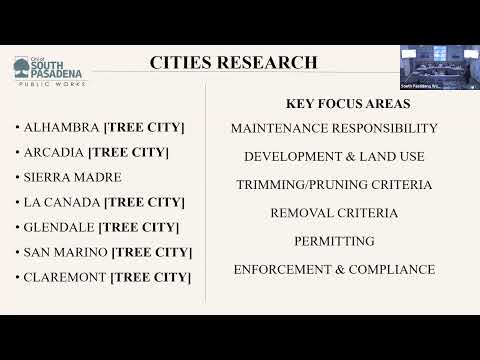
Danielle Garcia told the Public Works Infrastructure Commission the review grew from a City Council directive to identify areas to increase efficiency in permitting and to reevaluate removal and trimming criteria. Staff compared South Pasadena's code with Alhambra, Arcadia, Sierra Madre, Glendora, Glendale, San Marino and Claremont and found variation in how those cities treat maintenance responsibilities, removal and trimming thresholds, and enforcement.
Garcia said staff recommend: - Focusing regulation and active enforcement on a new "protected tree" list largely composed of native and drought-tolerant species rather than regulating every tree on private property. - Adding clearer maintenance guidelines for property owners and for trees located in public rights-of-way or easements. - Setting objective trimming thresholds aligned with ISA and ANSI best practices (for example, clearer guidance around the common 10% live-foliage guideline and an ANSI recommendation of no more than 25% removal in a year when appropriate). - Streamlining removal permitting and lowering replacement requirements, particularly for hazardous or dead trees and for many development scenarios where current replacement counts can be infeasible for property owners. - Narrowing the circumstances that trigger a 100-foot mailed neighbor-notification requirement to cases associated with development, director denials that are appealed, or when the director refers an application to the Natural Resources and Environmental Commission (NRAC).
Fees, staffing and process details noted in the presentation
Garcia and Acting Co-Director of Public Works Michael Bartanyans provided several specific clarifications about the current process and proposed changes. They said the city currently collects a $141 inspection fee (to cover the contracted arborist site visit), a $364 fee for permit processing when removals proceed, and a $424-per-tree replacement fee when on-site replacement is required. Garcia said staff are considering reducing replacement counts in many cases; she described an approach that would require only one native tree replacement for hazardous or dead trees and that could reduce replacement counts "by at least half" in other cases pending further ordinance drafting.
Staff said the city uses a contracted arborist (not a full-time staff arborist). The contracted arborist visits about twice a month for inspections; Michael Bartanyans said there could be roughly 15 property inspections scheduled on a given inspection day. Residents may also submit private arborist reports to supplement the city's review, but resident-paid reports are paid by the resident.
Trimming criteria and enforcement
Garcia said staff will include clearer language about triggers that require a permit. She cited the commonly used 10% live-foliage guideline and said the draft ordinance will add explanatory and educational materials so property owners can better understand what 9%, 10% or 12% of foliage looks like, and to incorporate ANSI guidance on larger annual limits when a tree can sustain heavier pruning.
On enforcement, staff advocated targeting limited enforcement resources by concentrating on protected trees and objective criteria that reduce subjectivity in issuance of violations. Garcia said neighbors and commissioners asked for incentives to encourage compliance and education materials to reduce disputes.
Replacement and development impacts
Commissioners raised the heavy replacement burdens that sometimes arise in development cases (for example, accessory dwelling unit projects) where staff said a single lot could be required to replace dozens of trees under current code. Garcia said staff saw cases with replacement counts as high as 30 trees for one lot and said the proposal aims to make replacement requirements viable for property owners while preserving canopy value.
Emergency and special-case handling
Staff said the draft code will retain avenues for expedited removal in emergencies (windstorms, immediate public-safety hazards) and will include clear criteria to allow removal where a homeowner's insurance is being canceled for tree-related risk, or where state-mandated defensible-space requirements in high fire-severity zones require vegetation changes. Garcia said those cases would not be appropriate for a standard notice-and-appeal flow that can take months.
Commissioner questions and feedback
Commissioners pressed staff on the following points: - Replacement ratio: Commissioner Hammond asked for a specific lowered-percentage target; Garcia said staff are still testing options and proposed, for hazardous or dead trees, replacement by a single native tree and a chart in the ordinance to guide other cases. - Notification radius: Chair Abelson asked why the city uses a 100-foot notification radius; staff said the 100-foot radius is in existing practice and that the property configuration can sometimes exclude nearby neighbors; commissioners asked staff to analyze whether a larger radius or other notification rules would be appropriate given very tall trees' impacts beyond immediate parcels. - Arborist staffing and consistency: Several commissioners asked whether the city will hire a full-time arborist to ensure consistent professional opinions. Garcia said the city currently uses a contracted arborist who is called for every application that triggers a professional review; staff said the urban forest management plan could include a goal to retain a full-time city arborist in the future.
What was not decided: No ordinance language was adopted at the meeting and no formal action was taken; staff asked the commission for feedback to incorporate into a draft ordinance that will go to City Council for direction.
Next steps
Garcia said staff will consolidate the commission's feedback and present recommended ordinance language to City Council. Staff proposed a public schedule that includes compiling commission feedback this summer, returning a draft ordinance with a reading in fall 2025, and seeking an ordinance in effect in early 2026.
Direct quotes (selected)
"We're looking at lowering [replacement requirements] primarily for any hazardous or dead trees, the replacement only being one native tree," Danielle Garcia said, describing staff's preliminary thinking on replacements.
"We currently have a contracted arborist. We don't have one who's a full-time staff, but she does take all of our cases that come through and is able to give the analysis that we're looking for," Garcia said when commissioners asked about staffing.
Ending
Staff characterized the direction as one toward simplification, clarity and modernization to maintain a healthy urban canopy while reducing burdens on residents and staff. The commission offered conditional support and asked staff to return a draft that includes proposed replacement ratios, clarified notice rules and the proposed protected-species list for final review before Council consideration.