Get Full Government Meeting Transcripts, Videos, & Alerts Forever!
Get email alerts on the City Budget topic
No spam. Unsubscribe anytime.
Smithville projects $500,000 revenue surprise as staff previews 2026 budget process
Summary
Finance staff told aldermen the city is projecting roughly $500,000 more revenue for 2025 driven by higher use tax and interest income; board reviewed second‑quarter financials, departmental baselines, and a calendar for the 2026 budget process.
Finance staff presented a second‑quarter financial update to the Board of Aldermen, reporting stronger‑than‑expected revenues and outlining the calendar and approach for the 2026 budget.
“The information that we'll present is slightly different than what you've seen in the past,” a staff member said as the board discussed a departmental, baseline‑plus‑requests format that will guide coming work sessions. Madeline Call, the city’s newly hired financial analyst, was introduced as having worked on the presentation.
Finance staff said two revenue categories—use tax and interest income—are performing much stronger than budgeted and together account for about a $500,000 positive swing in the general fund projection for the year. “We are projecting, just a little bit more, almost 500,000 in revenue for the year than what our original budget would be,” the finance presenter said. Interest income was noted as particularly robust: staff reported receiving roughly $60,000 per month in interest and projected total interest receipts of about $675,000 for the year, which at the time was about 138% of budget.
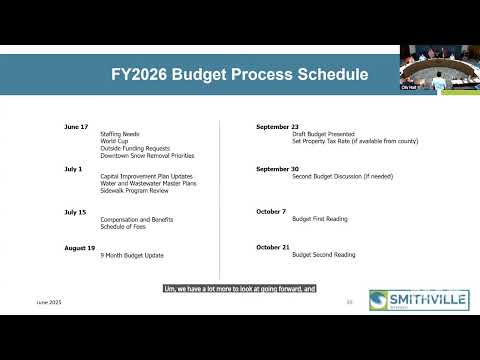
Staff gave a department‑by‑department preview of the 2026 budget process and timeline: June and July work sessions on staffing and capital requests, an August nine‑month update, a draft budget in September with the property‑tax rate set if available, and readings of the adopted budget in October. The presentation separates each department’s baseline operating budget (the cost to run the department as currently structured) from one‑time and new budget requests; departments have prioritized their capital and equipment requests internally.
Staff also summarized recent budget amendments (numbered 5–8 in the packet) and said Budget Amendment No. 9 would appear on the next regular session agenda. Departments that highlighted requests included streets (capital equipment and project design), parks (campground and building repairs), public safety (equipment), and administration (strategic planning and membership decisions).
Board members asked for comparative fee data, more detail on the vehicle‑replacement/VERF program, and additional breakdowns of outside agency requests. Staff said some capital projects have been pushed into 2026, reducing projected 2025 expenditures in funds such as water and wastewater.
No formal budget decisions were made at the work session; staff requested direction and feedback as they prepare formal budget documents and ordinances for later readings.