Get Full Government Meeting Transcripts, Videos, & Alerts Forever!
Get email alerts on the Education Levy topic
No spam. Unsubscribe anytime.
Council committee backs Families, Education, Preschool and Promise levy as amended after hours of debate and public comment
Summary
The Seattle City Council committee recommended passage of Council Bill 120981 on June 16, 2025, sending a renewed Families, Education, Preschool and Promise (FEP) levy — as amended — to full council. The meeting included extended public comment on school safety, restorative practices and food access, and votes on 12 amendments.
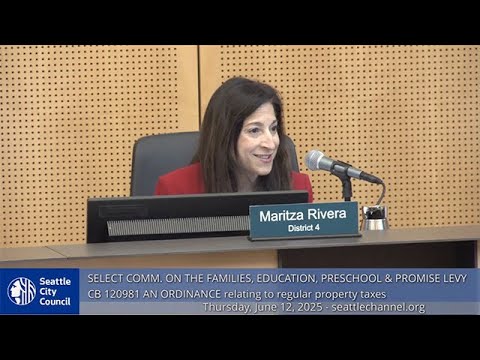
Chair Maritz Rivera of the Seattle City Council Families, Education, Preschool and Promise Committee moved Thursday to recommend passage of Council Bill 120981, a proposed property-tax levy renewal that would fund early learning, preschool, K–12 supports and Seattle Promise, and the committee voted to send the measure to full council on June 17 for final consideration.
The committee’s recommendation came after nearly three hours of public comment and detailed debate over 12 proposed amendments. Rivera framed the levy as an investment in children and families, saying the proposal "doubles affordable childcare slots" and "increases access across the city to our award-winning Seattle Preschool Program." She told colleagues the implementation process will include stakeholder engagement and called on members to focus on getting the measure to voters.
Why it matters: The levy would lift the city’s regular property-tax lid under RCW 84.55 and authorize additional taxes for up to six years to fund early learning, academic and health supports, school safety investments and college- and career-pathway programs. The committee’s action is a key procedural step that puts the measure on the council’s June 17 agenda for a final vote and, if approved, on the November ballot for Seattle voters to decide.
Public comment focused heavily on school safety. Dozens of speakers described divergent views from school communities about school resource officers — referred to in testimony and by the Seattle Public Schools (SPS) as school engagement officers, or SEOs — and urged the committee either to protect funding for SEOs where communities request them, or to prioritize restorative practices and non-punitive approaches.
Sarah Bremer, vice president of the Garfield High School PTSA, told the committee, "The Garfield High School PTSA board joins the majority of students, staff, school leadership, and families in urging the Seattle school board to withdraw the indefinite moratorium on school resource resource officers." Several other parents and former Garfield students echoed that position and asked the city not to adopt language that would discourage SEOs in individual school communities.
By contrast, multiple educators and restorative-practices coordinators urged the committee to fund and protect restorative practices work. Leanne Caspi, restorative practices program manager for Seattle Public Schools, said restorative work "didn't happen by chance" and credited continued levy funding for the positions that support the student-led and community-centered work. Testimony also included calls to expand food access and legal aid; Madeline Bistica, United Way of King County's food-security program manager, urged support for amendments to prioritize food access in school supports.
Amendments and votes at a glance: The committee considered 12 numbered amendments. Several were adopted; several failed. The committee’s final recommendation to pass Council Bill 120981 as amended will be sent to full council for the June 17 vote. Outcomes recorded in committee were:
- Amendment 1 (safety/implementation principles): Adopted as amended (Yes: 4; No: 2; Abstain: 2). Sponsor: Councilmember Mary Rink. The amendment clarifies that levy-funded safety investments should prioritize non-punitive approaches and addressing root causes of violence, and specifies equitable access for historically excluded communities. A verbal change substituting "historically excluded" for "historically underserved" was adopted before the final vote.
- Amendment 2 (early childhood — feasibility study on universal preschool + optional subsidized preschool subsidies): The committee split the motion. The first part, to add a feasibility study to explore universal citywide preschool, passed unanimously (8–0). The second part, to authorize subsidized preschool costs where SPP slots are unavailable, failed (Yes: 3; No: 5).
- Amendment 3 (add after‑school programming for at‑risk youth to service list): Adopted (committee recorded favorably; roll-call support recorded).
- Amendment 4 (explicitly add food assistance to K–12 health and safety services list): Adopted (8–0).
- Amendment 5 (add $2,000,000/year for Fresh Bucks; explicitly add food assistance and pay for school-based Fresh Bucks distribution): Failed (Yes: 3; No: 5). Sponsor: Councilmember Rink. The committee discussed whether Fresh Bucks, a city voucher program, belongs in a levy primarily focused on children; some members said Fresh Bucks targets adults and families and belongs in the general budget.
- Amendment 6 (restore full funding for environmental education and outdoor learning youth programs): Adopted (Yes: 5; No: 3). Sponsor: Councilmember Strauss. Supporters said the small program yields a high return through student field trips and volunteer engagement.
- Amendment 7 (add $1,000,000/year for restorative practices and explicitly list restorative practices among allowable services): Failed (4–4). Sponsor: Councilmember Rink. Debate centered on whether the levy or the subsequent implementation process should allocate dedicated dollars for restorative-practices staff.
- Amendment 8 (add $600,000/year to support vulnerable communities, including legal aid for immigrant families): Failed (Yes: 3; No: 5). Sponsor: Councilmember Rink. Supporters described legal-service needs for families facing federal immigration enforcement; some members said the levy already funds services that benefit immigrant children and worried about raising the levy amount.
- Amendment 9 (explicitly name public‑sector career pathways — e.g., Seattle Fire Department, Seattle Police Department — among college and career supports): Adopted (committee approved; final language retained a reference "including the trades"). Sponsor: Councilmember Strauss.
- Amendment 10 (add supports for foster‑care youth transition and career pathways in information‑technology coding languages): Adopted (8–0). Sponsor: Councilmember Saka.
- Amendment 11 (require written explanation when DEEL uses exceptions to competitive procurement when contracting with non‑public entities): Adopted after a reconsideration and re-vote (final: unanimous recorded support). Sponsor: Councilmember Kettle.
- Amendment 12 (clarify that the DEEL director may enter agreements with public entities beyond a listed set): Adopted (8–0). Sponsor: Councilmember Moore.
How the bill moved: Chair Maritz Rivera moved the committee recommendation to pass Council Bill 120981 as amended; the committee recorded an 8–0 recommendation in favor (eight members present and voting in the affirmative), and the measure was transmitted to the full council for the June 17 final vote.
What was and was not decided: The committee did not adopt several sponsor amendments that would have increased the levy’s projected revenue (Fresh Bucks expansion, restorative-practices earmark, expanded legal services, and one other smaller revenue addition). Multiple members repeatedly urged that detailed choices about program priorities — including where to place SEOs or restorative-practices staff — be resolved through DEEL’s implementation and stakeholder process rather than through line-item legislative mandates at the committee stage.
Quotes from the meeting: "If levy investments are changed to support adults and not kids, we would be completely altering the scope of the levy beyond its historical use," Chair Maritz Rivera said. Councilmember Rink, sponsor of several safety and food‑access amendments, said of the language she proposed in Amendment 1: "This amendment puts the safety of students first and protects them as places of learning and safe spaces that will not be interrupted by fear." Sarah Bremer, Garfield High School PTSA vice president, testified during public comment, "We stand in strong solidarity with Garfield students and staff and support this SEO position." Leanne Caspi, restorative practices program manager for Seattle Public Schools, said, "These moments didn't happen by chance. They're the result of intentional ongoing restorative practices work funded by the city through the current FEP levy and amendments."
Implementation and next steps: If the full council votes to place the measure on the November ballot and voters approve it, DEEL will lead the implementation plan, engage stakeholders (school district officials, parents, students, community-based providers and labor partners), and finalize program details and contracting. Several committee members emphasized that the implementation stage is where program-level tradeoffs and site‑specific decisions should be made.
Context and background: The ordinance references state law governing property-tax levies (chapter 84.55 RCW) and the exemption language under RCW 84.36.381. The proposed levy would create a designated fund, direct levy proceeds to described educational supports, and require an implementation and evaluation plan if voters approve the measure.
Ending: The committee’s recommendation advances a broad package that, as amended in committee, keeps the levy focused on early learning, preschool expansion, K–12 supports and college- and career-pathway investments while explicitly leaving many program-level choices to DEEL’s forthcoming stakeholder process. The bill will be considered by the full Seattle City Council on June 17; if the council approves placement on the ballot, voters will decide the measure in the November special election.