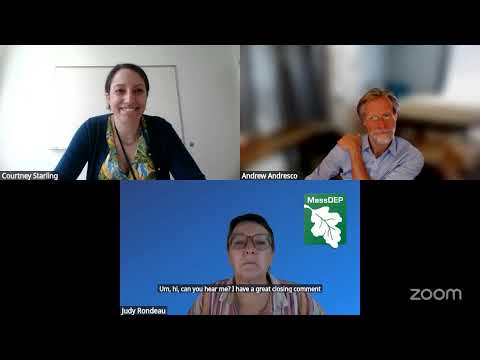
MassDEP bureau details grant programs and application tips for water projects
Loading...
Summary
Staff from the Massachusetts Department of Environmental Protection's Bureau of Water Resources outlined dozens of grant and loan programs, application rules and timelines for municipalities, water suppliers, tribes and nonprofits, and provided contacts for each program.
Staff from the Bureau of Water Resources at the Massachusetts Department of Environmental Protection on a virtual workshop outlined a suite of grant and loan opportunities for water-quality monitoring, stormwater and sewer work, drinking-water infrastructure and cybersecurity, and offered application guidance for prospective applicants.
The presentation matters because the grants support projects that affect drinking-water safety, wastewater and stormwater management, PFAS and other emerging-contaminant responses, and compliance with federal Clean Water Act and state water-management requirements.
Courtney Starling, a grant administrator for the bureau, began the session with general application guidance, emphasizing that applicants should follow submission instructions and evaluation criteria exactly. “The only things we score on are in the criteria,” Starling said, noting page limits, platform-specific submission methods and the need to use the right substitute W-9 when contracting with the state.
Program staff then summarized individual funding opportunities. Judy Rondo, nonpoint source outreach coordinator in the Watershed Planning Program, described a state-funded water-quality monitoring grant that supports volunteer and organized monitoring programs. “We have $200,000 available for fiscal year 25,” Rondo said; the program is open to federally recognized tribal nations and nonprofit organizations, does not require a matching contribution, and the bureau anticipates a request-for-proposals in fall 2025.
Rondo also introduced two federally funded Clean Water Act programs: the Section 604(b) water-quality management planning grant, which funds assessment and watershed planning and is open to all units of government (RFP expected fall 2025; funding level to be determined), and the Section 319 implementation grant, which funds on-the-ground projects to restore listed waters (anticipated combined FY2025–FY2026 RFP in spring 2026; nonfederal match generally 40%, though staff said waivers are being considered).
Other programs described included:
- MS4 municipal assistance grant: coalition-based grants to help municipalities meet MS4 permit obligations; last year’s round included about $250,000 and staff expect a similar schedule (RFR this summer or early fall; state funding level for FY25 not yet finalized).
- Nitrogen-sensitive-area (NRNSA) grants for Cape Cod watershed planning: last year’s allocation was about $825,000; RFR expected summer or early fall.
- Water Management Act grants for public water suppliers with Water Management Act permits (projects such as drought planning, yield studies and PFAS planning); typical match requirement is 20%; last year about $1 million was available.
- Ipswich River Basin water-supply and PFAS grant: limited to suppliers drawing from the Ipswich River Basin and focused on PFAS issues and flow protection; staff said this RFR typically posts later in the fall.
- M36 water-audit program: top-down or bottom-up audits of water systems to detect loss; the program posts a request for interest, hires a vendor and typically conducts audits January–May.
- Boston Harbor Water Transportation Trust Fund (Chapter 91) grants: irregular rounds funded by license and mitigation monies; the last round awarded more than $2.5 million to 10 organizations; match encouraged but not required.
- Emerging Contaminants in Small or Disadvantaged Communities (ECSDC) grant: program coordinator Andrew Andreescu said the grant supports planning, design and long-term solutions for emerging contaminants (including PFAS and manganese). Eligible applicants are community public water systems or nonprofit systems in the Clean Water Trust disadvantaged community program or serving fewer than 10,000 people. The ECSDC grant is noncompetitive, has no match requirement, and uses a rolling-entry process that begins with a needs-assessment survey sent to MassDEP’s Drinking Water Program (program.director-dwp@mass.gov, subject line: “ECSDC grant” plus the PWS ID).
- Small, Underserved, and Disadvantaged Communities (SUDC) drinking-water funding: staff said the bureau was notified of new EPA funds three weeks before the presentation and must submit a work plan by July 7; the program targets political subdivisions lacking household drinking-water/wastewater services or systems that violate national primary drinking-water standards. Staff advised systems to contact Janine Bishop or their regional MassDEP office for eligibility checks.
- Engineering-and-design planning assistance: MassDEP posted an RFQ on COMMBUYS and selected two firms (CEI and Fuss & O’Neill) to provide engineering and design planning help to small systems preparing projects for SRF loans and grants.
- Cybersecurity improvement grants: Andrew Andreescu said MassDEP launched a $2,000,000 program targeted at small and disadvantaged communities; eligible systems serving fewer than 10,000 people may receive up to $50,000 for operational-technology improvements. Staff said applications are accepted on a first-come, first-served basis and 25 public water systems have already applied.
Staff also reviewed State Revolving Fund (SRF) entry points and planning loans, sewer-overflow and stormwater-reuse planning grants (up to $250,000 for planning/design in small or disadvantaged communities), community septic-management assistance, lead-service-line planning support, and related grant programs housed in the Executive Office of Energy and Environmental Affairs (EEA). They urged prospective applicants to use COMMBUYS and EEA’s new GMS portal for notices and to maintain a mym ass.gov login.
On PFAS sampling specifically, Bob Smith of the Watershed Planning Program said the water-quality monitoring grant is a monitoring-focused program and that PFAS has not historically been a priority analyte. “PFAS has not been one of those,” Smith said, but he added that bundling PFAS sampling with priority analytes can improve a proposal’s competitiveness.
Staff answered applicant questions about funding sources (state vs. federal), the potential impact of anticipated federal SRF cuts (federal programs are uncertain; state-funded programs are likely to proceed), eligibility for sewer-overflow assistance, and whether private homeowners can receive direct PFAS-filter funding (MassDEP does not typically fund homeowners directly; some pass-through arrangements via local boards of health exist). Several staff encouraged applicants who had detailed or jurisdiction-specific questions to email staff or request follow-up meetings.
Courtney Starling closed by encouraging applicants to use the provided program contacts and to email questions to andrew.andresco@mass.gov and courtney.starling@mass.gov for follow-up. Staff said many grant timelines are still contingent on budget outcomes, but multiple RFRs are anticipated in summer–fall 2025 and some federal RFPs are expected in late 2025–spring 2026.
For program contacts and specific application instructions, staff repeatedly recommended COMMBUYS listings and the links on MassDEP slides; they also offered direct contacts for the programs described.