Get Full Government Meeting Transcripts, Videos, & Alerts Forever!
Get email alerts on the District Budget topic
No spam. Unsubscribe anytime.
Mesa County Valley School District No. 51 presents tight 2025-26 budget; revenues fall short of projected expenditures
Summary
District staff told the board the proposed 2025-26 budget shows modest state revenue growth and larger contract-driven cost increases, leaving expenditures slightly higher than expected revenues; two public hearings are scheduled before the June 17 adoption.
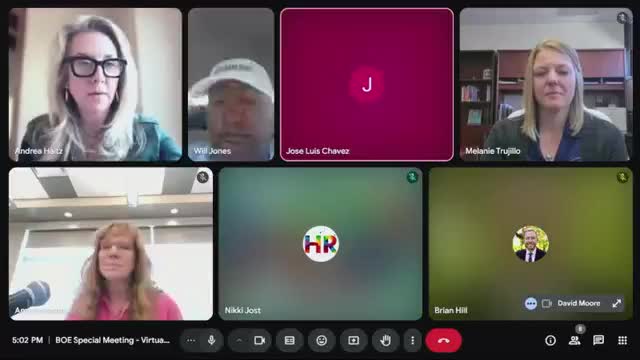
Mesa County Valley School District No. 51 officials presented the proposed 2025-26 budget at a special meeting, saying expected revenues will rise only modestly while required contractual costs will push total expenditures above anticipated income.
Melanie, the district's budget presenter, told the board the district expects a roughly 0.5% increase in state funding ("a little over a million dollars"), reflecting changes in student-count averaging and continuing declining enrollment. She said the district anticipates about $1.5 million in additional interest and investment earnings and a total of $2.9 million in additional revenue for next year.
The nut graf: The gap remains because required cost increases — notably higher costs for the district's self-insured medical plan and for student transportation — account for about $4.6 million of roughly $6.9 million in contractual or required expenditure additions, Melanie said. With those and other pressures, the proposed base budget "represents a base budget, with expected expenditures still slightly exceeding our expected revenues," she said.
Melanie reviewed changes since a more comprehensive update the prior week, including one additional part-time central-office position reduction that increased expected savings by $24,000. She said most salary increases were not included in the proposed base budget because collective-bargaining negotiations with MVEA remain pending; only the district's increased contribution to employee health premiums is reflected.
Beyond the general fund, staff flagged pressures in several other funds. Fund 17 includes the district's 2024 mill-levy override and the 2017 levy; staff plan to use some state mill-levy match revenues as a one-time source to refresh about 3,300 Chromebooks. Fund 19, the preschool fund, will house the district's universal preschool program and will use the Nisley Building as an early childhood center; staff plan for 901 preschoolers and said two fewer classrooms will be needed next year. Fund 21 (nutrition services) is operating in the third year of the state program Healthy School Meals for All; Melanie said that program is underfunded, that funding is guaranteed only through midyear, and that the district is budgeting as if ballot measures in November will sustain the program. Fund 62 reflects higher medical-insurance premiums that will take effect Jan. 1 and affect employees' December paychecks.
Melanie outlined next steps: the budget documents will be posted to the district transparency webpage and printed copies will be available at the district office, two public budget hearings will be held at the start of June, and the board is scheduled to consider final adoption on June 17.
Discussion at the meeting was brief; Directors Chavez, Heights and Jones had no additional questions after the presentation. No formal action was taken on the budget at the special meeting; the item was a presentation and public-review scheduling step in the district's budget process.
The district packet and the board's prior week's, more-detailed update are available on the district website for residents seeking line-by-line detail.