Get Full Government Meeting Transcripts, Videos, & Alerts Forever!
Get email alerts on the Affordable Housing topic
No spam. Unsubscribe anytime.
Affordable Housing Trust recommends keeping 10% accessibility minimum; CPC members caution about raising baseline
Summary
The Worcester Affordable Housing Trust Fund recommended the Community Preservation Committee retain a 10% minimum for accessible units (one-unit floor) rather than raising the baseline to 15% or two units, citing financial feasibility concerns for smaller developers and the effect of limited CPA funding.
The Worcester Affordable Housing Trust Fund urged the Community Preservation Committee on Sept. 16 to maintain a minimum requirement of 10% accessible units with a one-unit floor for projects that use Trust funding, rather than increasing the baseline to 15% or two accessible units.
Jeanette (Jen) [last name not specified in transcript], manager of the Affordable Housing Trust Fund, told the committee the Trust has required a minimum of 10% accessible units (with a one-unit floor) since its first round of funding, and that "this standard already doubles what the state building code requires." She said the Trust pairs the baseline requirement with bonus funding and scoring incentives to encourage projects that exceed the minimum.
Jeanette said the Trust's approach had produced measurable results: one currently funded project is delivering six of nine units as fully accessible, and the Trust is supporting 61 accessible units across its American Rescue Plan Act-funded projects, "more than double the 27 that would have been required under the state building code," she said.
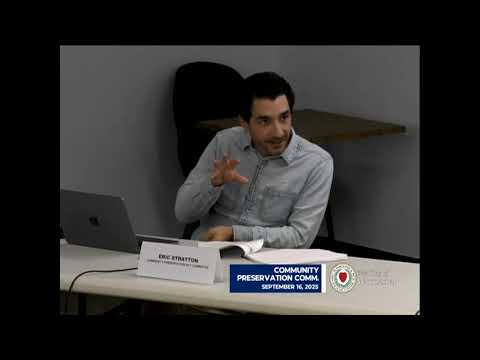
The Trust recommended keeping the minimum at 10% because raising it without additional subsidy "can make projects financially infeasible for smaller scale and emerging developers, effectively concentrating funding among only the largest, best capitalized firms," Jeanette said. Committee members agreed that the goal of increasing accessible units aligns with CPC priorities but expressed concern that a higher baseline could deter smaller applicants. Eric Stratton, who originally moved for the higher threshold, said he supported the Trust's recommendation for the current round but remains interested in pushing accessibility in future rounds when more funding or incentives are available.
Committee members also discussed enforcement and monitoring: Jeanette said Trust-funded projects follow a reimbursement model with monthly contractor requisitions, site visits and documentation to confirm work completion prior to disbursement. The Trust offers bonus funds and scoring incentives to drive higher accessibility outcomes while seeking to maintain a diverse pool of applicants.
The committee did not change the CPC's guidance at the meeting; members asked staff to continue coordinating with the Trust and consider additional outreach and technical assistance for applicants.