Get Full Government Meeting Transcripts, Videos, & Alerts Forever!
Get email alerts on the Flag Policy topic
No spam. Unsubscribe anytime.
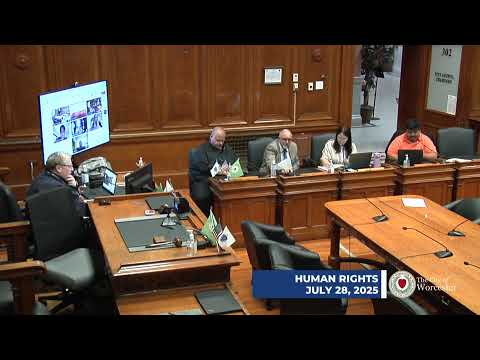
HRC asks city manager for status of government-speech flag policy and requests EO DEI research on flag-duration rules
Summary
After discord over recent cultural flag raisings, the commission unanimously asked the city manager for an update on the HRC's prior recommendation to adopt a government-speech flag policy and asked staff to research appropriate durations for flag displays.
The Worcester Human Rights Commission discussed the city’s cultural-flag program July 26 and unanimously approved two requests: one asking the city manager to report on the status of the commission’s prior recommendation that the city adopt a government-speech model for the official flagpole; the other asking the Executive Office of DEI (EO DEI) to research and recommend what the appropriate duration should be for a community flag to fly at City Hall.
Background: Commissioners reviewed a recent U.S. Supreme Court ruling involving Boston’s flag program and noted legal constraints on municipal flag policies. Staff described the city’s current practice as a hybrid: residents and organizations may request a flag-raising online; approved flags are typically up for one business day under existing administrative practice. Staff said logistical constraints (facilities scheduling, staff availability) and a small cost for weekend handling (staffing/expense estimates between roughly $200 and $300 per weekend request) shape how requests are scheduled.
Why this matters: Commissioners said the practical outcome of the current policy — that a flag requested for a Friday may remain physically up through the weekend if no subsequent request displaces it — has produced frustration from groups seeking to align flag-raisings with community events (for example, Juneteenth celebrations and Pride events). Some organizers chose alternate venues after disagreement with City Hall scheduling. Commissioners worried that a vague or inconsistent policy invites disputes and said they want a clear, equitable standard that recognizes both legal constraints and community needs.
What the commission did: On roll-call votes the commission (a) asked the city manager to report on where the HRC’s recommendation to adopt a government-speech policy stands, and (b) requested that EO DEI develop research and options on flag-duration rules (how long a community flag should remain displayed). Both motions passed unanimously.
Discussion highlights: Staff said the city’s current published requests page lists upcoming approved flag raisings; staff will assemble historical data for commissioners to review. Commissioners suggested options such as a predetermined list of government-recognized flags, a policy allowing multiple related flags (for example alternate versions of a cultural flag), a proclamation process for certain flags, or a schedule that aligns flags with proximate community events while avoiding indefinite displays. Commissioners also asked staff to research other municipalities’ approaches and the legal parameters described in recent court decisions.
Ending: EO DEI staff agreed to produce background research and a proposed approach for flag duration and scheduling so the commission can consider recommendations to the city manager.