Get Full Government Meeting Transcripts, Videos, & Alerts Forever!
Get email alerts on the External Complaint Process topic
No spam. Unsubscribe anytime.
Human Rights Commission reviews revised complaint form; seeks clarity on whether city will investigate or refer to MCAD
Summary
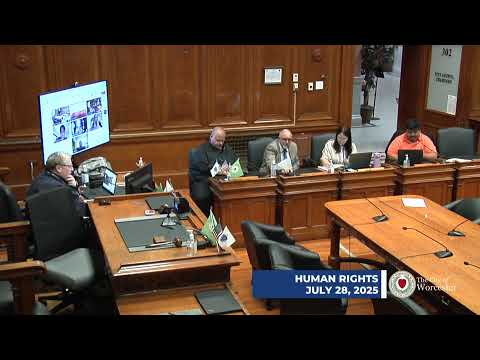
The Worcester Human Rights Commission reviewed a law-department–approved civil-rights complaint form July 26 and unanimously requested that the city manager clarify whether the city’s equity office will investigate complaints in-house or primarily refer them to agencies such as MCAD.
The Worcester Human Rights Commission examined a revised external civil-rights complaint form July 26 and asked city leadership for clarification on whether the city’s Executive Office of Diversity, Equity and Inclusion (EO DEI) will investigate complaints in-house or primarily refer them to outside agencies such as the Massachusetts Commission Against Discrimination (MCAD).
Director Patricia Lafore told commissioners the law department approved a revised complaint form that differs from an earlier draft the commission had supported. Key law-department requirements on the approved form, Lafore said, include: no acceptance of anonymous complaints; a 300-day statute-of-limitations consistent with MCAD practice; and a prohibition on listing a separate “WPD” category on the public form. The law department also approved allowing a complaint to be filed by a third party only when a legally recognized relationship (for example, a guardian of a minor) exists.
Why this matters: commissioners expressed concerns that many discrimination complaints in Massachusetts are processed primarily by MCAD and that MCAD’s backlog often means long waits for a final resolution. Commissioners said they had been led to expect that the city’s new equity office would increase local investigative capacity rather than acting mainly as a referral point. Several commissioners requested explicit confirmation of the city manager’s intent.
What the commission voted: In two related motions the commission unanimously approved: (1) a request that the city manager clarify whether the complaint program will act primarily as a referral service to standing entities (primarily MCAD) or whether the city intends to investigate complaints in-house using EO DEI staff; and (2) a request for a proposal from the city manager on how the external complaint process will be rolled out to the community, including communications and outreach. Both motions passed on roll-call votes with all present members voting in the affirmative.
Additional details: Lafore said staff will draft additional procedural documents and ancillary forms (withdrawal forms, motion forms) to mirror processes used by agencies such as MCAD and the EEOC. She said draft rules of procedure have been completed and were under review by the chief equity officer and would next go to the law department. Lafore also explained the city operates a bias/excessive-force hotline that is staffed during business hours by two investigators and rotating staff in the Human Rights office; initially that hotline saw a large number of calls after the DOJ report was released, then the volume leveled off.
Commissioners asked for a report back from the city manager’s office and for the commission to be included in planning the outreach and communications strategy for the external complaint process so residents know how and where to bring allegations. Commissioners also asked that any complaint packet the city receives be searchable and that the HRC receive the materials it needs to perform oversight.
Attribution: Patricia Lafore described the law department’s requirements and the staff work underway. Several commissioners — including Robert Bellotta, Randy Feldman and Guillermo Creamer Jr. — made and seconded the motions requesting clarification and a rollout plan. References to MCAD, EEOC and HUD were made during the discussion, as reflected in the transcript.
Ending: The commission will forward the motions to the city manager and asked staff to report back with the city manager’s clarification and a communication plan for public rollout once the rules and ancillary forms are complete.