Get Full Government Meeting Transcripts, Videos, & Alerts Forever!
Get email alerts on the Water Rights topic
No spam. Unsubscribe anytime.
Yakima County staff to draft resolution to negotiate sale of county water rights amid Ecology rule shift
Summary
County staff briefed commissioners on a proposed resolution to authorize negotiation of fee‑simple sales of county-owned water rights to support a 96‑bed farmworker housing project and to help establish a county water bank; commissioners directed staff to bring the resolution forward and pursue legislative and administrative fixes.
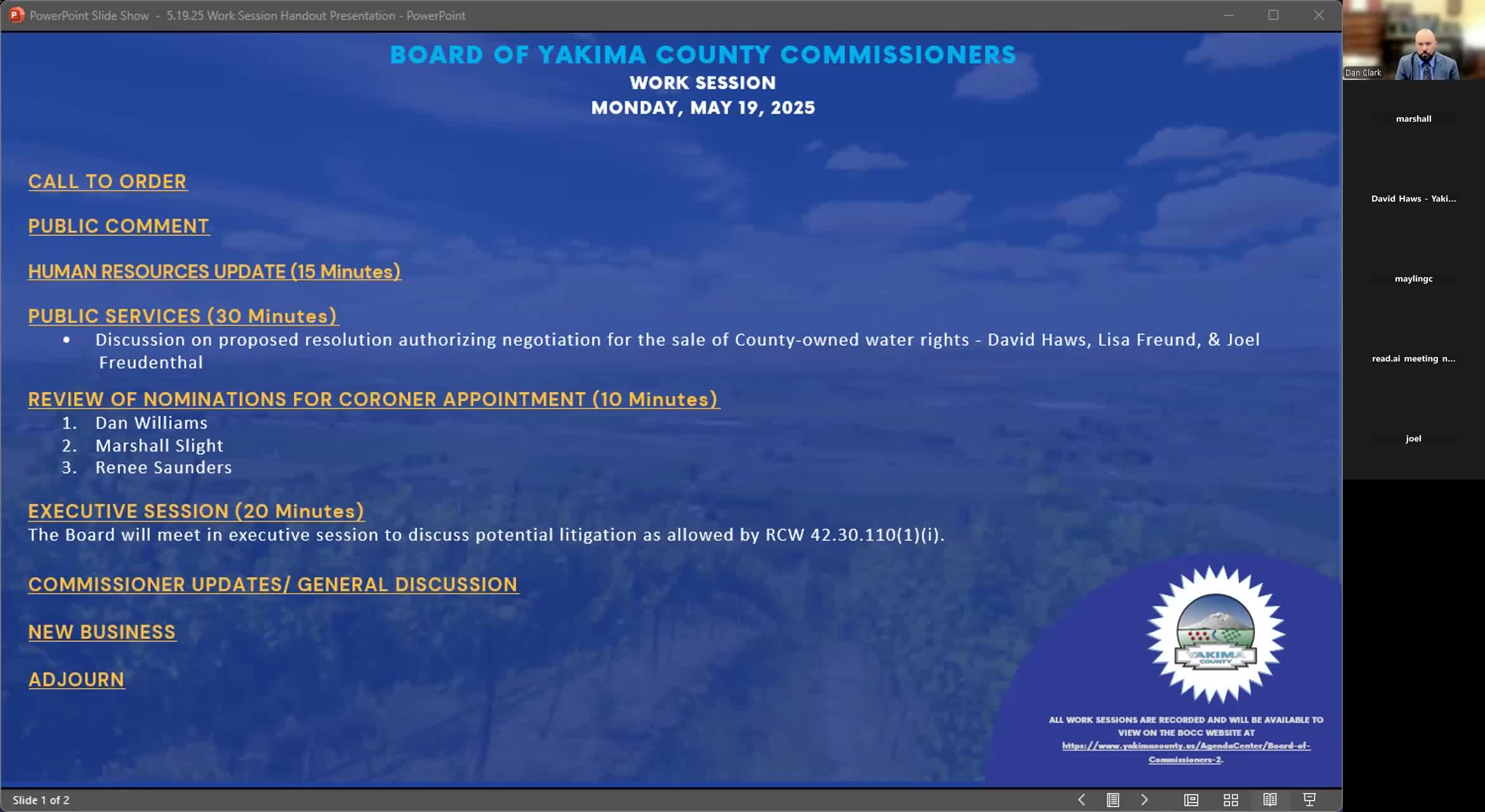
Yakima County commissioners on Monday reviewed a proposed resolution that would authorize county staff to negotiate the sale of a portion of county-owned water rights to qualifying applicants, a step tied to a requested purchase by a grower pursuing farmworker housing.
The resolution, drafted by county public‑services staff, would let staff negotiate fee‑simple sales of county water rights while requiring the county's existing real property management policy — including public notice and a public hearing — be completed before any final sale.
County staff said the item stems from a recent change in how the Washington State Department of Ecology is interpreting the classification of new water uses. David (public services staff) told commissioners that Ecology’s interpretation now treats some small water uses — notably new H‑2A farmworker housing and certain small local‑government facilities — as municipal uses even when they fall below traditional thresholds such as 5,000 gallons per day. He said that change has created new regulatory hurdles for projects that previously relied on exempt wells.
"This transaction ... could serve as a test case that would help us develop this part of the county water‑banking strategy," David said, describing the proposed sale as consistent with long‑term use planning and workforce housing support. Joel (public‑services staff) added that the issue also intersects with state health‑code classifications of Group A and Group B water systems.
Staff described one specific request from a grower seeking water rights to support a proposed 96‑bed farmworker housing project in the unincorporated county. Because Ecology signaled the new housing would be treated as a municipal use, the grower was told it must secure municipal water rights to proceed; county staff said the grower approached Yakima County because the county owns senior water rights intended to support development aligned with the comprehensive plan.
Commissioners expressed support for using county water rights to enable such development while noting open questions about the regulatory burden and timing. Commissioner Lindy asked what additional regulatory hurdles a municipal classification would impose; staff replied that the water‑bank framework is meant to address those burdens and that Ecology is reviewing the county's water‑bank application. Commissioners and staff said they also plan to pursue a legislative change to exclude farmworker housing from being classified as municipal use.
County staff said Ecology has had the county's water‑bank application for about nine months and that Ecology paused some water‑bank application work during the recent legislative session pending budget action. Staff said they expect Ecology to resume review once the governor signs the budget; commissioners asked staff to follow up with Ecology promptly.
No formal sale was approved Monday. Commissioners directed staff to bring the drafted resolution forward for placement on an upcoming agenda and to continue pursuing administrative and legislative steps to clarify the treatment of farmworker housing in Ecology rules.
Why it matters: The county holds senior water rights and is establishing a water bank as a tool to manage and, where appropriate, transfer water rights to support housing and rural development. Ecology’s reinterpretation affects how some agricultural employers provide housing for seasonal workers and could require growers to obtain different water rights or approvals.