Get Full Government Meeting Transcripts, Videos, & Alerts Forever!
Get email alerts on the Broadband topic
No spam. Unsubscribe anytime.
Snohomish County updates ARPA-funded broadband buildout, BEAD applications and digital equity work
Summary
County senior policy adviser Jason Bierman told the council on Jan. 7 that ARPA-funded projects and federal BEAD/NTIA applications aim to extend service to roughly 13,000 locations countywide, while digital equity efforts seek to help low-income and non-English-speaking residents connect.
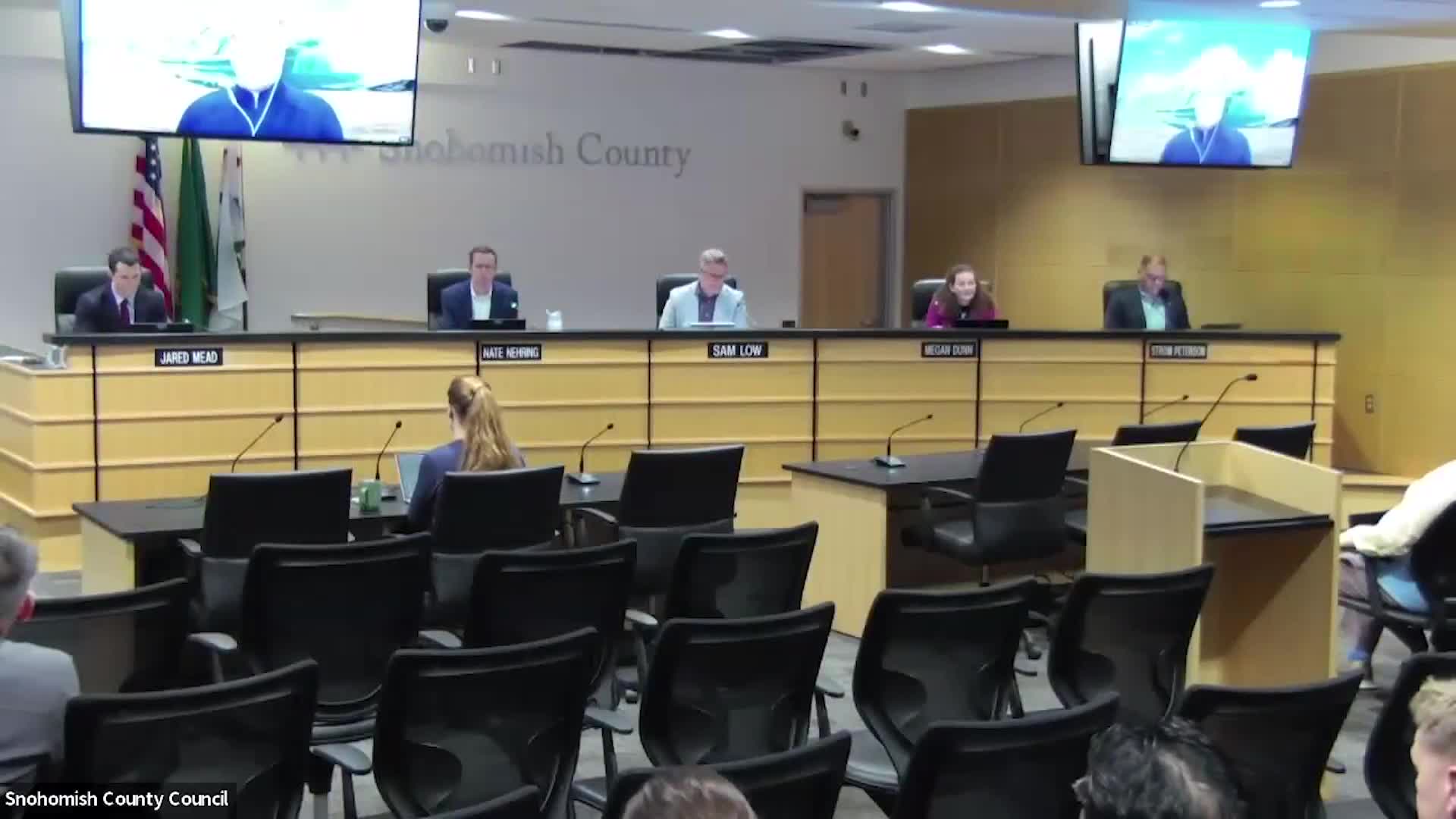
Snohomish County senior policy adviser Jason Bierman briefed the County Council on Jan. 7 in the Jackson Boardroom and by remote connection on the county’s ARPA-funded broadband projects, federal BEAD/NTIA application rounds and a digital equity partnership with Sno-Isle Libraries.
Bierman said the county is pursuing three ARPA-funded infrastructure projects and participating in state BEAD planning that together represent roughly 11 county project areas and nearly 13,000 serviceable locations. "We're estimating about 4,500 locations in the Stilly Valley," Bierman said of the largest project, which he described as funded from the state's ARPA allocation and contracted with Ziply to serve locations from Arlington east to Darrington.
The nut of the presentation: the county’s ARPA money is being used for targeted buildouts and a digital-equity program while the state and federal BEAD program will determine larger-area allocations. Bierman said the county has a mix of projects that prioritize unserved and underserved rural areas, community anchor institutions and digital equity.
Key details Bierman provided include: - SR 530 project: Funded through the state's ARPA allocation, estimated cost about $16,700,000, serving about 4,500 locations from Arlington east to Darrington. Contract completion in the agreement is October 2025; the county’s Ziply partner expressed optimism about finishing earlier. - Index project: Funded with the county’s ARPA appropriation, estimated to serve about 1,000 locations at roughly $2,700,000. Contract completion is stated as September 2026, with contractor activity (a field “sidewalk” verification) already underway. - Verlot/Granite Falls project: County-funded at about $1,600,000, intended to address public-safety communications gaps in recreation and hiking areas; contract completion is also September 2026 in the contract, with optimistic construction-season timelines possible. - Digital equity partnership: The county allocated about $1,500,000 of ARPA funds to Sno-Isle Libraries to buy devices, hotspots and provide digital navigation and training aimed at households without equipment, service or digital skills. Bierman said device checkouts have increased since the federal Affordable Connectivity Program (ACP) ended. - Planning study: The county contracted CBG for an in-depth broadband gap analysis; Bierman said the final draft (about 350 pages with attachments) was received and an executive summary will be prepared for council.
Bierman also summarized the state’s BEAD/NTIA process. He said Washington received roughly $1.2 billion for broadband expansion, but state and local stakeholders estimate full statewide fiber buildout could cost several billion dollars; that shortfall is shaping prioritization. The county has 11 BEAD project areas on file and is working to inform the state’s selection criteria, particularly for future rounds where Bierman said local input may be reduced. He also said the governor’s proposed budget includes $230 million to help offset local match requirements for BEAD projects.
On technology choices, Bierman said the county is pushing state officials to allow “hybrid” solutions such as satellite or fixed wireless for very remote small-cluster locations where running fiber would be disproportionately expensive (he cited an example of a 12-mile fiber run to serve about 20 locations). He said this advocacy aims to reduce per-location costs and increase coverage.
Bierman warned of an affordability gap caused by the end of the federal Affordable Connectivity Program: "When the Affordable Connectivity Program ended in May, we had about 25,000 subscribers who actually lost that benefit," he said, and county staff estimate tens of thousands of eligible households did not enroll before the program ended. He described the Sno-Isle device program as helpful but small relative to that loss, and noted the county, Sno-Isle and Island County jointly applied for a nationally competitive $10 million digital-equity grant to expand device distribution, workforce development and community digital access points (including at the Mariner Library).
Bierman closed by asking the council for support on outreach and letters of local coordination for BEAD round 1 applicants. He said round 1 closes at the end of the month and the state’s review panel will have 60 days to announce selections. The county plans public outreach, a GIS story map and coordination with Ziply and other partners to encourage sign-ups once infrastructure is available.
The presentation drew brief council thanks and a few procedural questions; council members asked about advocacy for restoring affordability programs and about timing for BEAD announcements. Bierman said staff would follow up with template letters for applicants and expected to know by the end of the week which providers asked for formal letters of support.