Get Full Government Meeting Transcripts, Videos, & Alerts Forever!
Get email alerts on the State Legislative Recap topic
No spam. Unsubscribe anytime.
State lawmakers brief San Juan County on tough budget, health, housing and salmon priorities
Summary
Three state legislators gave the county a post-session briefing, outlining a mix of budget cuts and new revenue to close a multi‑billion dollar gap, health‑care and housing work, salmon recovery plans and personnel appointments.
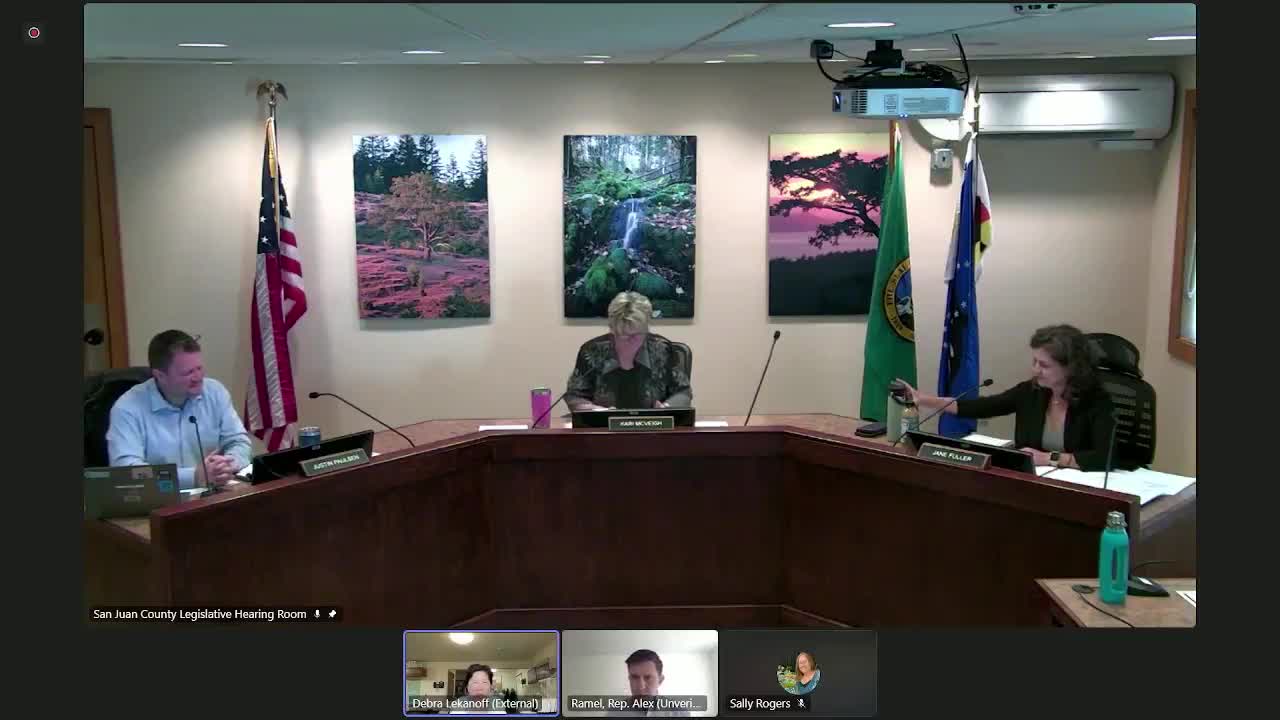
Representative Deborah Lekanoff, Representative Bridal and Senator Leavitt briefed the San Juan County Council on the 2025 legislative session on Tuesday, June 10, describing a budget made up of both cuts and new revenue and outlining policy work on health care, housing, salmon recovery and environmental rules.
The legislators said the 2025-29 budget addresses what they described as roughly a $14 billion shortfall over four years. They said lawmakers paired about $8 billion in new revenue with about $6 billion in cuts spread across programs and timelines, and prioritized avoiding cuts that would immediately threaten life and health services.
Rep. Lekanoff, who said she served as vice chair of the House health-care committee during the session, described work to clarify the role of the state insurance commissioner and efforts to protect and invest in Medicaid services. She also announced a state appointment: Dennis Worsham as the state Department of Health secretary, a public‑health official she described as experienced in chronic‑disease and communicable‑disease programs.
Housing was a recurring theme. Rep. Bridal and Sen. Leavitt described new measures intended to boost housing supply, including changes to unit‑lot subdivisions to facilitate middle‑housing ownership and a producer‑responsibility law to shore up recycling markets and reduce local hauling costs. Rep. Bridal said the session produced many housing supply bills and that he and colleagues followed legislation aimed at removing barriers to housing production.
On salmon and environment issues, Rep. Lekanoff said the delegation protected salmon‑recovery funding and will work on riparian buffer legislation and culvert investments in coordination with transportation and executive agencies. She announced a bipartisan statewide salmon tour to assess recovery priorities and stressed collaboration with tribes.
Council members thanked the delegation for state funding they said benefited local projects — including funding for ferry operations, a courthouse rehabilitation allocation described by the county as $1.5 million and support for school districts — and raised county concerns including PFAS guidance (Senate Bill 5033 mentioned by Rep. Lekanoff) and the local impacts of federal cuts to early‑childhood programs.
Council members and the delegation discussed levy lid authority for local governments (an increase the delegation said the governor had signaled he would veto this year) and the need to monitor the financial effects of a recent state Supreme Court public‑defense ruling.
The delegation and county officials agreed to continue working on transportation, salmon recovery and housing issues, and to keep county staff and elected leaders informed as statutes and administrative guidance develop.
Ending: Legislators and council members said they would continue consultations through the summer and into the next session to track implementation details and to follow up on county priorities such as ferry funding and education formulas.