
Pierce County narrows Fox Island bridge options; officials say permitting and funding will drive next steps
Get AI-powered insights, summaries, and transcripts
Subscribe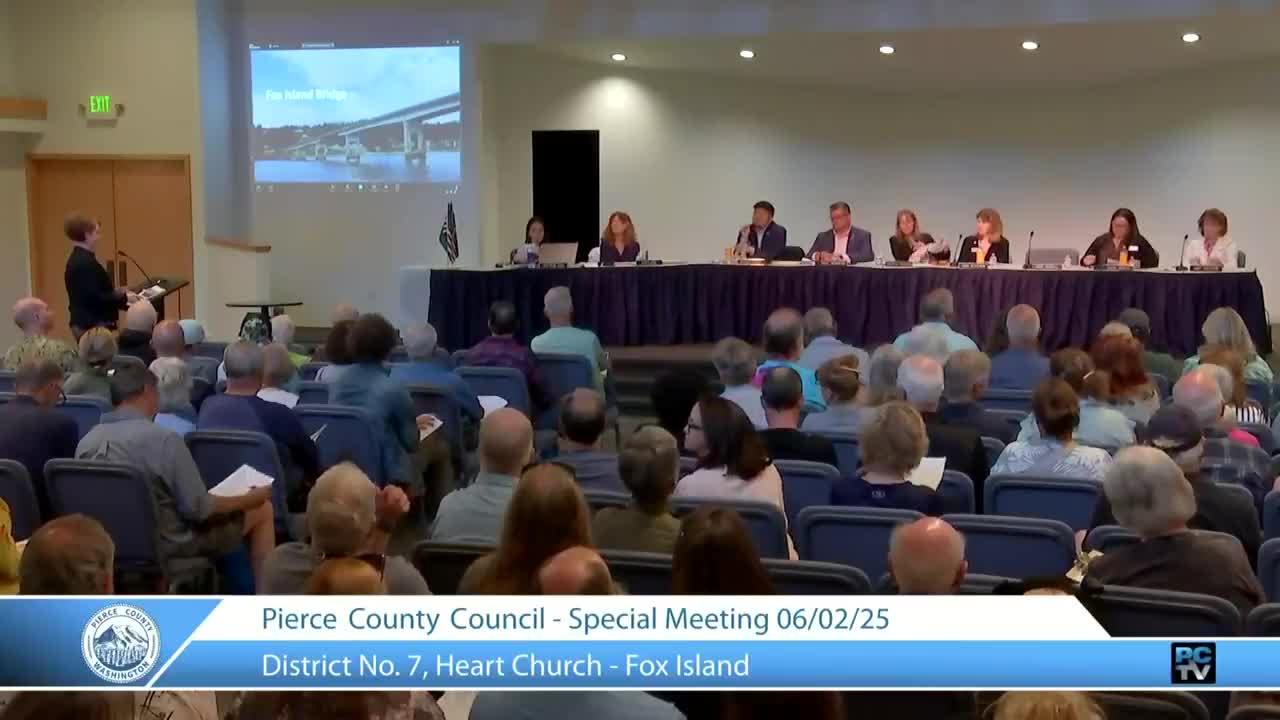
Summary
Pierce County engineers on Monday told residents gathered at the Fox Island in‑district meeting that they have narrowed a long list of possible fixes for the failing Fox Island Bridge to three options and will begin environmental permitting next year, with funding decisions to follow.
Pierce County engineers on Monday told residents gathered at the Fox Island in‑district meeting that they have narrowed a long list of possible fixes for the failing Fox Island Bridge to three options and will begin environmental permitting next year, with funding decisions to follow.
Leticia Neal, Pierce County engineer, said preliminary study work eliminated options such as rehabilitation, floating bridges, tunnels and ferry service and left two 2,000‑foot bridge alignments (one east and one west of the existing structure) and a longer roughly 3,000‑foot western alignment as the alternatives being carried forward for environmental review. “We have defined our purpose and need for the project,” Neal said, and the county will compare these alternatives through the SEPA/permitting process beginning in 2026.
The choice of a final alternative will be driven by permitting and property impacts, Neal and other county staff said. Neal warned that some designs shown in early analyses are intentionally conservative to avoid having to return to regulators for additional studies. “When we move forward with environmental permitting, it’s taking a look at a certain project area and all the things that are involved in this project,” she said. “You don’t want to have to go back and do additional studies.”
Why this matters: the bridge is the only land access to Fox Island. County staff stressed they must keep the existing structure safe and operable while pursuing a long‑term replacement and that permitting in a sensitive marine environment will strongly influence which alternatives are feasible.
What the county reported - Past and near‑term investments: Neal said the county has spent roughly $160,000–$220,000 on inspections since 2012, about $600,000 on bearing repairs and roughly $2.3 million on prior type‑size‑and‑location and financial studies. County staff told the audience they have programmed about $18 million in repairs over the next six years and plan to spend roughly $1 million on environmental phase work moving forward. - Timeline: County staff said they expect to start formal environmental permitting in 2026, which could take up to two years; a preferred alternative and design/property acquisition work could follow in 2028; construction might begin as early as 2030 but will depend on funding and permitting. - Sea‑level rise and federal rules: the county is using a conservative 3.1‑foot sea‑level rise assumption over a 75‑year design life to preserve eligibility for certain grants and to address drainage and structure needs, Neal said. She also said the federal lead agency (U.S. DOT) will make any final determination on whether nearby features such as the small boat launch trigger Section 4(f) historic/park protections.
Funding and authority County staff said no decisions have been made on how to pay for a replacement and that multiple funding sources will likely be required. Neal summarized options and who controls them: federal and state grants (decisions by state/federal agencies), general county funds and county road funds (county council), tolling (county council subject to State Transportation Commission approval), property tax levies (public vote), transportation‑benefit district tools including a motor vehicle tab fee (council or TBD; some measures require voter approval), sales tax or other voter measures, and road improvement districts (county). “I do not believe there is any one single funding source that can cover it,” Neal said.
Council member Robin Denson, who hosted the meeting, told residents she has heard a consistent preference for “the least expensive option” with minimum private‑property impacts: “The grand majority have relayed to me that you want the least expensive option…you want a good safe bridge…with the least impact on private property.”
Public reaction and elected officials Speakers from the community urged a range of approaches. John Olsen, a long‑time Fox Island resident, said the countywide taxpayer base should share the cost: “I think this project should have no different treatment.” Several speakers urged the council to rule out tolls; Daniel White told the council “tolls should be a total nonstarter.” Senator Krishnadassan and Representative Addison Richards both attended and said they would press for state assistance; Richards noted legislative work to speed permitting.
What the county will do next Neal said staff will finalize the type‑size‑location (TS&L) package by the end of the year and begin permitting work in 2026; the permitting phase will include public engagement, consultation with tribes and resource agencies, and iterative environmental analysis that could eliminate alternatives. County staff said they will update cost estimates and funding analyses as the project’s scope becomes clearer.
Unresolved questions County staff said they have not identified specific parcels that might require acquisition or eminent domain; those determinations and any notifications would follow property‑by‑property studies and council action. Neal also said the county continues to apply for bridge repair grants and recently submitted several local bridge program applications for girder repairs, bearing replacements and paint work. She cautioned that grant competitions are highly competitive and that being more “shovel ready” improves competitiveness.
Ending note: county officials urged residents to stay engaged during the environmental review and funding conversations. Neal said community feedback will be sought early in 2026 as permitting work begins.