Get Full Government Meeting Transcripts, Videos, & Alerts Forever!
Get email alerts on the Board Compensation topic
No spam. Unsubscribe anytime.
Pierce County council approves stipend program to reduce financial barriers for low‑income board members
Summary
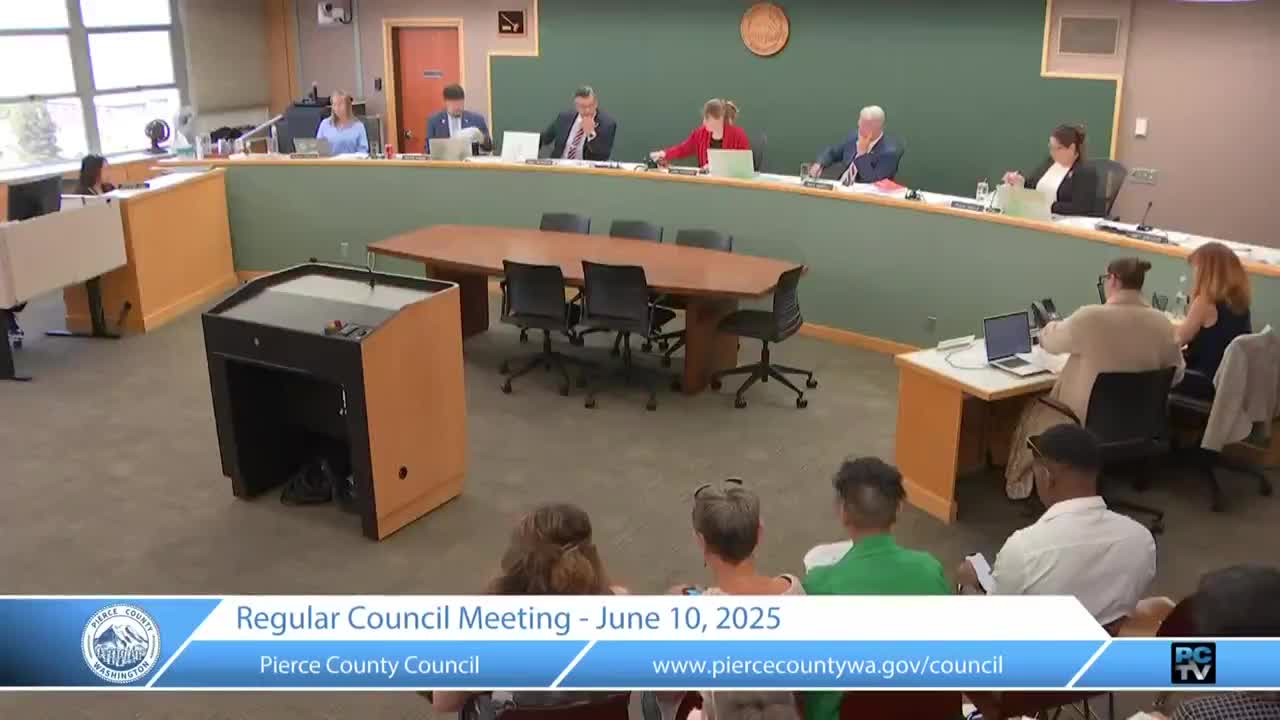
The Pierce County Council on June 10 adopted an ordinance creating a new Pierce County Code chapter to allow limited daily stipends for low‑income individuals appointed to county boards, commissions and committees, effective Sept. 1, 2025, with reporting requirements for the finance department.
Pierce County Council on Tuesday adopted an ordinance to create a new county code chapter that allows limited daily stipends and expense reimbursement for low‑income residents appointed to county boards, commissions and similar advisory groups.
The ordinance, O2025‑513, directs county staff to establish a Community Engagement Financial Support program under a new Pierce County Code Chapter 2.4 and sets an effective date of Sept. 1, 2025.
County staff told the council the change responds to a 2022 performance audit showing underrepresentation of lower‑income residents and younger people on county advisory bodies. Keri Waterland, staff for council, summarized the ordinance as creating “community engagement financial support” and described the audit findings that two‑thirds of board members reported incomes above $100,000 while roughly 30% of county residents earn less than $50,000 annually.
Under the ordinance, eligible appointees who meet a low‑income threshold (defined in the ordinance as up to 300% of the federal poverty limit) may receive up to $50 per day for attendance at official meetings or approved duties. Youth age 24 and under who meet the low‑income threshold may receive up to $100 per day. Stipends are limited to a combined maximum of $1,200 per recipient per calendar year; eligible individuals may also seek travel and lodging reimbursements consistent with Pierce County Code 3.92.020. The ordinance says compensation is subject to available funding and will not be paid retroactively prior to the effective date.
Julie Murray, executive counsel, told the council the program will rely on participant attestation for income verification: “We are going to ask people to attest to their income, and we will trust their submittal,” she said.
Supporters argued the targeted stipend is a modest way to remove a practical barrier that keeps working families, younger residents and lower‑income people from serving. Council member Yambe, who moved the ordinance for final action, said the measure is a small investment that can yield broader participation in county decision making. Council member Ayala described $50 as the difference that can cover a few hours of childcare or allow someone to take time off work to participate.
Opponents said the move would dilute the volunteer spirit of advisory service and risk creating a precedent for paying all volunteers. Council member Morell said he saw the proposals as reducing the definition of volunteerism and pledged to vote no. Council members expressed differing views about scope, verification and whether other supports (daycare, different per diems) should be part of the program.
The ordinance requires the finance department to provide a report by Dec. 1, 2026, summarizing spending, utilization, recipient demographics and recommended changes for the one‑year period following the Sept. 1, 2025 effective date.
The council voted 4–3 in favor of O2025‑513. Supporters said the ordinance is meant to be narrowly targeted to remove economic barriers; opponents said it raised questions about the role of volunteer service and the limits of county funding.
The ordinance references existing county code provisions on reimbursement and creates a delivery and reporting schedule intended to allow the executive branch to develop administration procedures before payments begin.
Why this matters: The stipend program is intended to broaden participation on county advisory bodies by removing a predictable financial barrier for people with limited incomes. The ordinance includes a short reporting timeline so the council and executive can evaluate how the program is used and whether it increases representation from underrepresented income and age groups.
Looking ahead: The program’s uptake, the accuracy of income self‑attestation, and available funding will be evaluated in the December 2026 finance report required by the ordinance.