Get Full Government Meeting Transcripts, Videos, & Alerts Forever!
Get email alerts on the School Facilities topic
No spam. Unsubscribe anytime.
Box Elder officials outline scaled facility plans and financing options after $220M bond failed
Summary
District leaders held a public work session to present alternatives after voters rejected a $220 million bond. Officials highlighted aging, unreinforced masonry buildings, 34 portables in use, rising construction costs and multiple finance paths including a $110 million option tied to a capital levy; no formal decisions or votes were taken.
Box Elder School District leaders and school board members laid out scaled alternatives for replacing and renovating aging school buildings, reducing use of portables and changing grade configuration at a public work session; no votes or formal decisions were taken.
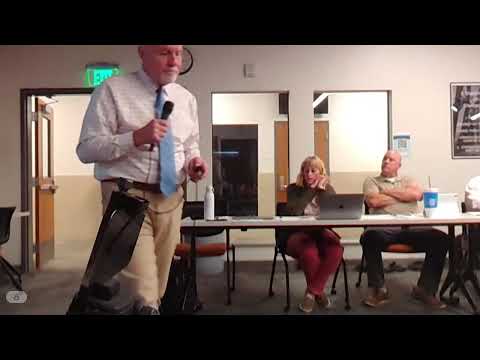
The district presented a menu of options that ranged from targeted additions to the two high schools and one new elementary to larger multi-school plans and a reconfiguration of grade bands (moving 9th grade into high school). Superintendent Steve Carls said, “No decisions will be made tonight. We're not voting,” and described the meeting as informational and for community input.
Why it matters: the district said several elementary and middle-school buildings date from the 1960s and predate reinforced-masonry building standards, leaving safety and comfort concerns (including lack of air conditioning) alongside overcrowding. Officials said portables are widely used — 34 districtwide — and cited increases in program need and space pressures, including a rise in full-day kindergarten, more special-education (IEP) placements and English-learner students.
Options, costs and contractor estimates
District staff summarized alternatives and updated cost estimates that have risen since the bond campaign. The $220 million bond that voters rejected in November had bundled multiple projects; staff said the scale and number of elements on that single ballot measure likely contributed to its defeat.
Neil (business administrator) presented a smaller financing scenario the district has modeled: “A $110,000,000 buys us 2 high school additions and an elementary school,” he said, and estimated an average cost to an owner of a median-valued home in the county at about $6.95 per month over a 20-year financing term (the district emphasized that the number varies with interest rates, valuation changes and financing structure). Staff also said a preliminary, higher cap driven by updated county valuations could allow a larger board-approved capital levy in the current year.
Contractors and the district’s facilities director, Corey Thompson, said hard-construction pricing has climbed rapidly: firms are now quoting roughly $430–$500 per square foot for new schools in some recent local bids, up from mid-2021 bids in the mid-$200s per square foot. Thompson warned that timing of bidding (seasonality) and market conditions matter: “If it went to bid today, our best guess is $4.30 to $4.40 [hundreds of dollars per square foot],” he said, adding bids could be higher if delayed.
Capacity, programs and building condition
Heidi Jo West, elementary assistant superintendent, detailed program-driven space needs: “We have in 5 years doubled the number of EL students that we're serving and doubled the number of students that qualify for an IEP through special education,” she said, and explained that those program expansions require dedicated classroom and support spaces. The district also said career-and-technical-education (CTE) participation is high (Bear River High School was presented as having among the highest per-capita CTE enrollment in the state) and that such programs need upgraded lab and shop space.
Officials walked attendees through specific project concepts: building a new elementary in the northwest (West Tremont) to remove portables in the north, replacements for North Park and Lakeview elementaries, repurposing or replacing middle schools, and targeted additions at the two high schools to receive 9th-grade students under a 9–12 configuration. Several proposals were presented as phased approaches so the district could prioritize either safety (replace older unreinforced masonry schools) or capacity (relieve overcrowding where growth is concentrated).
Community reaction and trade-offs
Public commenters and board members raised familiar trade-offs: property-tax impacts on homeowners and small businesses, the effect on local rents and commercial viability, and differing community preferences about grade configuration. Karen Cronin, identified as a board member, told the group she supported paying a modest monthly levy: “take my money… $23 a month is nothing,” she said, describing personal experience teaching in hot classrooms.
Multiple audience members urged the district to prioritize the oldest, highest-risk buildings (elementaries with unreinforced masonry and no AC) rather than broad, expensive packages. Others emphasized that reconfiguration to 9–12 for high school could improve continuity for some students and academic acceleration options but also creates concerns about mixing 9th graders with older peers in the same campus.
Financing mechanics and timing
District staff explained two principal financing paths: (1) a voter-approved general-obligation bond, which allows a larger tax increase if approved by voters, and (2) board-driven capital levies and lease-revenue bonds (truth-in-taxation and capital-levy mechanisms) that are more limited by statute but do not require a public bond election. Neil said the district’s modeling showed roughly $8.8 million annual debt service on a $110 million bond under current assumptions and emphasized that principal-and-interest cost depends on interest rates, county valuations, and when other district debts roll off the tax levy.
Staff noted there are also some district tools that can reduce immediate cash needs (selling district-owned land, tapping capital reserves in some cases), but repeatedly cautioned that delaying projects risks higher future construction costs.
What the board directed and next steps
No formal action was taken. The board and staff asked for continued community feedback and said they will refine cost and phasing plans, commission further demography and infrastructure studies, and return with more detailed, site-level proposals. Staff committed to providing written detail on what specific high-school additions would include and to coordinate with city/county partners on infrastructure consequences for any new school sites.
Ending
District leaders closed by asking attendees to continue sending input by email and to participate in future community briefings. The session was framed as an early step in a multi-year planning effort to balance safety, capacity and affordability while motions or bond questions are developed for any future formal action.