Get Full Government Meeting Transcripts, Videos, & Alerts Forever!
Get email alerts on the Urban Forestry topic
No spam. Unsubscribe anytime.
Clark HERO study: Worcester business owners favor trees but cite maintenance and landlord barriers
Summary
Clark University HERO student researchers told the Green Worcester advisory committee that local business and property owners see cooling and aesthetics as primary benefits of street trees but reported concerns about maintenance, sign blocking and lack of agency when renters cannot reach landlords.
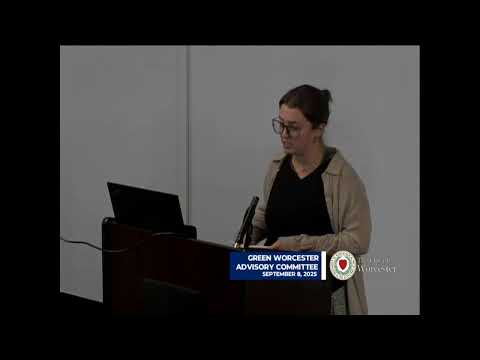
Clark University’s HERO (Human Environmental Regional Observatory) student researchers presented qualitative findings to the Green Worcester Advisory Committee on Sept. 8 about business and property owner attitudes toward street trees in the Maine South and Green Island neighborhoods of Worcester.
The students said most interviewees agreed trees add cooling and improve curb appeal; 70 percent cited shade and aesthetics as benefits, and 40 percent cited air-quality benefits. But interview subjects also raised barriers: 55 percent reported distrust in city maintenance of public trees, 55 percent described maintenance burden for property owners, and 30 percent worried about trees obscuring business signage. Students said many businesses are leased, limiting tenants’ ability to decide whether to plant trees.
The HERO team explained their methods: 24 interviews were conducted in Worcester (21 with business/property owners and three with community partners) and additional quantitative tree surveys were collected in Leominster earlier in the summer to provide context. The student presenters said canvassing in person produced more interviews than phone or email outreach.
Committee members asked whether resistance reflected reputation or direct experience. The students said both occur: some business owners pointed to nearby examples of pavement damage or other problems that shaped their caution, while others simply lacked space on-site. The team also reported that 65 percent of interviewees said tax or policy incentives would encourage participation in tree-planting programs, and that 75 percent were not aware of the city’s Green Worcester / GGC programs.
Committee members and students discussed outreach strategies. Students recommended stronger marketing of tree programs, targeted neighborhood consultation, planting on city-owned property where appropriate, and supportive services for maintenance. They also recommended reaching landlords through in-person meetings and landlord associations because many business tenants do not have direct contact with property owners.
The presentation concluded with students saying four HERO fellows plan individual follow-up projects and further interviews in Worcester, and with committee members thanking the team for the research.