Get Full Government Meeting Transcripts, Videos, & Alerts Forever!
Get email alerts on the Subdivision Land Use topic
No spam. Unsubscribe anytime.
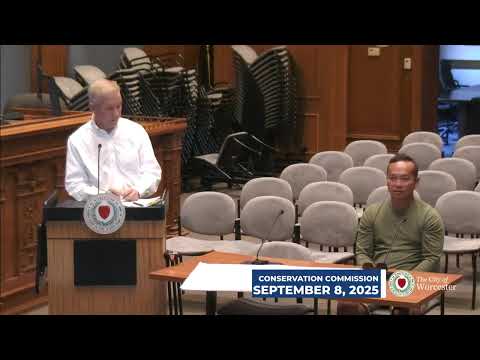
Conservation commission continues Chester Street four‑lot proposal after stormwater and maintenance questions
Summary
A four‑lot subdivision on Chester Street was continued to Sept. 29, 2025, after the commission pressed the applicant to resolve stormwater compliance, retaining-wall design, sewer easement relocation and long‑term maintenance arrangements.
The Worcester Conservation Commission on Sept. 8 continued the notice of intent hearing for four lots on the south side of Chester Street (lots 9–12) to the commission’s Sept. 29 meeting to allow the applicant and staff to resolve key stormwater and maintenance issues.
Applicant Mike Pham (principal) and wetland scientist Scott Heim of Northeast Ecological Services described existing conditions: the undeveloped, heavily wooded hillside contains wetland depressions near the rear of several proposed lots that appear to be fed by runoff from an adjacent, roughly 3.5–3.6 acre watershed on Assumption College property. Heim told the commission that the wetlands do not extend to Chester Street but that runoff from the watershed could focus at an overflow point during larger storms.
The project team proposed retaining walls behind the lots to stabilize steep slopes (roughly a 50‑foot drop over a few hundred feet) and noted a sewer easement crossing the lots that will require adjustment. Staff cautioned that a focused outlet from the wetlands could increase peak flows to the Chester Street design point; city drainage (DPW) comments remain outstanding and staff asked the applicant to meet with DPW and commission staff to resolve how the project will meet the Massachusetts stormwater standards.
Commissioners asked whether a headwall would direct flow through the buffer zone and raised the possibility that concentrated flows during a 10‑ to 100‑year event could undermine retaining walls if not captured. The applicant said the headwall was anticipatory—there is no visible continuous flow path now—but the grading plan includes measures to funnel potentially off‑center runoff into the headwall. The project team said long‑term maintenance of the retaining walls and headwall will require a homeowners association or other shared‑maintenance mechanism; otherwise, individual owners are unlikely to maintain elements that cross lot lines.
Staff recommended a continuation to allow further review of the stormwater calculations and DPW comments; the commission voted to continue the hearing and extend related construction deadlines. Vote: Commissioners recorded votes in favor of the continuation (Devin Canton—Aye; Duluth Kirschner—Aye; Lindsay Nystrom—Aye; Commissioner Petone—Aye).
(Ending) The applicant and staff agreed to meet before the next hearing to discuss stormwater compliance with DPW and to provide revised plans addressing retaining‑wall placement, sewer easement adjustments, and maintenance arrangements.