Get Full Government Meeting Transcripts, Videos, & Alerts Forever!
Get email alerts on the Stormwater Management topic
No spam. Unsubscribe anytime.
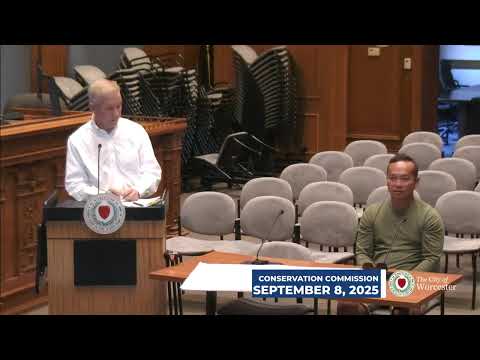
Worcester approves Green Hill Golf Course tee expansion and drainage improvements with conditions
Summary
The Worcester Conservation Commission on Sept. 8 issued an order of conditions for a tee expansion and drainage-improvement project at Green Hill Golf Course, approving infiltration trenches, headwalls and a rerouted cart path while requiring test pits, vegetation planting at outfalls and ongoing stormwater maintenance.
The Worcester Conservation Commission on Sept. 8 approved a tee expansion and drainage-improvement project at Green Hill Golf Course, issuing an order of conditions that requires test pits, planting at infiltration trench outfalls and routine stormwater-system maintenance.
The commission’s vote authorizes work at the eighth- and ninth-hole complex that includes three infiltration trenches (with header pipes and headwalls), lateral drains in fairways, energy-dissipation bowls at outlets and rerouting a cart path. The project was presented by Mark Gerlbach, design principal for the applicant’s consultant team, with civil engineers Ben Yacdonough and Megan Wazinski providing technical detail. City staff and Department of Environmental Protection (DEP) reviewers provided comments before the vote.
Commission staff said DEP issued two comments the day of the meeting: one about the project’s treatment-train approach and one asking for test pits to confirm soils and depth to groundwater. The applicant told the commission the site is roughly 15 feet above the pond, so groundwater is not anticipated to be shallow, but the team agreed to perform test pits as requested. Staff also asked that buffer zones be labeled on plan sheets and recommended planting native shrubs at the infiltration outfalls to provide additional filtration.
In discussion commissioners pressed the project team on outlet protection and potential scouring near Green Hill Pond. The applicant said headwalls will include sized energy-dissipation bowls and will be set back behind the existing shrub and tree line; any runoff after dissipation would pass through existing vegetation. The design team said they would coordinate with staff on shrub planting at outfalls and limit disturbance at the toe of slope.
The commission closed the hearing and then voted to issue the order of conditions as described, with conditions added to require: confirmed test-pit data at infiltration locations; revised drawings showing outfall plantings to be determined in the field by staff and the project team; a certification and maintenance schedule for stormwater infrastructure; limits on dewatering and concrete wash; and standard wetland protections. Staff cited condition numbers during the meeting (including conditions referenced as 24, 25, 27, 37, 39, 46, 49, 50, 51 and 68 in the draft order of conditions).
Vote: Commissioners voted in favor (recorded as: Devin Canton—Aye; Duluth Kirschner—Aye; Lindsay Nystrom—Aye; Commissioner Petone—Aye). The motion to issue the order of conditions carried.
The project team also said they will consult with staff on required test pits and on planting species. The commission recorded that the applicant had provided a TSS removal worksheet and that DEP had assigned a file number the day of the meeting.
The commission’s action allows work to proceed only after the conditions are satisfied and required follow-up (test pits, revised plans, planting commitments and stormwater maintenance certification) is completed or made part of the order of conditions.
(Ending) The commission’s order includes ongoing stormwater maintenance and certification requirements; staff will track submission of test-pit data, revised planting plans and certification materials during construction.