Get Full Government Meeting Transcripts, Videos, & Alerts Forever!
Get email alerts on the Land Use topic
No spam. Unsubscribe anytime.
Commission approves amended Maldenwood subdivision conditions, reducing road width and replication area
Summary
The Conservation Commission approved amendments to the Maldenwood subdivision order of conditions on July 21, allowing a reduced roadway width (28 feet to 24 feet), a smaller wetland replication area, and updated phasing and monitoring requirements; staff supported the change because it lowers resource-area impacts.
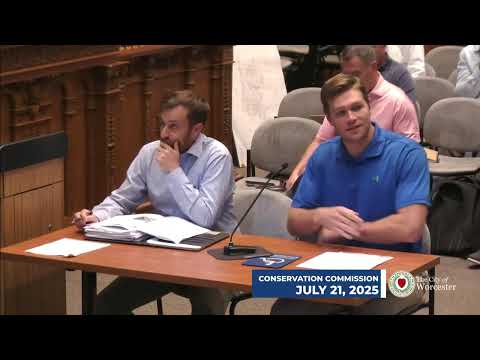
WORCESTER — The Worcester Conservation Commission approved an amendment to the Maldenwood subdivision’s existing order of conditions on July 21, accepting a narrower roadway, reduced impervious area, and a smaller wetland replication area while imposing updated phasing and monitoring requirements.
Attorney Mark Born represented Whippoor LLC and described the proposed changes: a decrease in travel‑way width from 28 feet to 24 feet reducing impervious surface by 2,304 square feet, the addition of a couple of catch basins to improve stormwater handling, and a reduction of the previously-approved wetland replication area from roughly 347 square feet to 41 square feet. The applicant also asked the commission to modify site phasing restrictions to allow up to five foundations open at a time (previously three) and to remove a turbidity‑monitoring requirement; staff recommended updating conditions rather than piecemeal edits.
Why it matters: The change reduces permanent impact to wetland buffers and avoids the removal of mature trees that would have been required to construct the previously proposed replication area. The commission’s updated conditions included a new recorded performance agreement reference, revised phasing language (maximum of five duplex lots open for disturbance at a time), and ongoing monitoring and construction‑monitoring-report requirements by an independent inspector with specific certifications (CESWE, CPESC, PE, PWS, or equivalent).
Staff rationale and conditions: Staff said the proposed reduction in impacts was beneficial and that the replication area previously proposed would have required removal of mature trees adjacent to the bank. The commission adopted a full set of updated conditions capturing the existing order’s intent while modernizing language and codifying construction phasing and performance-security recording references. Conditions included requirements for SWIP, stormwater system maintenance (condition 37), infiltration inspection, certification, construction sequencing, and long-term monitoring and maintenance for replication areas.
Vote and next steps: Commissioners voted to issue the amended orders of conditions unanimously (Canton Aye; Kirschner Aye; Frattoni Aye). The applicant must record the updated performance agreement and provide revised stamped plans per staff comments. Construction will be phased per the new limits, and monitoring reports must be submitted during construction and following replication.
Speakers: Mark Born (applicant’s counsel) and Julian Vetrova (New England Environmental Design) joined the hearing; Steph (staff) summarized staff conversations and the rationale for updated conditions.
Ending: Staff will circulate the finalized conditions and the recording instructions for the updated performance agreement; the applicant will return required pre-construction materials.