Get Full Government Meeting Transcripts, Videos, & Alerts Forever!
Get email alerts on the Urban Agriculture topic
No spam. Unsubscribe anytime.
Committee asks administration for report on rules for backyard hens, holds zoning petitions
Summary
After hearing petitions to allow egg‑laying hens in residential areas, the economic development committee voted to hold one petition and file the duplicate petition while directing the administration to prepare a report on regulatory options, enforcement, and best practices from other Massachusetts cities.
The Worcester City Standing Committee on Economic Development took up two related petitions seeking to permit residents to keep egg‑laying chickens: a petition to amend the zoning ordinance to allow chickens in certain residential zones and a separate petition asking the council to create a permitting process for hens.
Committee members reviewed a history of planning board hearings dating back to 2021. The planning board has repeatedly cited insufficient detail in early proposals, but in 2022 and again in 2025 recommended that the council direct the administration to draft a city ordinance with specific regulatory controls. Peter Dunn, the city’s chief development officer, summarized that the planning board’s 2021 vote denied the initial amendment because it lacked development of regulatory controls, while later actions encouraged the council to ask the administration to craft an ordinance drawing on other municipalities’ models.
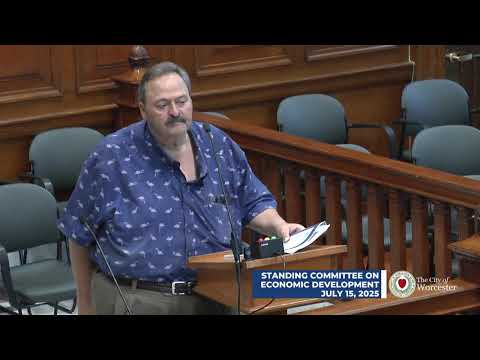
Petitioners and residents spoke on both sides. Joseph Mangiameli, the petitioner for a recent zoning petition, described six proposed provisions he considered necessary: a fee‑based permit for egg laying only, limit to single‑family dwellings, no roosters, a maximum of six hens, submission of coop design to a board (planning board or ZBA) and a requirement for proper waste handling (including use of city yellow trash bags). Resident Ted Costas said he opposes expanding chickens in his neighborhood because of rodent concerns, inspection capacity and disease risk; he asked who would inspect coops and how enforcement would work.
Committee members, including Councilor Toomey and Councilor Pacillo, said they wanted a careful, research‑driven approach and suggested looking at Somerville and Brockton ordinances as models. Councilor Atel Hajjai and others noted that an earlier petitioner, Amanda Shearstone, had compiled model ordinances and that inspectional services staff have experience from other cities; the new commissioner of inspectional services previously worked in Somerville and could offer insight.
The committee directed the city manager’s office, working with the law department and inspectional services (and recommended inclusion of health and animal control as relevant agencies), to prepare a report that would summarize municipal ordinance models, describe enforcement and complaint handling, set recommended permit or accessory‑use approaches, and propose dimensional and nuisance controls. The committee voted to hold item 3B (the petition referred to the planning board) and to file item 4A (the related petition filed to accelerate conversation), pending receipt of the administration report.
On the committee votes to hold 3B and file 4A, the roll call recorded: Councilor Pacillo — yes; Councilor Toomey — yes; Chairperson Councilor Meryl Carlson — yes. The committee did not adopt a final ordinance; rather it asked staff to return with a detailed report and recommended ordinance language for the council’s consideration.