Peabody committee advances revisions to accessory dwelling unit zoning, seeks legal and building-inspector opinions
Loading...
Summary
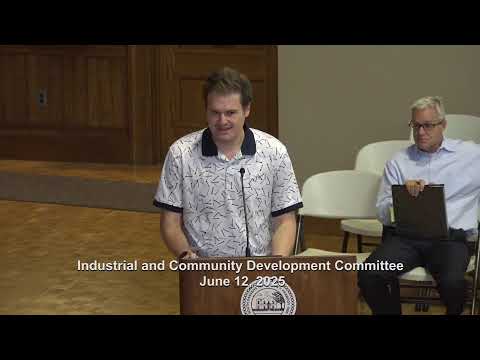
The Peabody City Industrial and Community Development Committee on June 12 reviewed a revised zoning amendment to allow accessory dwelling units (ADUs) and voted to request written opinions from the city solicitor and the building commissioner before finalizing the language.
The Peabody City Industrial and Community Development Committee on June 12 reviewed a revised zoning amendment to allow accessory dwelling units (ADUs) and voted to request written opinions from the city solicitor and the building commissioner before finalizing the language.
Community Development Director Kurt Bellavance told the committee he revised a state model ordinance after committee feedback and that the draft now trims the purpose statement, tightens definitions and adds references to local standards such as the zoning dimensional controls in section 7.2. "I appeared before you, in March with a, draft of a, ordinance regarding, ADUs or accessory dwelling units," Bellavance said as he summarized changes.
The proposed changes would (1) resolve overlapping definitions (for example, the word "lot" is defined both in the ADU section and in the main zoning definitions), (2) remove a broad "transit station" definition that Bellavance said does not apply to Peabody, (3) add a definition for family accessory living area (FALA or FALAs) because the ADU text references it, (4) reference the city's existing dimensional standards (section 7.2) rather than restating them, (5) require one additional off‑street parking space for an ADU rather than the previously drafted "up to two," and (6) clarify that determinations about whether an alteration to a preexisting nonconforming structure is "substantially more detrimental" would be made by the building commissioner as an as‑of‑right determination.
Bellavance also said the draft treats lawfully existing family accessory living areas in single‑family districts at the time of adoption as protected ADUs; he estimated there are "about 650" such FALAs now, and said making them protected ADUs would prevent an owner from claiming a FALA and then adding an additional ADU on the same lot. Councilors pressed for written guidance on that approach because converting existing FALAs could raise legal challenges. "I just have a sense that it may be challenged," Councilor Manning Martin said, asking for a formal written opinion from the city solicitor and for the building commissioner to provide written feedback.
Councilor McGinn said Bellavance had modified the state model and verified the draft with other departments but recommended additional verification, especially on the nonconformance section. McGinn also asked for consideration of the defined term "modular dwelling unit" (a drafted term not currently used) and whether it should be retained and placed in the ordinance in an appropriate location. Several councilors said removing the transit‑station language made the draft cleaner; McGinn and others cited the Executive Office of Housing and Livable Communities' (EOHLC) guidance to remove elements that do not apply to a local community.
Councilor Cherko raised a revenue question: current FALA inspections carry fees (about $100 per inspection), and converting FALAs to protected ADUs could reduce that fee revenue. Cherko estimated the city could be foregoing tens of thousands of dollars annually; Bellavance said fewer than a dozen ADU applications were in the pipeline at his last check but that his last count of active FALAs was an approximate figure.
On enforcement questions, Councilor Welton asked about short‑term rental enforcement for ADUs; Bellavance said he would consult the building commissioner, who has experience with short‑term rental monitoring from a prior position. Several councilors emphasized that the committee should obtain written opinions before finalizing the ordinance.
The committee moved to request written opinions from the city solicitor and the building commissioner on specified items in the draft: administration and enforcement (section 6.18.0.14), the nonconformance language (section 6.18.0.3 / section 5 nonconformance), the proposed definition and use of the term "lot" in the ADU section, whether and how to use the term "modular dwelling unit" in the ordinance, and the proposed elimination of the FALA regime. The motion to request those written reviews passed on a roll call vote, 5‑0.
Next steps: the committee asked staff to incorporate the edits discussed and to return the revised draft with the building commissioner and city solicitor's written feedback before taking the ordinance out of committee for final action.