Get Full Government Meeting Transcripts, Videos, & Alerts Forever!
Get email alerts on the Capital Improvement Plan topic
No spam. Unsubscribe anytime.
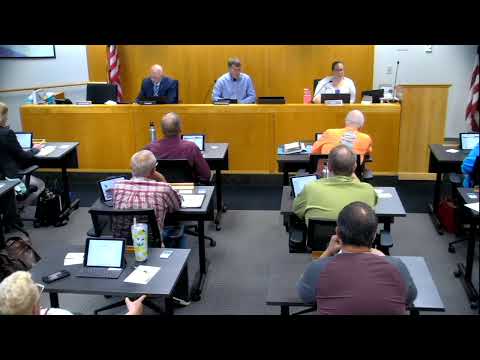
Board approves 2026 capital improvement transfers, authorizes sales tax use across county projects
Summary
Chippewa County supervisors approved a slate of resolutions transferring sales tax and other funds for 2026 capital projects, covering debt service, airport contribution, facilities and parks, highways and bridges, IT equipment, land conservation, and sheriff equipment.
The Chippewa County Board of Supervisors approved multiple resolutions on June 10 authorizing transfers of sales tax and other funds to cover 2026 capital improvement plan (CIP) expenditures.
County staff presented the CIP summary and funding sources, noting some line items are placeholders to accept grant or donated funds if awarded. The board approved a series of resolutions forwarded by the executive committee that move specific sums from the sales tax property tax relief fund and other fund balances into project accounts for 2026.
Key approved transfers and authorizations included: - Debt service: Resolution 16-25 authorized transfers totaling $2,105,178 from the sales tax/property tax relief fund and bond-premium fund balance to pay principal and interest on 2018, 2020, 2022 and 2024 capital improvement project bonds (itemized in the resolution as $944,700; $250,875; $422,700; $6,903; plus $86,722 in bond-premium fund balance). - Airport contribution: Resolution 17-25 authorized $132,890 from sales tax/property tax relief fund as Chippewa County's 2026 annual contribution to the Chippewa Valley Regional Airport for capital projects and/or debt service. - Facilities & Parks: Resolution 18-25 authorized $500,000 for Parking Lot A replacement (phase 2), $150,000 to remodel the Branch 3 jury box, and $50,000 for planning/design work for a Sheriff's Department remodel (phase 1), all funded by sales tax. - Highway projects: Resolution 19-25 authorized $2,800,000 in sales tax transfers for roadway and bridge projects; it also authorized use of $1,100,000 in highway machinery fund balance for machinery replacement and $100,000 for building improvements, and $300,000 from sales tax for non-highway fleet replacement. - Information Technology: Resolution 20-25 authorized $245,000 from sales tax for computer and IT equipment replacement and upgrades. - Land Conservation & Forest Management (LCFM): Resolution 201-25 placed $500,000 in the CIP (approximately $250,000 in state grants and $250,000 in donations) for a warming shelter and maintenance shed at Hickory Ridge; $120,000 from snowmobile trail aids for snowmobile bridges (if DNR grants approved); $300,000 (approx. $150,000 state grants + $150,000 fund balance) for county forest land acquisitions; and $100,000 from county stewardship fund balance for stewardship projects. - Sheriff's Office: Resolution 202-25 authorized $195,000 to purchase a mobile command trailer and $135,000 to replace TASERs in a phased acquisition, both funded by sales tax.
Board members asked for clarifications during the presentation. A supervisor with a law-enforcement background highlighted prioritization questions for capital items, pointing to the jury box remodel and warming-shelter costs. County staff and other supervisors explained that several LCFM and snowmobile items are contingent on grant or donated funds and that placeholders are necessary in the CIP to receive restricted grant dollars if awarded.
Supervisors also discussed airport contributions. Board members said the county receives an annual operations report from the airport commission and noted federal subsidy programs support passenger service to smaller airports. The airport contribution was described by supporters as funding restricted to airport capital projects and debt service under the airport agreement.
All resolutions listed above were forwarded by the executive committee and approved by the full county board as part of the 2026 budget process. Several supervisors urged care in using discretionary sales tax dollars, emphasizing that sales tax items are most flexible for local decision-making while some items are grant-restricted and cannot be reallocated.