
Cooperative Extension warns SNAP-Ed contract uncertainty could cut local nutrition education
Get AI-powered insights, summaries, and transcripts
Subscribe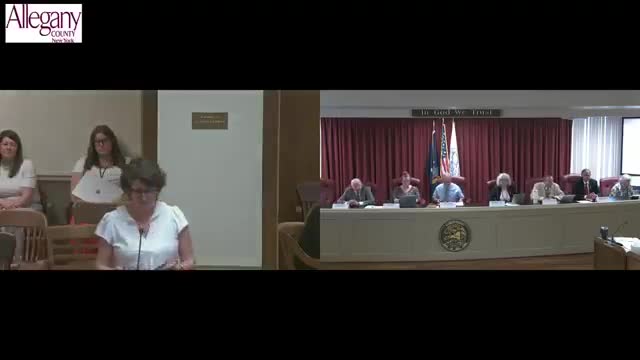
Summary
Loris Hunsberger of Allegany County Cooperative Extension told the Resource Management Committee the county’s SNAP-Ed education contract may be canceled and staff expect clarity in about a month; the program currently supports two full‑time educators and roughly $24,000 in non‑personnel local costs.
Loris Hunsberger, Cooperative Extension, told the Allegany County Resource Management Committee that the county’s SNAP‑Ed education contract may be canceled and the office expects to know the contract’s status in about a month.
Hunsberger said SNAP‑Ed provides flexible nutrition education to people who are eligible for SNAP benefits and explained how the county program differs from the older EFNEP classroom model. “So SNAP isn't just through the schools. It's, anybody who is so even if you don't get SNAP benefits, if you are eligible for SNAP benefits, you can,” Hunsberger said. She added the program teaches label reading, MyPlate planning and other practical skills: “It covers everything from learning how to read a label, to, yeah, the My Plate… knowing how to balance, everything on your plate without always just going for a pre prepared frozen dish.”
Why it matters: SNAP‑Ed is the Cooperative Extension’s main nutrition‑education vehicle; losing the contract would reduce local classes and outreach. Hunsberger said the local program has two full‑time educators, covers parts of her and administrative time and about $24,000 in non‑SNAP personnel expenses. She said the current SNAP‑Ed cycle started Oct. 1 and is a five‑year cycle.
Committee members asked about program scope and eligibility. A member asked whether SNAP education is only for families with children; Hunsberger replied that eligibility is based on being eligible for SNAP — participants need not have children. She also explained differences with EFNEP: EFNEP required multiple sessions and had lower completion rates, while SNAP‑Ed can run single classes and other flexible formats. Hunsberger said some targeted curricula (for example, for people with diabetes) are available.
On next steps, Hunsberger said staff are advocating for the program and contacting state and federal legislators. She also said the office is completing its audit while awaiting the contract decision. “If you want to shoot me an email with the specifics, I can ask all of our smarter than me people that have better answers,” she said when asked for follow up.
No formal committee action was recorded on SNAP‑Ed at the meeting; the discussion was informational and staff committed to follow up with additional information and advocacy.
The committee also noted the uncertainty’s practical impact on staffing and program planning: Hunsberger said the program currently supports two full‑time educators and covers some administrative costs, and that the non‑personnel line runs about $24,000. She said the office will likely know the contract outcome in about a month and is preparing for either result.