Get Full Government Meeting Transcripts, Videos, & Alerts Forever!
Get email alerts on the County Budget topic
No spam. Unsubscribe anytime.
Glynn County outlines FY2026 budget proposal, recommends 14 new full‑time positions and nearly $22 million in capital projects
Summary
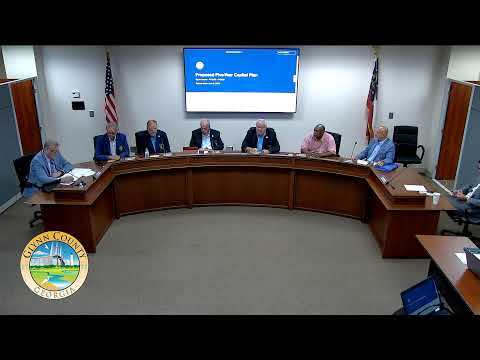
At a June 12 public hearing, Glynn County staff presented a proposed fiscal 2026 budget that shifts to charging indirect costs to departments, adjusts FTE accounting, recommends 14 new full‑time and five part‑time positions and includes nearly $22 million in capital spending; adoption is scheduled for June 19.
Glynn County officials on Thursday presented the proposed fiscal year 2026 budget and opened a public hearing, emphasizing changes to how indirect costs and full‑time equivalent (FTE) positions are accounted for and detailing a nearly $22 million capital plan.
The county’s budget presenter, a county staff member, told the Board of Commissioners that the budget document was posted online and that formal adoption is scheduled for June 19. “Those changes are not gonna have much of a financial impact at all, but there are some issues with some FTE numbers and things like that,” the presenter said, adding that narrative and position counts will be corrected before adoption.
The budget presenter said the proposed FY2026 plan uses 35 separate funds (excluding internal service funds) and moves to allocate indirect costs to individual departments through five internal service funds: fleet, facilities, administrative services, insurance and information technology. “We have 35 different funds for fiscal year ’26,” the presenter said. The shift to charging indirect costs at the department level is intended to give “a better picture of what it costs to run each department,” the presenter said.
Why it matters: the proposal sets the financing and priorities that will guide county services and capital investment for the year that begins July 1. The allocation method, staffing changes and capital projects affect department budgets, future operating costs and how the county reports costs across funds.
Key figures and changes
- Revenue composition: the presenter said about 70% of countywide revenue in the budget comes from taxes. Within that tax total, 57% is property tax, 23% is sales tax and 13% is accommodation excise tax. The presenter noted that SLOS/SLOTS funding referenced in the budget is accounted for separately and is not included in the annual totals reported in the main budget because it is budgeted over a multi‑year term.
- Expenditure mix: roughly 47% of total county expenditures in the proposed budget are for public safety, 13% for public works and 12% for culture and recreation. By type, about 54% of expenditures are personnel and related benefits, 26% operating costs and 13% capital.
- Positions and FTEs: the presenter said 71 positions were requested by departments for FY2026; the budget recommendation includes 14 new full‑time positions and five new part‑time positions. The presenter explained that a new, standardized method tying hours worked to static FTE values for part‑time and full‑time employees caused an apparent jump in FTE counts and that several counting errors remain to be corrected. The presenter said two part‑time positions are grant funded for 24 months to support camera review and data analysis (described in the presentation as “flock positions”).
- Capital plan: the county is building a five‑year capital plan (initiated about two years ago). The FY2026 capital budget was described as just under $22,000,000, with a focus this year on drainage improvements and beach‑related projects such as the bridal pools. The presenter said the budget display links each project to the county’s strategic goals and shows estimated annual operating cost impacts by year.
Pension fund and oversight
County officials clarified that the county’s pension trust is accounted for as a fiduciary fund and is not available for general spending. A commissioner noted the pension fund is overseen by a pension board that reviews investments; in the meeting that speaker said, “we don't do anything with it. We actually have a pension board that reviews those investments and make sound decisions based on recommendations from, the investment community if you will.” The presenter said the pension fund was “in a good place” despite recent market volatility.
Process and next steps
The presenter said millage rates are estimated for budget preparation but are scheduled for formal adoption later in the summer (July–August). The county will correct narrative items and FTE counts and return for formal adoption at the June 19 commission meeting. The chair opened a public hearing with time limits (30 minutes per side, five minutes per speaker); no members of the public spoke and the hearing portion was closed.
Commissioners used the meeting to thank staff and department heads for the work that produced the budget. The board took no formal policy votes on expenditure or millage changes during the June 12 session; staff will bring the revised document back for adoption on June 19.