Get Full Government Meeting Transcripts, Videos, & Alerts Forever!
Get email alerts on the Wildfire Community Preparedness topic
No spam. Unsubscribe anytime.
Missoula experts press home hardening, local planning and prescribed fire as wildfire risk rises
Summary
At a June 2025 City Club Missoula forum, wildfire researchers, county planners and emergency managers urged investments in home hardening, local land-use planning, targeted fuels work and community preparedness, while noting legal, funding and air-quality constraints to prescribed burning.
Missoula — At a City Club Missoula forum in June 2025, wildfire experts, county planners and emergency managers described mounting wildfire risk in Missoula County and recommended a mix of home hardening, land-use updates, targeted fuels treatments and better community preparedness to reduce losses.
Kimmy Barrett, senior wildlife research and policy analyst at Headwaters Economics, opened the panel by framing the problem as one of structure vulnerability rather than wildlands alone. "This is not a wildfire problem. This is a home ignition problem," Barrett said, summarizing decades of research showing that embers, radiant heat and direct flame contact — not the presence of nearby green vegetation — are the primary causes of home loss in many community fires.
The forum brought local data and programs into the national context. Greg Dillon, director of the Fire Modeling Institute at the Missoula Fire Sciences Lab (U.S. Forest Service), described how simulation models and national mapping efforts (wildfirerisk.org) show where fire probability and intensity intersect with homes. Dillon said updated data place Missoula at about the 90th percentile for wildfire risk among U.S. communities and explained the lab's work to translate wildland hazard into community-scale risk zones tied to mitigation actions.
Why it matters: Panelists said treating wildfire as an issue of homes, roads and local planning shifts responsibility and tools toward municipal codes, subdivision rules, building standards and homeowner mitigation. County and city officials face tradeoffs between encouraging housing and limiting development in high-hazard places; panelists warned that existing patterns of growth and the number of homes in the wildland-urban interface (WUI) increase the chance of large urban conflagrations.
Key points
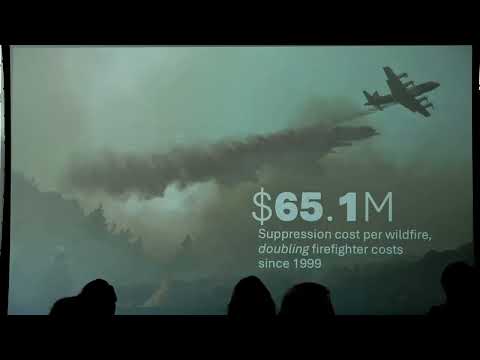
- Scale of the risk: Barrett cited national figures used in her research: about 44 million structures sit in the WUI, roughly 130,000 structures have burned or been damaged since 2005 (about 65% of that loss occurred in California), and embers cause the majority of home losses. She said suppression costs have risen; Barrett cited an average suppression cost on the order of $65.1 million for high-cost fires and noted that 98% of fires are contained but the small percentage that escape under extreme conditions produces most community-scale disasters.
- Home-hardening and defensible space: Barrett and other speakers emphasized construction and landscape measures that lower a home's ignition risk — examples ranged from replacing combustible siding, roofs and vents to clearing bark mulch and creating noncombustible zones near structures. Barrett summarized research demonstrating that replicating ignition-resistant materials on new construction can be cost-competitive; she said many effective retrofit measures are in the "low-hanging fruit" range (roughly $2,000–$10,000) and that some structural retrofits can be far costlier.
- Mapping and priorities: Dillon described the Fire Lab's probabilistic modeling (burn probability, flame length) and the wildfire hazard potential maps the lab updates biennially. He said the Fire Lab and partners created "community wildfire risk reduction zones" on wildfirerisk.org that correlate exposure (flame contact, ember zone, community core) with recommended actions for land managers, planners, emergency services and homeowners.
- Local planning and regulation: Karen Hughes, director of Missoula County Planning, Development and Sustainability, said the county will start a countywide land-use plan and a Community Wildfire Protection Plan (CWPP) and that the city recently updated its land-use plan and codes project. Hughes argued for using subdivision rules, zoning and building codes together to direct where growth occurs, manage density in high-hazard areas, and require construction features that reduce structure ignitability. She noted statutory complexities in Montana and varying political appetite across rural and urban parts of the county.
- Emergency management and evacuation limits: Adrian Beck, director of the Missoula Office of Emergency Management, described the county's pre-disaster mitigation planning and a year-round wildfire mitigation program unique in Montana. Beck emphasized personal preparedness ("Sign up. Smart911.com"), the limits of prescriptive evacuation routing in a landscape with one-way-in/one-way-out drainages, and the need for public trust in incident commanders who make decisions based on conditions.
- Funding, insurance and incentives: Panelists noted available grant programs, including the USDA Community Wildfire Defense Grant (CWDG) and local grants that were described as typically operating on a 75/25 cost-share (grant covers about 75%, homeowner about 25%). Barrett and others warned that insurance markets are already responding to wildfire risk: insurers are offering incentives for mitigation but also tightening availability and coverage in some high-risk areas; loss of coverage can affect mortgages and municipal finance.
- Prescribed fire and air quality: The panel discussed prescribed burning as a necessary landscape tool but also a politically and technically complex one in Missoula because of valley air quality. Speakers said federal, state and local agencies and public-health regulators must coordinate; panelists noted past and ongoing efforts to create MOUs and interagency processes to scale prescribed fire while managing smoke impacts.
Questions from the audience touched on renter protections, outreach to landlords, post-event recovery and rebuilding, and legal or regulatory barriers to adopting codes. Karen Hughes said public buy-in matters: elected officials typically need demonstrable community support before adopting new regulations. Panelists repeatedly urged locally tailored outreach, neighborhood "spark plugs" to demonstrate mitigation work, and use of the county's mitigation specialists to request home assessments.
No formal actions or votes were taken at the forum; speakers described existing and planned programs rather than adopting new rules.
Ending: Panelists urged immediate practical steps — register at Smart911 for emergency alerts, request a wildfire risk assessment through Wildfire Ready Missoula County, and incorporate updated wildfire risk mapping into local land-use and recovery planning — while acknowledging that larger-scale change will require funding, statutory clarity and cultural shifts about living with fire.