Get Full Government Meeting Transcripts, Videos, & Alerts Forever!
Get email alerts on the Infrastructure Rsid topic
No spam. Unsubscribe anytime.
Missoula County staff outlines new RSID plan, proposes $15,600 impact fee for new connections
Summary
Missoula County Public Works described plans to create a new RSID, assess impact fees at building permit, and hold a public hearing July 10; staff said the proposed maximum impact fee is $15,600 per dwelling-equivalent and commissioners would consider financing expansion up front.
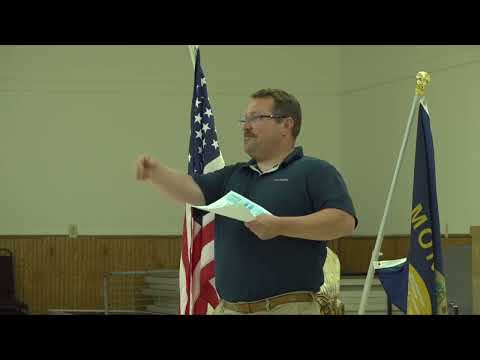
Jason Mitchell, Missoula County public works chief, told the Lolo Community Council on June 10 that county staff are preparing a new Rural Special Improvement District (RSID) and proposing to assess impact fees at the time of building permits.
The county’s engineering consultant, HDR, completed a service-level or impact-fee study that concluded newcomers could be charged up to $15,600 per dwelling-equivalent, Mitchell said. “How much? $15,600,” he said. Mitchell added the intent is to have developers or new homeowners pay a pro rata share of system expansion instead of placing that cost on current RSID users.
Council members pressed Mitchell on timing and scope. He said the county aims to present an RSID-creation hearing to the commissioners on July 10, allow roughly five to six weeks for public comment, then hold a follow-up public hearing in mid- to late August (Mitchell suggested Aug. 14 or Aug. 21) before the commissioners decide whether to initiate the final RSID and assessments.
Why it matters: Mitchell said the county wants a mechanism that separates operations-and-maintenance (O&M) costs from growth-driven expansion so that existing ratepayers do not shoulder the cost of extending capacity. Under the proposal, O&M would remain on current rate structures while impact fees would fund upsizing and added capacity.
How the county would pay up front: Mitchell said the county would seek funding through a mix of sources if it elects to underwrite expansion in advance of repaying those costs with impact fees. He listed possible sources including bonds, low-interest loan programs, ARPA-related funding already used for earlier RSID work and a pending $5,000,000 congressional community-project request the county is pursuing. “There’s still some hope of this $5,000,000 congressional spending,” Mitchell said.
Scope, phases and who pays: Mitchell described a parallel approach: remove properties not receiving service from the current RSID, create a new RSID with a largely identical boundary, and use the new RSID to fund redundancy and repairs while expansion capacity would be financed separately and reimbursed by impact fees. He described construction phasing tasks such as upsizing wells (to meet DEQ requirements to operate at maximum daily capacity with the largest well out of service) and bioreactor installations as examples of elements that would be charged to impact fees because they constitute expansion rather than repair.
Questions and clarifications from the meeting: Mitchell said the county previously passed a resolution that set a new-connection charge at $10,000 and increased it by $1,000 per year; the county attorney has advised the staff to pursue impact-fee methodology instead. He said impact fees may be recalculated at legally allowed intervals (Mitchell suggested a five-year review rather than annual inflation adjustments) and that accessory dwelling units would generally require a separate service connection and therefore an additional fee. He also said the county is examining methods to apportion assessments (for example, by improved land value rather than bare land) but that legality of alternate methodologies was under review by outside counsel and the Department of Revenue.
What was not decided: The county has not adopted the impact fee; Mitchell presented the study and described next steps. The July 10 RSID hearing is the next formal milestone; no commissioner vote on an RSID or on a finalized fee was recorded at this meeting.
Context and next steps: Mitchell said staff will publish the finalized impact-fee study online when complete and that the county hopes to begin issuing “well-served” letters to developers as soon as August so plats can advance. He outlined a tentative procurement schedule that would allow bidding this winter and construction of a waterline in summer 2026 and sewer bidding in winter 2026 with construction in summer 2027, contingent on final approvals and funding.