Get Full Government Meeting Transcripts, Videos, & Alerts Forever!
Get email alerts on the County Budget 2026 topic
No spam. Unsubscribe anytime.
Douglas County previews 2026 budget, flags revenue uncertainty and behavioral health fund uses
Summary
County staff presented a 2026 budget preview at a County Commission work session, outlining revenue trends, a $20.7 million behavioral health fund balance, prior one-time commitments and a timeline for public hearings and deliberations. Staff warned of volatility in investment income and limited room to fund new behavioral-health requests.
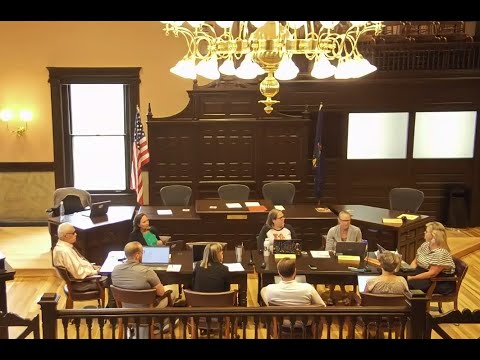
At a Douglas County Commission work session, county staff presented a preview of the proposed 2026 budget and outlined key revenue trends, the status of the behavioral health projects fund and a timeline for public hearings and deliberations.
The presentation, delivered by staff member Sarah, said assessed valuation growth for the 2026 budget will be 5.7 percent and that staff currently projects $12.7 million in revenue for the behavioral health projects fund in 2025, of which about $6.6 million is expected from the county's behavioral-health sales tax and $5.2 million from property tax amounts that predated the sales tax. Sarah said the behavioral health fund had an actual starting fund balance of about $20.7 million in 2025 and that the commission approved $3.2 million in one-time capital expenditures from that fund during 2025.
Why it matters: the budget sets how services funded by property tax, sales tax and other fees are delivered across county departments and to community partners. Staff emphasized that volatile revenue sources'notably investment income and slower sales-tax growth than in recent years'could limit the county's capacity to add ongoing spending.
County staff told commissioners the county is working to sustain core services while managing inflation and compensation pressures. The presenter said the county completed a classification and compensation update during the 2025 budget cycle, the first in more than a decade, and that 2026 planning must account for those costs.
On revenues, staff summarized: assessed valuation growth is projected at 5.7 percent (five-year average 7.7 percent; 10-year average just under 6 percent); 2024 total sales-tax collections were about $9.7 million and rose about 0.64 percent over 2023; and investment income for 2024 was roughly $7.5 million compared with a $4.7 million figure used in the 2025 adopted budget. The county's treasury yields averaged about 4.18 percent at the time of the work session, and staff said estimates for 2026 are partly locked in by rates already set, but that future variability is a key uncertainty.
Staff described several funds and their revenue sources: the general fund (largely property-tax supported, representing about 70'77 percent of its revenue), an employee-benefits fund (funded only by property tax), a Road and Bridge fund (which receives state gas-tax and its own property-tax levy), a one-cent countywide sales-tax fund used for debt service (half of the one-cent is retained in the general fund and half is used for debt), the motor-vehicle operations fund (fee-based; state controls some fees), a 911 emergency-telephone fund (paid by phone-bill fees), and the behavioral health projects fund (a blend of the quarter-cent behavioral-health sales tax and transfers of property-tax funds predating the sales tax).
Sarah noted the motor-vehicle operations fee is set by the state and does not cover all local costs; staff said local taxpayers currently subsidize part of that state-mandated service. On the one-cent county sales tax, Sarah clarified that cities in Douglas County, including the City of Lawrence, receive a share of that tax; the county receives a smaller share.
Behavioral health fund details: staff reported the fund's 2025 starting balance (~$20.7 million), anticipated 2025 revenue of $12.7 million (including $6.6 million from the behavioral-health sales tax), and ongoing expenditures estimated at $10.8 million for 2025. Staff noted the county had approved $3.2 million in one-time capital projects in 2025 (examples given included supportive housing projects and work with community partners such as DECA and Ninth Street Missionary Baptist). The presenter said fund-balance targets calculated from ongoing revenue would suggest retaining about $3.2 million as an operating reserve; that calculation leaves an estimated $14.4 million available for one-time capital uses in 2025, recognizing some of that is already committed.
The presentation also described prior 2025 budget actions that reduced the mill levy: the commission moved about $917,172 in projects previously supported by the general fund into the behavioral health fund, enabling a 2.9-mill levy reduction; the employee-benefits fund mill levy was lowered by 2 mills as part of the same levy adjustments. Staff also said an ongoing $600,000 flexible housing pool was added as a new obligation to the behavioral health fund in 2025.
Senior Resource Center transition: Jill Jellicker, assistant county administrator, said the county set aside $250,000 in the prior budget to support the planned transition of the Senior Resource Center (SRC) to become a county department. She said the transition is scheduled to be effective Oct. 1, 2025, and that personnel costs tied to the county's updated classification and compensation system account for a majority of the initial fiscal impact. Jellicker said staff expects to cover most of the near-term costs within the $250,000 set-aside but will not be able to eliminate all compression issues immediately.
Requests and timeline: staff reported 58 supplemental requests for 2026 totaling about $10 million (approximately $2.9 million from county departments and $7.2 million from community partners). Staff estimated roughly $6.1 million of the community-partner requests would be eligible for behavioral-health sales-tax funding, but said the available capacity in that tax for new, ongoing obligations is under $2 million. Key schedule items staff gave to commissioners: a proposed-budget release targeted for June 27 (staff said this date was tentative), budget hearings beginning July 7, a goal to finish deliberations by July 16 so the county clerk can be notified by the July 20 statutory deadline if the commission intends to exceed the revenue-neutral rate, a work session to review CIP projects on July 30 and public hearing for the 2026 budget on Aug. 27. Staff encouraged public engagement "early and often" after the proposed budget is released.
Public engagement and partner oversight: staff said community partners have submitted financial documents and 990s and that the county is using an online application to standardize supplemental-request submissions. Staff said community partner awards under $80,000 are handled through a simplified agreement; awards above $80,000 require invoices, key-performance indicators and a scope of work.
Commissioners asked clarifying questions during the session, including about the one-cent sales-tax split among county and cities, details of the behavioral health-sales-tax receipts, the timeline for receiving the budget book and when the public should engage. Commissioner Anderson asked when commissioners would receive the budget book; staff replied they expected to provide it in the last week of June in advance of a public release. Commissioner Kelly participated remotely and reserved some questions about behavioral-health sales-tax details for the business meeting later that evening.
Staff emphasized revenue uncertainty (investment income and sales-tax growth), the county's interest in sustaining core services while addressing compensation and infrastructure needs, and limited capacity to fund new ongoing behavioral-health obligations without reducing other services or using reserves.
The work session recessed to a 5:30 p.m. business meeting.