Get Full Government Meeting Transcripts, Videos, & Alerts Forever!
Get email alerts on the Tobacco Regulation topic
No spam. Unsubscribe anytime.
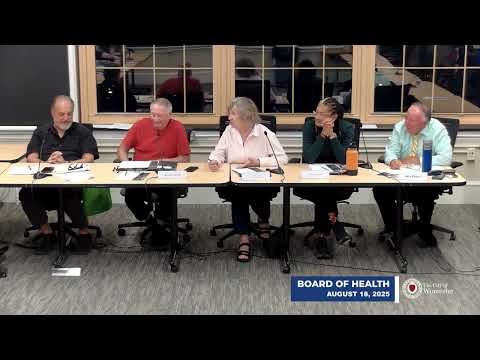
Worcester Board of Health denies hookah-bar permit waiver for Nomesco
Summary
The Worcester Board of Health voted 3-2 to deny a request by Nomesco to operate a hookah/smoking‑bar at its current downtown location, citing public‑health concerns about retailer density and youth exposure. Board members who supported the business cited jobs and downtown vitality.
The Worcester Board of Health voted 3-2 on a motion to deny a waiver that would have allowed Nomesco to operate as a smoking bar at its current downtown location, preserving the 500‑foot buffer and other October 2023 tobacco permit rules.
The vote came after a staff presentation and testimony from public‑health experts and business owners. Gary Rosen moved to grant the waiver; Michael Perrado seconded. The motion failed, with Rosen and Perrado voting yes and Chair Friend, Charisse Allen, Leon Negron Cruz and Francis Anthes voting no (final tally: 2 yes, 3 no). The board left the city’s October 2023 tobacco product sales permit restrictions in place.
The vote settled a debate between public‑health officials who warned that concentrated tobacco retailing and smoking bars increase exposure and normalize use, and business owners and employees who said denying the waiver would cost jobs and close a long‑standing downtown business.
Staff presentation and public‑health evidence Kyle (public health staff) and Amy (public health staff) summarized the board’s October 2023 tobacco permit rules and early outcomes. They reported that the city had 234 active tobacco sales permits at the time the regulation passed; as of the presentation there were 222 — a 5% decline in roughly 22 months. The staff slides said 28 permits have lapsed, been revoked, or been denied since implementation and that about 12 retail locations could no longer sell at their present addresses because they fall within 500 feet of another retailer or a school. Staff also said they have denied at least 16 permit applications since the regulation took effect, including two pending appeals.
The presentation mapped retailers, denials and appeals against neighborhood measures of smoking prevalence, median household income and the proportion of Black, Indigenous and people of color. Staff reported that retailers concentrate in lower‑income neighborhoods with higher smoking prevalence and that two appeal locations sit in the city’s top retail‑density neighborhoods. The presentation also noted that Worcester has a far higher density of smoking bars than Boston — characterized in the presentation as about 10 times Boston’s density — and said smoking bars are exempt from Massachusetts’s flavored‑product ban. Kyle said roughly 3,000 primary and secondary students now have one fewer tobacco retailer within 1,000 feet of their school because of the regulation.
Public‑health experts who testified described scientific and policy rationales. Chris Banthen, a technical assistance provider for the Massachusetts Department of Public Health, cited state law (Chapter 270, Section 22) and explained that municipalities may prohibit smoking bars; he described density limits and permit caps as tools cities use to reduce inequitable clustering of retailers. Dr. Joseph DeFranza, who researches hookah smoking, said hookah bowls can deliver nicotine levels comparable to cigarettes and that hookah use can promote initiation. Caroline Kranas, training program director at the UMass Chan Medical School Center for Tobacco Treatment Research and Training, said flavors attract young users and cited the board’s youth survey data, which staff summarized as about 8% of high‑school students reporting use of electronic nicotine devices and 87% of those who use them saying they would not use them if unflavored. Dr. Hirsch read a letter from UMass pulmonary specialists summarizing studies that find many toxins in hookah smoke and noting high smoke volumes per session.
Business testimony and economic concerns Owners and employees of Nomesco and supporters, including the Worcester Regional Chamber of Commerce, urged approval. Jahaira Palino, identified as an owner, said the business enforces a 21+ policy and ID checks and warned that without the waiver “our business will be shut down.” An employee and multiple staff members described security, ventilation measures and workplace practices; Chamber representative Mike Kane called Nomesco a minority‑ and woman‑owned business and said denial would cost jobs.
Board deliberations and vote During deliberations, members balanced competing responsibilities. Gary Rosen urged approval to save local jobs and noted that existing smoking bars operate nearby; he framed the decision as narrowly about one business’s location. Members who opposed granting the waiver emphasized the board’s statutory role to promote and protect public health and to prevent concentrated exposure in vulnerable neighborhoods. Chair Friend and other members noted the regulation’s purpose in addressing youth exposure and neighborhood inequities.
Action recorded - Motion: "Grant a waiver for Nomesco to operate as a smoking bar in its present location." Mover: Gary Rosen. Second: Michael Perrado. Vote: Michael Perrado — yes; Gary Rosen — yes; Charisse Allen — no; Leon Negron Cruz — no; Francis Anthes — no. Outcome: failed (motion not adopted). Notes: The board left the October 2023 tobacco product sales permit restrictions in effect; the applicants retain administrative appeal routes for permit denials.
Why this matters The board’s decision preserves the 500‑foot buffer policy that staff says contributed to a modest reduction in active permits and has already prevented multiple retailers from re‑establishing in restricted locations. Board members cited the regulation’s intent to reduce exposure in lower‑income neighborhoods and near schools. Business owners said the restriction threatens jobs and downtown vibrancy; the board must weigh those local economic effects against the public‑health rationale.
What’s next The board did not grant the requested waiver; two permit appeals related to the regulation remain pending. Staff will continue to enforce the 2023 tobacco product sales permit rules and to process administrative appeals and denials as required.