Get Full Government Meeting Transcripts, Videos, & Alerts Forever!
Get email alerts on the Unified Housing Strategy topic
No spam. Unsubscribe anytime.
Metro presents Unified Housing Strategy; asks Industrial Development Board to weigh underwriting, TIF thresholds and bond authority
Summary
Travis Miller of Metro Nashville’s Housing Division presented the Unified Housing Strategy to the Industrial Development Board Ad Hoc Committee, urging coordination on underwriting, TIF affordability thresholds and possible use of IDB bond authority for mixed‑income financing.
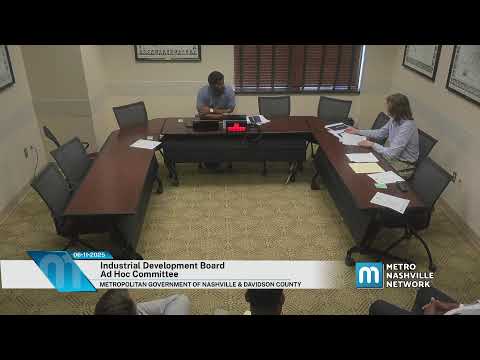
Travis Miller, housing policy and program coordinator with Metro Nashville Planning Department’s Housing Division, presented the Unified Housing Strategy (UHS) to the Industrial Development Board Ad Hoc Committee and outlined actions where the IDB could support countywide affordability goals.
Miller said the UHS estimates Nashville will need more than 90,000 new homes over the next 10 years (about 9,000 annually) and that the largest shortfall is units affordable to households at or below 60% of area median income (AMI), with particular emphasis on households at or below 30% AMI. Miller noted Metro’s data and public engagement identified six themes: rising housing demand; constrained supply and lack of housing choice; barriers to homeownership; housing instability and displacement risk; gaps in services and navigation; and equity disparities affecting renters and homeowners of color.
"These are the people that make Nashville run — our social workers, our hairstylists, our clerks," Miller said, describing typical households that fall below 80% AMI. He highlighted cost-burden statistics the strategy identified: for example, Miller cited that 74% of single-parent renters are cost-burdened and that 54% of Black renters and 52% of Hispanic renters are cost-burdened, compared with 47% of white renters.
The UHS sets seven strategies emphasizing ecosystem coordination, financing and funding tools, expanding housing choice, supporting sustainable homeownership, creating permanent supportive housing, preserving affordability and strengthening renter protections. Actions identified for the IDB include: coordinating RFPs and reporting for Metro-funded housing programs; partnering to establish underwriting capacity (Metro budgeted funding for underwriting services); making affordability a threshold requirement for TIFs and pilots where housing is involved; and evaluating whether the IDB’s bond authority could be used to issue bonds for mixed-income or affordable housing (subject to legal and fiscal review).
Miller and committee members discussed constraints: the transcript records counsel and staff noting state law and credit-rating implications for city-backed credit support, and that IDB conduit issuance has historically been repaid from project revenues without recourse to Metro. Metro staff said finance and legal are actively reviewing bond proposals and that UHS lists the mixed-income financing toolkit, including potential IDB bonding, as a high-priority item for the next 1–3 years, with short-term work already underway on underwriting capacity and an annual policy priorities process to adapt actions to shifting market conditions.
Committee members pressed for specifics: how underwriting would be executed, whether affordability thresholds would apply to all TIFs or only those with housing, and the fiscal risk if Metro provided credit enhancement. Metro staff said they would coordinate further with IDB members, developers and existing program partners and welcomed board input on market participants who could advise the underwriting study.
There was no formal vote; Miller closed by noting the UHS will be posted on Metro’s website with an executive summary, full strategy and annual implementation documents that the IDB and other partners can use to align funding and program priorities.