Get Full Government Meeting Transcripts, Videos, & Alerts Forever!
Get email alerts on the Solar Glare Policy topic
No spam. Unsubscribe anytime.
Commission directs staff to pursue solar glare reductions near March Air Reserve Base
Summary
The Riverside County Airport Land Use Commission voted unanimously to direct staff to draft policy measures aimed at reducing cumulative glare from solar panels near March Air Reserve Base, including requiring anti‑reflective or textured panel surfaces and encouraging ground‑mounted tracking systems where feasible.
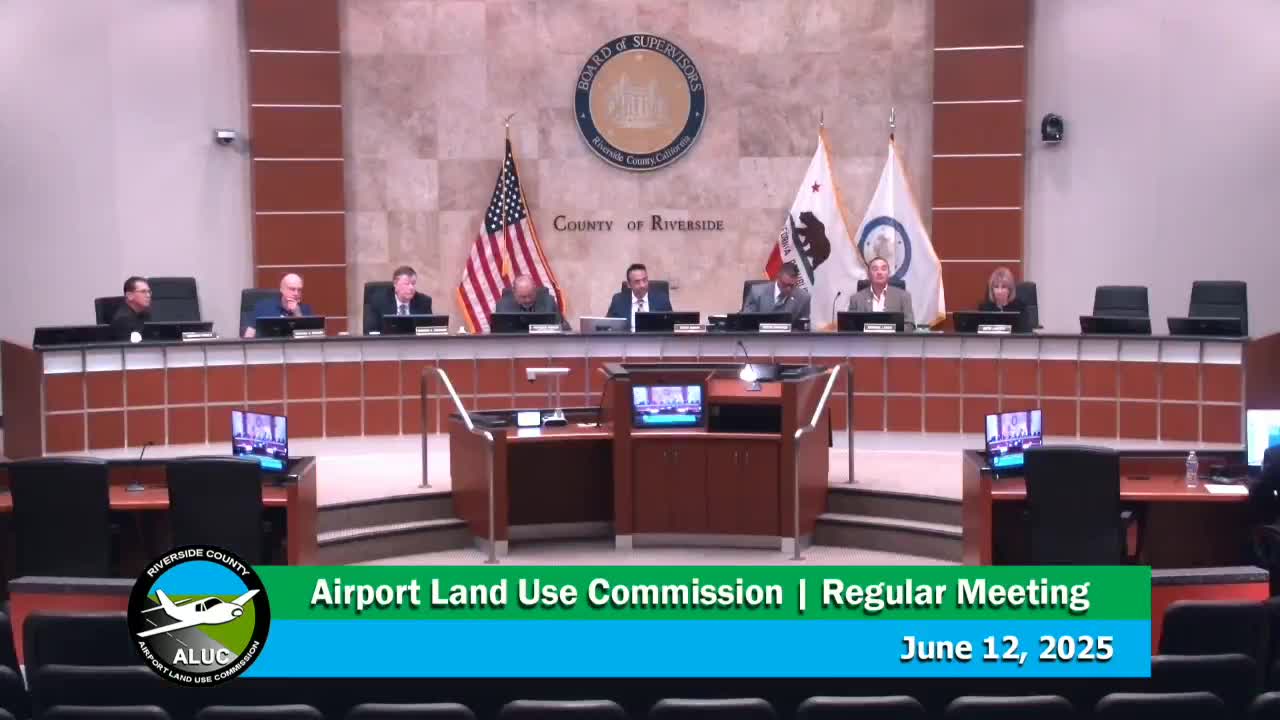
At a meeting of the Riverside County Airport Land Use Commission, commissioners directed staff to continue drafting policy measures to reduce cumulative glare from solar photovoltaic (PV) systems near March Air Reserve Base, officials said.
The move responds to a staff presentation outlining the commission’s existing stance that green‑level glare is acceptable while yellow and red levels are prohibited, and recommending new minimum surface or coating standards for new solar installations. Paul Reul, the county director presenting the item, said staff “recommends that the commission adopts the policy…reaffirming the existing solar policy of no glare and green level glare as acceptable and yellow and red level glare as prohibited,” and that new projects “include either anti reflective coatings or textured glass.”
The recommendation follows a March Air Reserve Base cumulative glare study that analyzed 26 rooftop and ground projects and found that although most individual systems registered only green‑level glare, the number of glare sources increases the opportunity for intersections between glare cones and flight paths. The study also reported that all 26 projects analyzed used fixed‑mount panels, which staff said are more likely to produce glare at certain sun angles.
Staff described technical options to reduce reflectivity, including textured glass and anti‑reflective (AR) coatings, and noted price ranges it found in its research: smooth glass panels typically at about $2.50–$3.50 per watt before incentives; coated/AR panels at roughly $3.00–$4.50 per watt; and textured panels about $3.00–$4.00 per watt. Staff also recommended encouraging, where site conditions allow, ground‑mounted tracking systems that follow the sun’s path and can both raise efficiency and reduce fixed‑angle glare exposure.
Commission discussion emphasized public safety and the competing policy goals of expanding solar energy while protecting flight operations. A commissioner who spoke during the discussion said safety is paramount and described the staff recommendations as a cautious, incremental approach: “baby steps,” the commissioner said, noting the committee could return to strengthen standards later if monitoring showed ongoing problems.
Commissioners voted unanimously to direct staff to continue developing the policy and return with formal language for notice and adoption. Staff said any policy proposed for adoption would be brought back on a future agenda with required public notice and opportunity for comment.
Background: federal guidance on solar glare has evolved since an FAA interim policy in 2013 and a later Federal Aviation Administration review in 2021 that narrowed certain FAA concerns to control towers. The March Air Reserve Base compatible‑use study (2023) advised developers to consider lower‑glare panel options and, for some sites, to shift from fixed mounts to tracking systems.