Get Full Government Meeting Transcripts, Videos, & Alerts Forever!
Get email alerts on the West Avenue Phase 2 topic
No spam. Unsubscribe anytime.
Miami Beach outlines West Avenue Phase 2 construction, traffic and parking plans
Summary
City and contractor detailed drainage, pump station, segment phasing, parking mitigation and ADA access for the West Avenue Phase 2 project; construction is scheduled to begin in June and segments 2–3 are expected to take about 10–12 months.
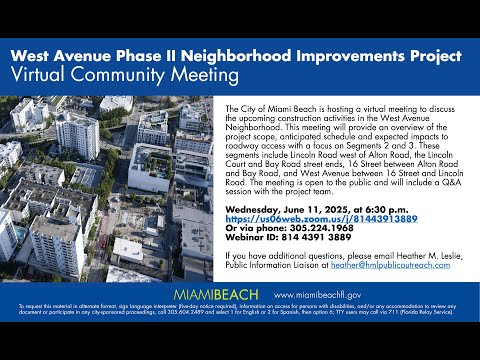
City of Miami Beach staff and the project contractor on Tuesday briefed residents on West Avenue Phase 2, describing the project scope, segment phasing, a new pump station and traffic and parking mitigations that will be in place as work begins in June.
The project "encompasses an area between 14th Street North to the canal, and from Alton Road west to the bay," Ariel Gitian, the city's senior project manager, said during the virtual meeting. The city and Rickman Construction described underground drainage upgrades, an on‑site pump station already under construction and elevated roadway, sidewalks, protected bike lanes, new lighting and a baywalk at the end of Lincoln Road.
The briefing matters because the work will affect local access and parking for several years: the overall project was described as lasting roughly "3 to 3 and a half years," and the contractor estimated that segments 2 and 3 will take about 10 to 12 months to complete. Steve Kaske, Rickman Construction project manager, said the drainage upgrades include staged treatment chambers and an 84‑inch diameter discharge pipe that carries treated runoff to Collins Canal and a dissipator box at Lincoln and West Avenue. "The largest component of the underground infrastructure improvement is the drainage capacity improvements," Kaske said.
City staff said the project is being built in multiple, nonsequential segments to speed work and limit prolonged disruption in any one place. The contractor will perform utility locates and underground work first and then proceed with roadway and harmonization (the process of matching new roadway grades to existing driveways and walkways). Heather Leslie, public information liaison for the project, said harmonization packages will be provided in advance and that one‑on‑one meetings will be scheduled with property representatives.
Residents asked about impacts and accommodations. Alberto Ventura, assistant parking director, explained a temporary parking mitigation program: the city arranged access to up to about 75 spaces in three garages for residents who choose to participate; participating residents would pay up to $16 per month and the city will subsidize the remainder. David Gomez, director of capital improvements, said a previous commission resolution authorized the subsidy and that the city also converted a number of commercial metered spaces to 24‑hour resident access and designated additional lots to expand capacity in the zone.
The project team addressed access and safety concerns: routine work hours were described as generally 7 a.m. to 5 p.m. with a 6 a.m.–6 p.m. parking restriction in active work zones, and temporary parking outside work hours is permitted where not barricaded. Kaske said crews will create pedestrian and bicycle detours when sidewalks are closed and will coordinate closely with emergency services. He noted that some work may require occasional Saturday activity or late‑day work for utility connections. "We will coordinate with public works and the fire department," Kaske said, adding that crews will notify affected buildings before any planned utility tie‑ins.
Residents raised several recurring issues: undergrounding of overhead electric lines is not part of this contract and would be a separate, multiyear FPL program requiring neighborhood buy‑in; removal and replacement of landscaping and sidewalk islands will be part of harmonization and will be coordinated with property owners; and the pump station site at 1671 West Avenue (the triangular green space) will receive landscaping and the generator and control platform work must be completed before final landscaping. The city said that, when feasible, harmonization and landscaping for a segment will be finished before crews move to the next segment, though final top asphalt lifts may be staged to preserve striping and aesthetics across larger runs.
On accessibility, staff reiterated that ADA accommodations will be maintained and that residents with specific needs should contact Heather Leslie directly; the city's ADA coordinator may also be involved. Several residents who said they are visually impaired or use mobility aids were told staff will schedule one‑to‑one coordination.
The meeting closed with staff urging residents to sign up for project email updates and the city's MB Alert traffic notices for real‑time construction and traffic advisories. "We will have more of these as we move through the segments that are more segment specific," David Gomez said. "We are really looking forward to getting this project started and getting to a point where we no longer cause disruption, but rather improvement."